Local presenter urges solar-plus-battery microgrids for resilience after extended outages
March 30, 2025 | Woodside Town, San Mateo County, California
This article was created by AI summarizing key points discussed. AI makes mistakes, so for full details and context, please refer to the video of the full meeting. Please report any errors so we can fix them. Report an error »
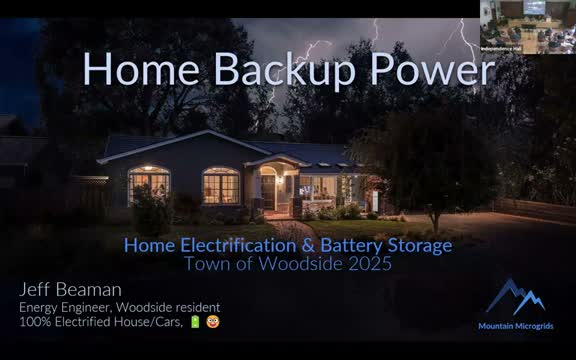
Jeff Beeman, founder of Mountain Microgrids, recommended a tiered approach to backup power — from portable batteries to whole‑house batteries to solar-plus-battery-plus-generator microgrids — and emphasized that the right choice depends on outage frequency, desired loads and budget.
Beeman said his neighborhood experienced prolonged outages in 2023, including a 13.5‑day period without grid power for his block. "At 5 and a half days, even if you have a 500‑gallon tank of propane... you ran the tank dry," he said, arguing that hybrid systems can avoid fuel logistics and extend autonomy.
He described practical trade-offs: portable gas generators are inexpensive but noisy and high‑maintenance; whole‑house standby generators are effective but burn significant fuel (he cited roughly $130 per day in propane for large units); home-battery systems are quieter and cheaper to operate; and combining solar with batteries can extend run time and improve the economics of a backup installation. He said, based on his installations and customer feedback, pairing a generator with a hybrid battery system can reduce generator run time by about 80% and that many homeowners see a 7–9 year ROI on combined systems, depending on usage and incentives.
Why it matters: as electrification increases household dependence on electricity for heating and hot water, longer or more frequent outages raise both comfort and safety issues; panelists said planning for resilience is increasingly part of electrification decisions.
What attendees asked: residents asked about vehicle-to-home capability and whether EVs can serve as home batteries. Beeman said regulatory and hardware limitations remain; Tesla has early gateway options in beta and some pilot programs (including a PG&E vehicle-to-home pilot with Ford F‑150 Lightning) are underway.
Next steps: attendees were invited to consult vendors that provide combined solar+battery systems and to consider incremental steps (portable batteries, inlet connections) as interim resilience measures.
Beeman said his neighborhood experienced prolonged outages in 2023, including a 13.5‑day period without grid power for his block. "At 5 and a half days, even if you have a 500‑gallon tank of propane... you ran the tank dry," he said, arguing that hybrid systems can avoid fuel logistics and extend autonomy.
He described practical trade-offs: portable gas generators are inexpensive but noisy and high‑maintenance; whole‑house standby generators are effective but burn significant fuel (he cited roughly $130 per day in propane for large units); home-battery systems are quieter and cheaper to operate; and combining solar with batteries can extend run time and improve the economics of a backup installation. He said, based on his installations and customer feedback, pairing a generator with a hybrid battery system can reduce generator run time by about 80% and that many homeowners see a 7–9 year ROI on combined systems, depending on usage and incentives.
Why it matters: as electrification increases household dependence on electricity for heating and hot water, longer or more frequent outages raise both comfort and safety issues; panelists said planning for resilience is increasingly part of electrification decisions.
What attendees asked: residents asked about vehicle-to-home capability and whether EVs can serve as home batteries. Beeman said regulatory and hardware limitations remain; Tesla has early gateway options in beta and some pilot programs (including a PG&E vehicle-to-home pilot with Ford F‑150 Lightning) are underway.
Next steps: attendees were invited to consult vendors that provide combined solar+battery systems and to consider incremental steps (portable batteries, inlet connections) as interim resilience measures.
Don't Miss a Word: See the Full Meeting!
Go beyond summaries. Unlock every video, transcript, and key insight with a Founder Membership.
✓
Get instant access to full meeting videos
✓
Search and clip any phrase from complete transcripts
✓
Receive AI-powered summaries & custom alerts
✓
Enjoy lifetime, unrestricted access to government data
30-day money-back guarantee
