Subcommittee Hears Competing Views on H.47/17 Mid‑Decade Redistricting Plan
February 25, 2026 | 2026 Legislative Meetings, South Carolina
This article was created by AI summarizing key points discussed. AI makes mistakes, so for full details and context, please refer to the video of the full meeting. Please report any errors so we can fix them. Report an error »
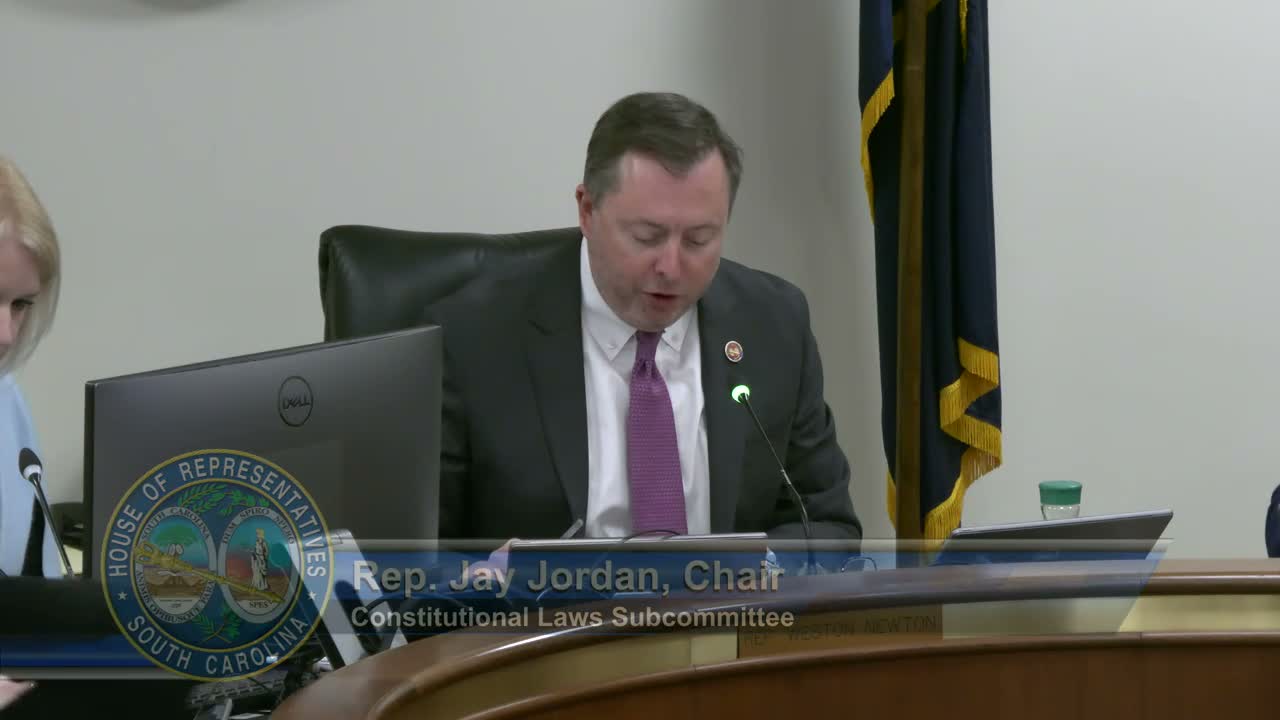
A South Carolina constitutional law subcommittee heard competing testimony on H.47/17 on Tuesday, a proposed mid‑decade redistricting plan that would replace the state’s congressional district boundaries and authorize legislative leaders to participate in litigation over maps.
Representative Pace introduced the bill and told the committee he instructed mapmakers to produce a plan "in a way that is totally racially agnostic" intended to make the 6th Congressional District more competitive. He said, based on 2020 numbers, the plan would move the 6th from roughly D+16–17 to about D+4–6, and he asked the panel to hear public testimony before further action.
Supporters said the change is needed to restore voter choice in a district many Republicans argued has been insulated from competition. John McGrath, chairman of the Berkeley County Republican Party, urged the committee to advance the bill, saying the current structure "has produced a congressional seat largely insulated for meaningful competition." CJ Westfall, chairman of the Dorchester Republican Party, told lawmakers the map would "give folks of the 6th District something that they haven't had in a generation," describing the proposal as a way to restore accountability.
Opponents disputed the map’s fairness and its community‑of‑interest impacts. Lynn Teague of the League of Women Voters of South Carolina said, "This map, however, manages to be far worse," and testified the plan reduces the Black voting‑age population in the 6th District from 46.89% to 35.67% while cutting a partisan Democratic lean from 65.03 to 52.25. Teague added the districts "don't meet the usual house standard of compactness" and warned the plan would proceed with limited public input outside legislative hearings.
Demographer John Morgan, who has drawn maps in multiple states, presented a technical comparison and told the committee the enacted plan’s District 6 performs at about D+23, while the Pace proposal is closer to D+1 on 2024 presidential data. Morgan said the proposed plan increases county splits (11 counties split under the proposal versus 10 under the enacted plan) and stretches some districts geographically in ways that could raise legal challenges over communities of interest and continuity.
Witnesses and members also discussed litigation risk. Pace acknowledged there is a high chance any mid‑decade redistricting will prompt lawsuits; Morgan said that if courts reject a map, a court could draw districts and would likely afford less weight to partisan intent.
The hearing included emotionally charged public comment: Brad Capshaw said he felt "effectively disenfranchised" under the existing lines, and several speakers linked the map debate to broader concerns about investment and representation in rural parts of the state. Members pressed witnesses on outreach and who, if anyone, in Washington, D.C., had been consulted; Pace said he had informal discussions with White House staffers but no public individuals who dictated the plan.
The subcommittee did not take a vote on H.47/17. Chair thanked witnesses and members for testimony and adjourned the session. If the committee advances the bill, members said follow‑up questions about public outreach, county splits, and litigation risk would likely be part of any subsequent consideration.
Representative Pace introduced the bill and told the committee he instructed mapmakers to produce a plan "in a way that is totally racially agnostic" intended to make the 6th Congressional District more competitive. He said, based on 2020 numbers, the plan would move the 6th from roughly D+16–17 to about D+4–6, and he asked the panel to hear public testimony before further action.
Supporters said the change is needed to restore voter choice in a district many Republicans argued has been insulated from competition. John McGrath, chairman of the Berkeley County Republican Party, urged the committee to advance the bill, saying the current structure "has produced a congressional seat largely insulated for meaningful competition." CJ Westfall, chairman of the Dorchester Republican Party, told lawmakers the map would "give folks of the 6th District something that they haven't had in a generation," describing the proposal as a way to restore accountability.
Opponents disputed the map’s fairness and its community‑of‑interest impacts. Lynn Teague of the League of Women Voters of South Carolina said, "This map, however, manages to be far worse," and testified the plan reduces the Black voting‑age population in the 6th District from 46.89% to 35.67% while cutting a partisan Democratic lean from 65.03 to 52.25. Teague added the districts "don't meet the usual house standard of compactness" and warned the plan would proceed with limited public input outside legislative hearings.
Demographer John Morgan, who has drawn maps in multiple states, presented a technical comparison and told the committee the enacted plan’s District 6 performs at about D+23, while the Pace proposal is closer to D+1 on 2024 presidential data. Morgan said the proposed plan increases county splits (11 counties split under the proposal versus 10 under the enacted plan) and stretches some districts geographically in ways that could raise legal challenges over communities of interest and continuity.
Witnesses and members also discussed litigation risk. Pace acknowledged there is a high chance any mid‑decade redistricting will prompt lawsuits; Morgan said that if courts reject a map, a court could draw districts and would likely afford less weight to partisan intent.
The hearing included emotionally charged public comment: Brad Capshaw said he felt "effectively disenfranchised" under the existing lines, and several speakers linked the map debate to broader concerns about investment and representation in rural parts of the state. Members pressed witnesses on outreach and who, if anyone, in Washington, D.C., had been consulted; Pace said he had informal discussions with White House staffers but no public individuals who dictated the plan.
The subcommittee did not take a vote on H.47/17. Chair thanked witnesses and members for testimony and adjourned the session. If the committee advances the bill, members said follow‑up questions about public outreach, county splits, and litigation risk would likely be part of any subsequent consideration.
View the Full Meeting & All Its Details
This article offers just a summary. Unlock complete video, transcripts, and insights as a Founder Member.
✓
Watch full, unedited meeting videos
✓
Search every word spoken in unlimited transcripts
✓
AI summaries & real-time alerts (all government levels)
✓
Permanent access to expanding government content
30-day money-back guarantee
