Attorney General Defends OAG Budget, Urges Rejection of Training Cut and Outlines Enforcement Fund Plan
February 21, 2026 | Public Safety, Transportation, and Environment Subcommittee, Budget and Taxation Committee, SENATE, SENATE, Committees, Legislative, Maryland
This article was created by AI summarizing key points discussed. AI makes mistakes, so for full details and context, please refer to the video of the full meeting. Please report any errors so we can fix them. Report an error »
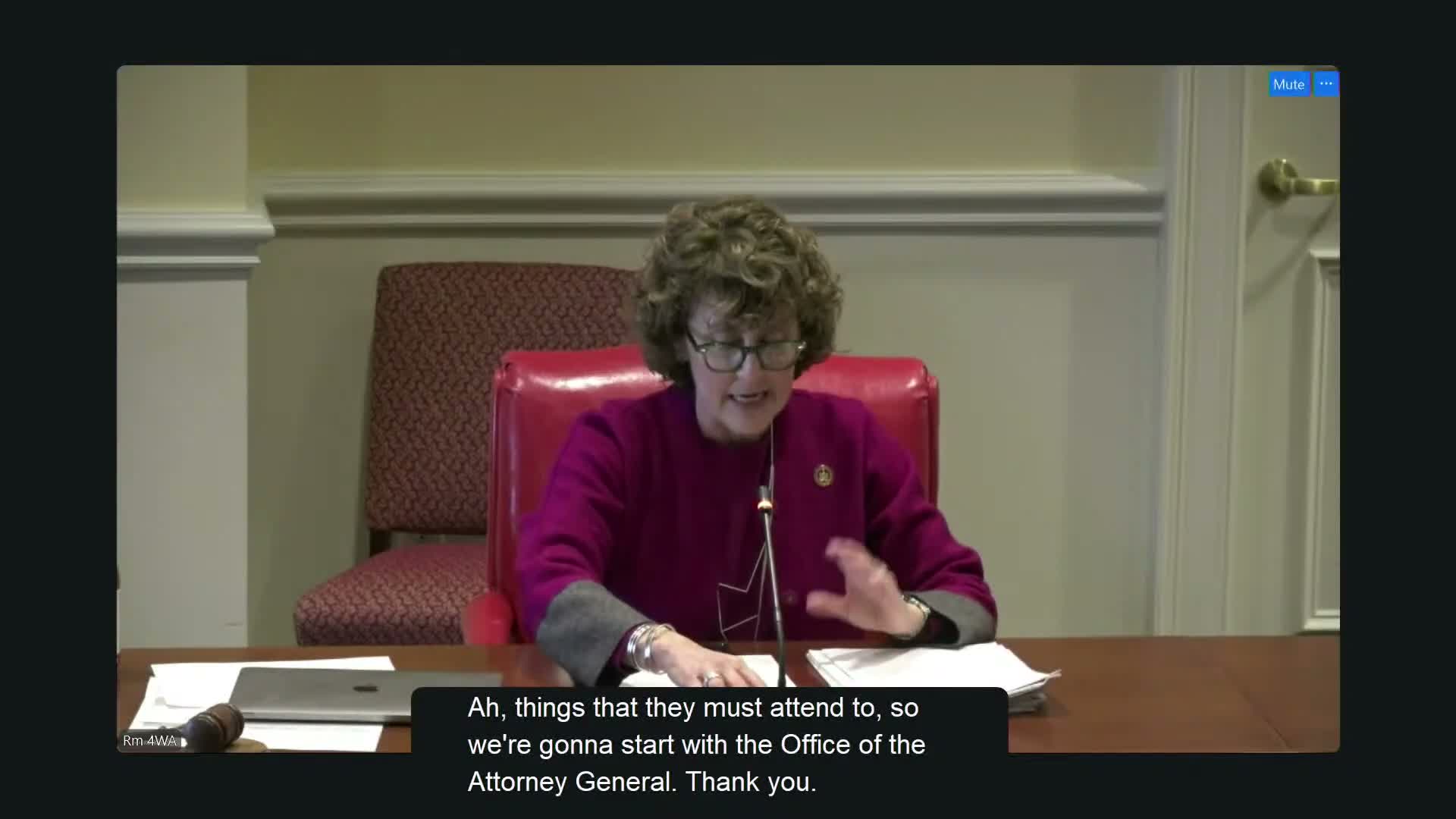
Attorney General Anthony Brown told the Public Safety, Transportation, and Environment Subcommittee on Feb. 20 that the Office of the Attorney General (OAG) needs resources to maintain litigation and enforcement capacity and asked lawmakers to reject a proposed $100,000 cut to training.
Brown and a Department of Legislative Services analyst, Scott Benson, appeared before the subcommittee as DLS summarized OAG's fiscal 2027 allowance and performance metrics. Benson noted an increase of about $8.3 million (roughly 8.9%) in the fiscal 2027 allowance and called out personnel and contractual‑services changes, the role of the Maryland Legal Services Corporation (MLSC) and the ACE (Access to Counsel and Evictions) program funding stream.
Brown pushed back on specific recommendations from DLS. He said training and professional development are essential, describing the office's 12‑hour minimum continuing education requirement for lawyers and asking the committee to "reject the recommendation that you cut $100,000 from our training budget." Brown described the OAG workforce as roughly 440 positions on the OAG budget that support about 1,059 staff across agency client units and said 87% of his budget is payroll.
He highlighted the work of a newly funded Federal Accountability Unit (FAU), saying the unit has preserved "more than $100,000,000 in education funding and, and more for other programs," and asked the committee to request further reporting on which programs and agencies benefitted from preserved federal funds.
Brown also described in‑house legislation (referred to in testimony as House Bill 705) to create an enforcement recovery fund for certain recoveries. Under the proposal, OAG would retain up to 25% of recoveries above $100,000, capped at $7,500,000 in a year, to support enforcement efforts. Brown said the change is intended to finance enforcement operations while preserving restitution to consumers and not to interfere with existing settlement funds such as opioid recoveries or the ACE special fund.
On litigation, Brown reviewed a high‑profile maritime case against the vessel interest tied to a major infrastructure incident; the state has a June trial date before a federal judge, and Brown said the case is bifurcated into liability and damages phases. He also told lawmakers OAG plans a roughly $10 million multiyear project to modernize case, document and matter management systems to reduce expensive outside support for discovery and improve in‑house capacity.
DLS asked the OAG to provide timelines for procuring a consumer‑protection contract (ticket‑scalping work), more detail on FAU outcomes, and an implementation plan and cost estimate for recommendations to improve Medicaid fraud‑control efficiency. Brown agreed to provide further information and emphasized that certain FY27 increases reflected pass‑through funds (for MLSC/ACE) rather than discretionary OAG resources.
The committee asked follow‑up questions about tariff litigation at the U.S. Supreme Court; Brown said Maryland did not join an earlier tariff suit because it could not show direct state injury at the time but that a national invalidation benefits Maryland consumers. He agreed to explore whether and how refunds could be recovered and whether importers would be required to pass returns on to consumers.
The committee adopted—or indicated it would pursue—several committee narratives and reporting requests from DLS, including further information on the FAU and updated programmatic cost projections for the ACE program. The subcommittee invited OAG staff to provide the additional details requested by DLS.
Brown and a Department of Legislative Services analyst, Scott Benson, appeared before the subcommittee as DLS summarized OAG's fiscal 2027 allowance and performance metrics. Benson noted an increase of about $8.3 million (roughly 8.9%) in the fiscal 2027 allowance and called out personnel and contractual‑services changes, the role of the Maryland Legal Services Corporation (MLSC) and the ACE (Access to Counsel and Evictions) program funding stream.
Brown pushed back on specific recommendations from DLS. He said training and professional development are essential, describing the office's 12‑hour minimum continuing education requirement for lawyers and asking the committee to "reject the recommendation that you cut $100,000 from our training budget." Brown described the OAG workforce as roughly 440 positions on the OAG budget that support about 1,059 staff across agency client units and said 87% of his budget is payroll.
He highlighted the work of a newly funded Federal Accountability Unit (FAU), saying the unit has preserved "more than $100,000,000 in education funding and, and more for other programs," and asked the committee to request further reporting on which programs and agencies benefitted from preserved federal funds.
Brown also described in‑house legislation (referred to in testimony as House Bill 705) to create an enforcement recovery fund for certain recoveries. Under the proposal, OAG would retain up to 25% of recoveries above $100,000, capped at $7,500,000 in a year, to support enforcement efforts. Brown said the change is intended to finance enforcement operations while preserving restitution to consumers and not to interfere with existing settlement funds such as opioid recoveries or the ACE special fund.
On litigation, Brown reviewed a high‑profile maritime case against the vessel interest tied to a major infrastructure incident; the state has a June trial date before a federal judge, and Brown said the case is bifurcated into liability and damages phases. He also told lawmakers OAG plans a roughly $10 million multiyear project to modernize case, document and matter management systems to reduce expensive outside support for discovery and improve in‑house capacity.
DLS asked the OAG to provide timelines for procuring a consumer‑protection contract (ticket‑scalping work), more detail on FAU outcomes, and an implementation plan and cost estimate for recommendations to improve Medicaid fraud‑control efficiency. Brown agreed to provide further information and emphasized that certain FY27 increases reflected pass‑through funds (for MLSC/ACE) rather than discretionary OAG resources.
The committee asked follow‑up questions about tariff litigation at the U.S. Supreme Court; Brown said Maryland did not join an earlier tariff suit because it could not show direct state injury at the time but that a national invalidation benefits Maryland consumers. He agreed to explore whether and how refunds could be recovered and whether importers would be required to pass returns on to consumers.
The committee adopted—or indicated it would pursue—several committee narratives and reporting requests from DLS, including further information on the FAU and updated programmatic cost projections for the ACE program. The subcommittee invited OAG staff to provide the additional details requested by DLS.
Don't Miss a Word: See the Full Meeting!
Go beyond summaries. Unlock every video, transcript, and key insight with a Founder Membership.
✓
Get instant access to full meeting videos
✓
Search and clip any phrase from complete transcripts
✓
Receive AI-powered summaries & custom alerts
✓
Enjoy lifetime, unrestricted access to government data
30-day money-back guarantee
