PUC trims Black Hills Clean Heat Plan, approves BE pilot and limits DSM spending
February 25, 2026 | Public Utilities Commission, Governor's Boards and Commissions, Organizations, Executive, Colorado
This article was created by AI summarizing key points discussed. AI makes mistakes, so for full details and context, please refer to the video of the full meeting. Please report any errors so we can fix them. Report an error »
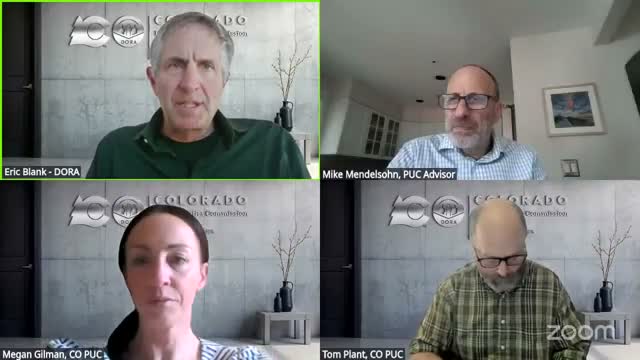
The Colorado Public Utilities Commission on Feb. 25 modified Black Hills Colorado Gas Company's proposed Clean Heat Plan (CHP), narrowing eligible DSM expenditures and setting budgets for beneficial electrification (BE) and demand-side management (DSM).
Advisory staff presented the options and both commissioners and counsel debated three central constraints: (1) prevent ratepayer funding of like-for-like equipment replacements, (2) require DSM funds be targeted to residential and income-qualified weatherization programs, and (3) set BE budgets based on the independent SWEEP analysis incorporated into the record.
After deliberation, commissioners voted to require DSM spending be limited to residential programs and income-qualified weatherization, and disallow funding for like-for-like replacements. Commissioner Plant proposed allocating the settlement's $8.8 million budget across BE and DSM using SWEEP's percentage split; staff and commissioners recorded figures of roughly $4.34 million for BE and $4.46 million for DSM.
Commissioners also removed proposed AMLD and RNG investments from the CHP at this time, citing cost-effectiveness concerns on the record. The commission approved a Rocky Ford outreach pilot (described in the record as approximately $80,000 for marketing/tracking) and a $380,000 thermal-pilot budget previously agreed.
On cost recovery, advisors recommended a CHP rider as proposed in the settlement; commissioners agreed to adopt the rider approach with an annual forecast and true-up mechanism and asymmetric carrying charges as described by advisers. The commission directed consolidated CHP/DSM reporting, suggested waiving the March 31 reporting deadline for a 6-month reporting window post-mail date, and set a target to consolidate the next CHP and DSM filings into a single filing roughly one year from the mail date.
Commissioners asked staff to draft a TBC order capturing the decisions and the specific guardrails that will govern implementation and reporting. The order will specify reporting deadlines, budget allocation figures, and the rider filing mechanics.
"Based on this record, those programs would be structured largely off of the SWEEP proposed incentive levels," Commissioner Gilman said, summarizing the evidentiary basis the commission relied upon.
Next steps: staff will prepare the written order reflecting the budget allocations, implementation guardrails, CHP rider mechanics, and reporting schedule.
Advisory staff presented the options and both commissioners and counsel debated three central constraints: (1) prevent ratepayer funding of like-for-like equipment replacements, (2) require DSM funds be targeted to residential and income-qualified weatherization programs, and (3) set BE budgets based on the independent SWEEP analysis incorporated into the record.
After deliberation, commissioners voted to require DSM spending be limited to residential programs and income-qualified weatherization, and disallow funding for like-for-like replacements. Commissioner Plant proposed allocating the settlement's $8.8 million budget across BE and DSM using SWEEP's percentage split; staff and commissioners recorded figures of roughly $4.34 million for BE and $4.46 million for DSM.
Commissioners also removed proposed AMLD and RNG investments from the CHP at this time, citing cost-effectiveness concerns on the record. The commission approved a Rocky Ford outreach pilot (described in the record as approximately $80,000 for marketing/tracking) and a $380,000 thermal-pilot budget previously agreed.
On cost recovery, advisors recommended a CHP rider as proposed in the settlement; commissioners agreed to adopt the rider approach with an annual forecast and true-up mechanism and asymmetric carrying charges as described by advisers. The commission directed consolidated CHP/DSM reporting, suggested waiving the March 31 reporting deadline for a 6-month reporting window post-mail date, and set a target to consolidate the next CHP and DSM filings into a single filing roughly one year from the mail date.
Commissioners asked staff to draft a TBC order capturing the decisions and the specific guardrails that will govern implementation and reporting. The order will specify reporting deadlines, budget allocation figures, and the rider filing mechanics.
"Based on this record, those programs would be structured largely off of the SWEEP proposed incentive levels," Commissioner Gilman said, summarizing the evidentiary basis the commission relied upon.
Next steps: staff will prepare the written order reflecting the budget allocations, implementation guardrails, CHP rider mechanics, and reporting schedule.
Don't Miss a Word: See the Full Meeting!
Go beyond summaries. Unlock every video, transcript, and key insight with a Founder Membership.
✓
Get instant access to full meeting videos
✓
Search and clip any phrase from complete transcripts
✓
Receive AI-powered summaries & custom alerts
✓
Enjoy lifetime, unrestricted access to government data
30-day money-back guarantee
