Senate clears $200–$250 million revenue-bond plan to finance electric utility winter-storm recovery
February 26, 2026 | Senate, Committees, Legislative, Mississippi
This article was created by AI summarizing key points discussed. AI makes mistakes, so for full details and context, please refer to the video of the full meeting. Please report any errors so we can fix them. Report an error »
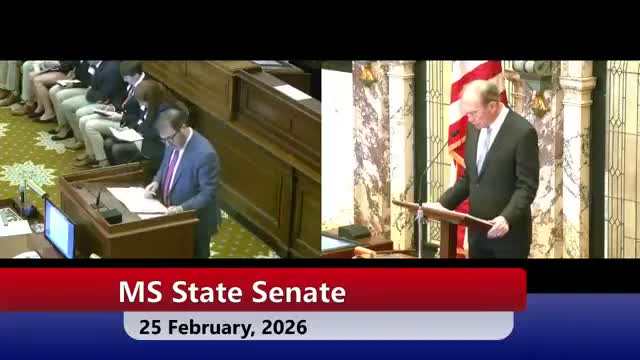
The Mississippi Senate adopted and passed legislation authorizing system-restoration revenue bonds to help electric utilities recover from damage caused by the 2026 winter storm.
Senator Harkins described the measure as modeled on post-Katrina financing and said the approach can lower the cost to ratepayers compared with private-market financing. "You're looking at a possible rate of about $3, almost $3 a month for about 30 years to cover the cost [under private financing]," Harkins said, and contrasted that with roughly $1.50 per month for 15 years under the proposed bond structure. He estimated bond proceeds in the range of $200 million to $250 million, noting final cost calculations were pending and a reverse repealer was included in the bill.
Under the bill, utilities submit restoration costs to the Public Service Commission, which audits and certifies costs and issues a financing order that the State Bond Commission can use to issue system-restoration bonds. The bonds would be serviced by a system-restoration charge collected from utility customers and held in designated sinking and restoration funds in state treasury; the PSC must approve the rate and certify the financing order. Senators asked what happens if revenues are insufficient to service the bonds; sponsors said PSC processes and sinking-fund structures would be used to set charges at levels expected to meet debt service and that technical work will continue.
What happens next: The committee substitute was adopted and SB 32-29 passed by morning roll call. Sponsors said the PSC will certify costs and structure the charge, and the State Bond Commission will issue bonds and administer funds once costs are finalized.
Quote: "We expect it to be between 200 and $250,000,000 to go into this, this fund," Senator Harkins said of the bond program.
The measure includes detailed provisions for cost certification, sinking-fund creation and procedures to suspend the system-restoration charge once bonds are retired.
Senator Harkins described the measure as modeled on post-Katrina financing and said the approach can lower the cost to ratepayers compared with private-market financing. "You're looking at a possible rate of about $3, almost $3 a month for about 30 years to cover the cost [under private financing]," Harkins said, and contrasted that with roughly $1.50 per month for 15 years under the proposed bond structure. He estimated bond proceeds in the range of $200 million to $250 million, noting final cost calculations were pending and a reverse repealer was included in the bill.
Under the bill, utilities submit restoration costs to the Public Service Commission, which audits and certifies costs and issues a financing order that the State Bond Commission can use to issue system-restoration bonds. The bonds would be serviced by a system-restoration charge collected from utility customers and held in designated sinking and restoration funds in state treasury; the PSC must approve the rate and certify the financing order. Senators asked what happens if revenues are insufficient to service the bonds; sponsors said PSC processes and sinking-fund structures would be used to set charges at levels expected to meet debt service and that technical work will continue.
What happens next: The committee substitute was adopted and SB 32-29 passed by morning roll call. Sponsors said the PSC will certify costs and structure the charge, and the State Bond Commission will issue bonds and administer funds once costs are finalized.
Quote: "We expect it to be between 200 and $250,000,000 to go into this, this fund," Senator Harkins said of the bond program.
The measure includes detailed provisions for cost certification, sinking-fund creation and procedures to suspend the system-restoration charge once bonds are retired.
View the Full Meeting & All Its Details
This article offers just a summary. Unlock complete video, transcripts, and insights as a Founder Member.
✓
Watch full, unedited meeting videos
✓
Search every word spoken in unlimited transcripts
✓
AI summaries & real-time alerts (all government levels)
✓
Permanent access to expanding government content
30-day money-back guarantee
