Santa Barbara finance committee flags widening budget gap, advances revenue options including transfer tax
February 25, 2026 | Santa Barbara City, Santa Barbara County, California
This article was created by AI summarizing key points discussed. AI makes mistakes, so for full details and context, please refer to the video of the full meeting. Please report any errors so we can fix them. Report an error »
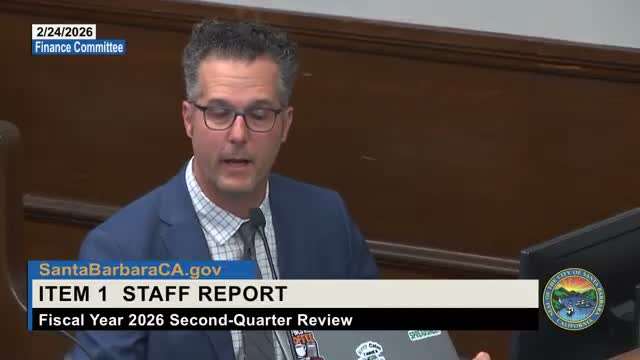
Santa Barbara City Finance Director Kate De Martini told the committee on Feb. 24 that the city’s general fund faces a widening structural deficit and that, without action, staff projects reserves could be exhausted by the end of fiscal year 2028.
De Martini presented six-month actuals through Dec. 2025 and a midyear review showing expenditures rising faster than revenues, driven by higher wages, benefits and insurance costs for roughly 400 city facilities. The presentation recommended receiving the midyear report, adopting resolutions to adjust appropriations, and approving proposed modifications to the city’s salary-control resolution for certain authorized positions.
Staff walked members through department-level performance. Police and fire were projected to finish below or near budget because of vacancies; parks, library and public works showed mixed results and some deferred capital work. Enterprise funds such as water and wastewater reported stronger results in part because of fee adjustments; water showed a midyear surplus, and wastewater added to its operating reserve.
To address the gap, staff summarized more than 300 ideas from departments and prioritized roughly 200 into a three-tier implementation framework. Tier 1 items are near-term measures with relatively low implementation effort; staff highlighted reclassifying certain positions to better align duties and funding some roles through enterprise funds rather than the general fund to reduce pressure.
Revenue options staff recommended exploring include a property transfer tax that would apply to sales above a specified threshold (staff analyzed a $3 million threshold as a baseline and modeled alternatives including $5 million and $10 million) and modest targeted increases to the city’s cannabis business tax. Staff modeled a property-transfer-tax rate of $9.50 per $1,000 on sales over $3 million and estimated roughly $5 million annually in revenue if current high-end sales trends continue and voters approve the measure. Staff emphasized these are models and outcomes depend on property-market behavior and voter approval.
Staff also discussed potential coastal-zone strategies (including additional RV camping or parking capacity) and cost-recovery adjustments for special events and park programs; several members asked staff to return with sensitivity analyses and clearer community-impact information, including how increases could affect nonprofit-run cultural events.
The committee moved and seconded the staff recommendation to receive the report and forward the requested appropriations adjustments and salary-control amendments to the full City Council; the motion was recorded as passing unanimously by the members present.
What happens next: staff will provide additional analysis requested by members (including alternative transfer-tax thresholds and refined cost-recovery proposals) before the item returns to the full Council for any ordinance or ballot-authority decisions.
De Martini presented six-month actuals through Dec. 2025 and a midyear review showing expenditures rising faster than revenues, driven by higher wages, benefits and insurance costs for roughly 400 city facilities. The presentation recommended receiving the midyear report, adopting resolutions to adjust appropriations, and approving proposed modifications to the city’s salary-control resolution for certain authorized positions.
Staff walked members through department-level performance. Police and fire were projected to finish below or near budget because of vacancies; parks, library and public works showed mixed results and some deferred capital work. Enterprise funds such as water and wastewater reported stronger results in part because of fee adjustments; water showed a midyear surplus, and wastewater added to its operating reserve.
To address the gap, staff summarized more than 300 ideas from departments and prioritized roughly 200 into a three-tier implementation framework. Tier 1 items are near-term measures with relatively low implementation effort; staff highlighted reclassifying certain positions to better align duties and funding some roles through enterprise funds rather than the general fund to reduce pressure.
Revenue options staff recommended exploring include a property transfer tax that would apply to sales above a specified threshold (staff analyzed a $3 million threshold as a baseline and modeled alternatives including $5 million and $10 million) and modest targeted increases to the city’s cannabis business tax. Staff modeled a property-transfer-tax rate of $9.50 per $1,000 on sales over $3 million and estimated roughly $5 million annually in revenue if current high-end sales trends continue and voters approve the measure. Staff emphasized these are models and outcomes depend on property-market behavior and voter approval.
Staff also discussed potential coastal-zone strategies (including additional RV camping or parking capacity) and cost-recovery adjustments for special events and park programs; several members asked staff to return with sensitivity analyses and clearer community-impact information, including how increases could affect nonprofit-run cultural events.
The committee moved and seconded the staff recommendation to receive the report and forward the requested appropriations adjustments and salary-control amendments to the full City Council; the motion was recorded as passing unanimously by the members present.
What happens next: staff will provide additional analysis requested by members (including alternative transfer-tax thresholds and refined cost-recovery proposals) before the item returns to the full Council for any ordinance or ballot-authority decisions.
Don't Miss a Word: See the Full Meeting!
Go beyond summaries. Unlock every video, transcript, and key insight with a Founder Membership.
✓
Get instant access to full meeting videos
✓
Search and clip any phrase from complete transcripts
✓
Receive AI-powered summaries & custom alerts
✓
Enjoy lifetime, unrestricted access to government data
30-day money-back guarantee
