Committee opts not to form an IFD now, asks staff to pursue alternatives and report back
February 25, 2026 | Santa Barbara City, Santa Barbara County, California
This article was created by AI summarizing key points discussed. AI makes mistakes, so for full details and context, please refer to the video of the full meeting. Please report any errors so we can fix them. Report an error »
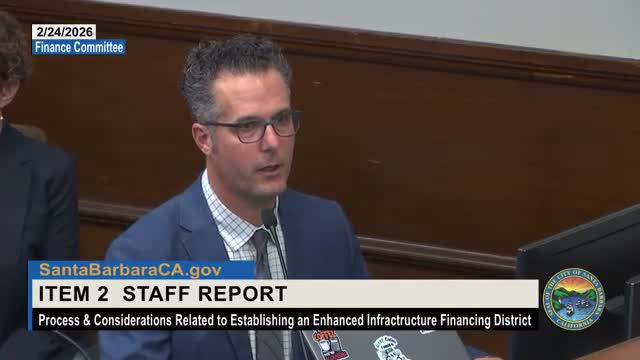
City staff and external advisors presented multiple models for an Improved Financing District (IFD) and compared alternatives for delivering affordable housing and other infrastructure finance.
The presentation explained the IFD mechanism: a formation year establishes a base assessed value; future incremental growth above that base is redirected to an IFD fund rather than the usual taxing entities and can be used for infrastructure, debt service, or PayGo projects. Staff modeled three primary approaches: a city-only IFD, a city-plus-county participation model, and internal policy options that would capture incremental growth without a formal IFD. Estimated funding available varied by scenario: a city-only IFD with debt issuance could generate roughly $31 million in debt and $15 million in PayGo over 10 years (about $46 million combined in the staff model); city+county participation produced materially larger totals; a non-IFD policy produced substantially less.
Staff emphasized development and timing risk: IFD revenue depends on realized increases in assessed value from completed projects, so delayed or canceled developments reduce available IFD funds. Advisors also outlined that IFD formation is typically a 6–8 month legal and administrative process and that issuing debt before project costs are certain carries financial risk for the city.
Committee members discussed tradeoffs and alternatives. Several members expressed concern about redirecting future property-tax growth away from the general fund, given existing budget pressures. Staff noted Measure C (the city’s sales-tax measure that funds capital) could be used to issue debt for housing without forming an IFD, though that would require careful compensation decisions about other Measure C projects.
After extended discussion and public comment supporting the IFD concept, the committee voted on a motion (moved by Councilmember Hartmann, seconded by Councilmember Santa María) instructing staff not to proceed with forming an IFD at this time but to continue working with housing providers, the county and other partners to evaluate alternatives, including debt issuance under Measure C or internal policy options, and to return with recommendations. The motion was recorded as passing unanimously by those present.
What happens next: staff will continue evaluating options and return to the Council with analyses that outline tradeoffs, project-readiness requirements, and recommended pathways for financing housing and related infrastructure.
The presentation explained the IFD mechanism: a formation year establishes a base assessed value; future incremental growth above that base is redirected to an IFD fund rather than the usual taxing entities and can be used for infrastructure, debt service, or PayGo projects. Staff modeled three primary approaches: a city-only IFD, a city-plus-county participation model, and internal policy options that would capture incremental growth without a formal IFD. Estimated funding available varied by scenario: a city-only IFD with debt issuance could generate roughly $31 million in debt and $15 million in PayGo over 10 years (about $46 million combined in the staff model); city+county participation produced materially larger totals; a non-IFD policy produced substantially less.
Staff emphasized development and timing risk: IFD revenue depends on realized increases in assessed value from completed projects, so delayed or canceled developments reduce available IFD funds. Advisors also outlined that IFD formation is typically a 6–8 month legal and administrative process and that issuing debt before project costs are certain carries financial risk for the city.
Committee members discussed tradeoffs and alternatives. Several members expressed concern about redirecting future property-tax growth away from the general fund, given existing budget pressures. Staff noted Measure C (the city’s sales-tax measure that funds capital) could be used to issue debt for housing without forming an IFD, though that would require careful compensation decisions about other Measure C projects.
After extended discussion and public comment supporting the IFD concept, the committee voted on a motion (moved by Councilmember Hartmann, seconded by Councilmember Santa María) instructing staff not to proceed with forming an IFD at this time but to continue working with housing providers, the county and other partners to evaluate alternatives, including debt issuance under Measure C or internal policy options, and to return with recommendations. The motion was recorded as passing unanimously by those present.
What happens next: staff will continue evaluating options and return to the Council with analyses that outline tradeoffs, project-readiness requirements, and recommended pathways for financing housing and related infrastructure.
Don't Miss a Word: See the Full Meeting!
Go beyond summaries. Unlock every video, transcript, and key insight with a Founder Membership.
✓
Get instant access to full meeting videos
✓
Search and clip any phrase from complete transcripts
✓
Receive AI-powered summaries & custom alerts
✓
Enjoy lifetime, unrestricted access to government data
30-day money-back guarantee
