Finance committee advances cannabis tax change and asks staff to differentiate medical and recreational sales
February 25, 2026 | Santa Barbara City, Santa Barbara County, California
This article was created by AI summarizing key points discussed. AI makes mistakes, so for full details and context, please refer to the video of the full meeting. Please report any errors so we can fix them. Report an error »
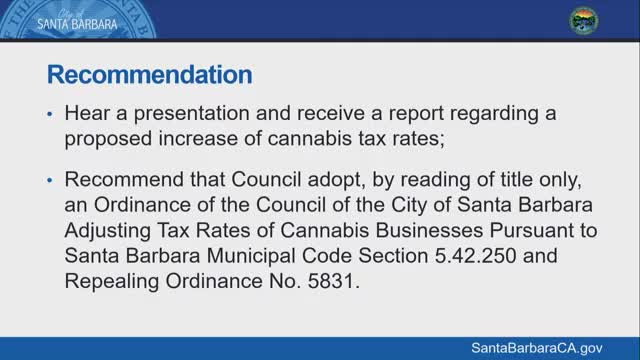
Staff presented background on the city’s cannabis business tax, noting voters authorized a tax of up to 20% in 2016 and local rates were set in 2018. The two retail categories most responsible for revenue — in-store retail and retail-delivery-only — are currently taxed at 6%. There are six authorized cannabis retail businesses in the city (five retail storefronts and one manufacturing facility), and annual cannabis-tax receipts peaked near 2021 at roughly $2 million and have fallen toward an adopted FY2026 budget of about $1 million.
Cannabis-tax staff recommended increasing the two retail categories from 6% to 8% (a 2 percentage-point increase). Staff explained that consumers pay multiple stacked taxes (local cannabis tax plus sales tax and state special taxes) and that increases risk driving sales to neighboring cities; consultants advised staying within comparable regional rates to reduce leakage. Staff projected a rough annual revenue lift of $200,000–$400,000 from a 2-point increase but cautioned that projections are approximate and depend on market response.
Committee members debated whether to exempt or treat medical dispensaries differently from recreational retail. Several members supported carving out medical-only retail from the higher rate to avoid imposing greater cost on medicinal consumers, while others noted administrative complexity and legal questions that staff and the city attorney could clarify. Members also discussed business-count sensitivity, the potential for on-site consumption venues (salons), and the need to coordinate outreach with local cannabis businesses.
Chair Friedman moved and the motion was seconded to direct staff to prepare ordinance language reflecting a 2-point increase for the two retail categories and to explore and draft options to differentiate or exempt medical sales; the motion was presented and seconded and committee discussion indicated intent to refer the ordinance to full Council with staff to finalize language and business outreach steps.
What happens next: staff will draft ordinance language, coordinate an outreach webinar for cannabis businesses, and return the item to the Council (tentatively discussed for mid-March) for consideration of an implementing ordinance.
Cannabis-tax staff recommended increasing the two retail categories from 6% to 8% (a 2 percentage-point increase). Staff explained that consumers pay multiple stacked taxes (local cannabis tax plus sales tax and state special taxes) and that increases risk driving sales to neighboring cities; consultants advised staying within comparable regional rates to reduce leakage. Staff projected a rough annual revenue lift of $200,000–$400,000 from a 2-point increase but cautioned that projections are approximate and depend on market response.
Committee members debated whether to exempt or treat medical dispensaries differently from recreational retail. Several members supported carving out medical-only retail from the higher rate to avoid imposing greater cost on medicinal consumers, while others noted administrative complexity and legal questions that staff and the city attorney could clarify. Members also discussed business-count sensitivity, the potential for on-site consumption venues (salons), and the need to coordinate outreach with local cannabis businesses.
Chair Friedman moved and the motion was seconded to direct staff to prepare ordinance language reflecting a 2-point increase for the two retail categories and to explore and draft options to differentiate or exempt medical sales; the motion was presented and seconded and committee discussion indicated intent to refer the ordinance to full Council with staff to finalize language and business outreach steps.
What happens next: staff will draft ordinance language, coordinate an outreach webinar for cannabis businesses, and return the item to the Council (tentatively discussed for mid-March) for consideration of an implementing ordinance.
View the Full Meeting & All Its Details
This article offers just a summary. Unlock complete video, transcripts, and insights as a Founder Member.
✓
Watch full, unedited meeting videos
✓
Search every word spoken in unlimited transcripts
✓
AI summaries & real-time alerts (all government levels)
✓
Permanent access to expanding government content
30-day money-back guarantee
