Senate committee advances bill to require cities to allow step housing after heated debate over transit and supervision rules
February 25, 2026 | Legislative Sessions, Washington
This article was created by AI summarizing key points discussed. AI makes mistakes, so for full details and context, please refer to the video of the full meeting. Please report any errors so we can fix them. Report an error »
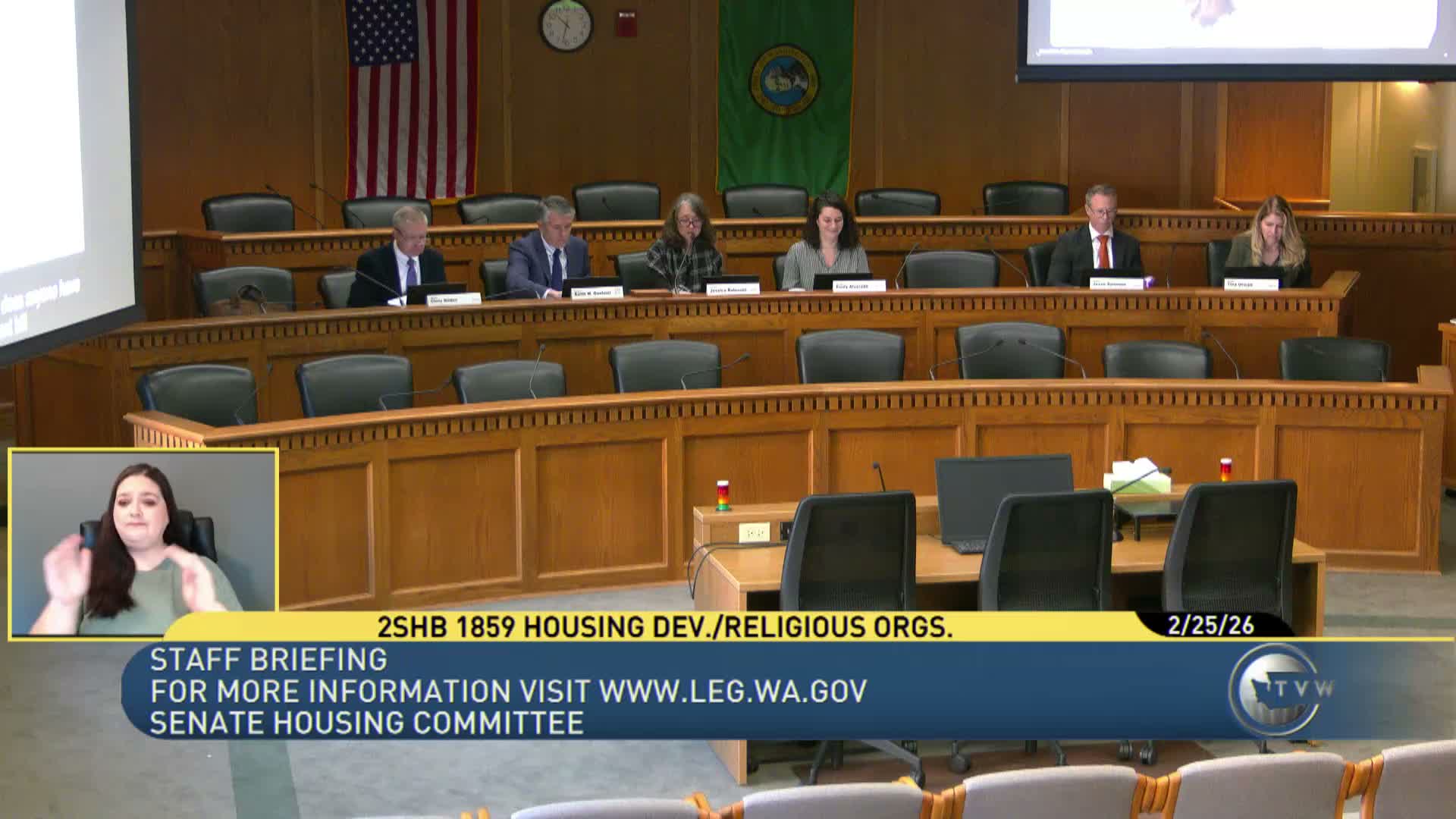
The state Senate Housing Committee on return from caucus voted to advance substitute House Bill 2266, a measure that would require cities and planning counties in urban growth areas to allow transitional housing, permanent supportive housing, indoor emergency shelters and indoor emergency housing in certain zones and to apply streamlined administrative design review where applicable.
Committee staff described the bill as removing some zoning barriers and directing jurisdictions to adopt the act’s requirements within two years or at their next comprehensive-plan update.
The hearing focused on a set of proposed amendments. Senator Gildan proposed amendment A1 to require step-housing zones be within 1 mile of transit. "Let's get them in places where, they will be near to transit and they can get to the places they need to be at to complete their recovery," Senator Gildan said, arguing residents often lack private transportation.
Chair members rejected A1 on a voice vote. Senator Gildan also sponsored amendment A2 to allow cities and planning counties to review operations plans (policies on nuisances, occupancy, supervision, security, intake and behavior management and neighborhood communication). Senator Alvarado argued against A2, saying, "taking this amendment, we would be reintroducing subjective review back into the permitting process," warning it would add cost and delay.
Amendment A3 — which would have required 24-hour on-site supervision unless an operations plan demonstrated a lower level was appropriate — generated the most sustained debate. Senator Gildan cited complaints of ‘‘increased 911 calls of drug use of crime being increased near these particular housing areas’’ and said the amendment aimed to ensure safe, well-run facilities. Senator Orwell said she was a "reluctant no" because of concerns over how adequacy of staffing would be decided. Senator Gaynor urged support, saying 24-hour staffing can provide safety and connection to services. The Chair expressed concern that a blanket 24-hour requirement could "restrict access to especially some of these smaller nonprofit organizations and these smaller projects," potentially reducing available shelter capacity.
Senator Gildan said she was willing to "finesse" the language and work with colleagues as the bill moves to the floor, but the amendment was not adopted on a voice vote. Amendment A4, offered by Senator Gaynor to limit new requirements under the act to cities with populations of 10,000 or more, was also rejected.
Senator Alvarado moved adoption of a striking amendment labeled A that committee staff described as cleanup and a balanced approach to keep cities and providers negotiating in good faith and to reduce barriers where permits fall through. He said the package "reduces barriers, making it easier for people to move inside" and emphasized the goal of moving people off the street into permanent, deeply affordable housing. The committee approved the motion and the bill as amended was sent to the Rules Committee with a do-pass recommendation; the bill passed subject to signatures.
The debate threaded two competing priorities: ensuring shelter and supportive housing are sited near services and transit and avoiding regulatory changes that could delay projects or sideline smaller nonprofit providers. Several members said they wanted stronger operational standards and staffing but raised practical concerns about imposing rigid, statewide mandates that could limit local housing supply. Senator Gildan and others signaled an intent to continue negotiating specific language before floor action.
Next steps: HB 2266 will be reported to the Rules Committee; if taken up by the full Senate, members said they expect to refine operational and supervision language before final passage.
Committee staff described the bill as removing some zoning barriers and directing jurisdictions to adopt the act’s requirements within two years or at their next comprehensive-plan update.
The hearing focused on a set of proposed amendments. Senator Gildan proposed amendment A1 to require step-housing zones be within 1 mile of transit. "Let's get them in places where, they will be near to transit and they can get to the places they need to be at to complete their recovery," Senator Gildan said, arguing residents often lack private transportation.
Chair members rejected A1 on a voice vote. Senator Gildan also sponsored amendment A2 to allow cities and planning counties to review operations plans (policies on nuisances, occupancy, supervision, security, intake and behavior management and neighborhood communication). Senator Alvarado argued against A2, saying, "taking this amendment, we would be reintroducing subjective review back into the permitting process," warning it would add cost and delay.
Amendment A3 — which would have required 24-hour on-site supervision unless an operations plan demonstrated a lower level was appropriate — generated the most sustained debate. Senator Gildan cited complaints of ‘‘increased 911 calls of drug use of crime being increased near these particular housing areas’’ and said the amendment aimed to ensure safe, well-run facilities. Senator Orwell said she was a "reluctant no" because of concerns over how adequacy of staffing would be decided. Senator Gaynor urged support, saying 24-hour staffing can provide safety and connection to services. The Chair expressed concern that a blanket 24-hour requirement could "restrict access to especially some of these smaller nonprofit organizations and these smaller projects," potentially reducing available shelter capacity.
Senator Gildan said she was willing to "finesse" the language and work with colleagues as the bill moves to the floor, but the amendment was not adopted on a voice vote. Amendment A4, offered by Senator Gaynor to limit new requirements under the act to cities with populations of 10,000 or more, was also rejected.
Senator Alvarado moved adoption of a striking amendment labeled A that committee staff described as cleanup and a balanced approach to keep cities and providers negotiating in good faith and to reduce barriers where permits fall through. He said the package "reduces barriers, making it easier for people to move inside" and emphasized the goal of moving people off the street into permanent, deeply affordable housing. The committee approved the motion and the bill as amended was sent to the Rules Committee with a do-pass recommendation; the bill passed subject to signatures.
The debate threaded two competing priorities: ensuring shelter and supportive housing are sited near services and transit and avoiding regulatory changes that could delay projects or sideline smaller nonprofit providers. Several members said they wanted stronger operational standards and staffing but raised practical concerns about imposing rigid, statewide mandates that could limit local housing supply. Senator Gildan and others signaled an intent to continue negotiating specific language before floor action.
Next steps: HB 2266 will be reported to the Rules Committee; if taken up by the full Senate, members said they expect to refine operational and supervision language before final passage.
Don't Miss a Word: See the Full Meeting!
Go beyond summaries. Unlock every video, transcript, and key insight with a Founder Membership.
✓
Get instant access to full meeting videos
✓
Search and clip any phrase from complete transcripts
✓
Receive AI-powered summaries & custom alerts
✓
Enjoy lifetime, unrestricted access to government data
30-day money-back guarantee
