Committee clears childcare bill that would require licensed premises to be free of controlled substances
February 25, 2026 | Legislative Sessions, Washington
This article was created by AI summarizing key points discussed. AI makes mistakes, so for full details and context, please refer to the video of the full meeting. Please report any errors so we can fix them. Report an error »
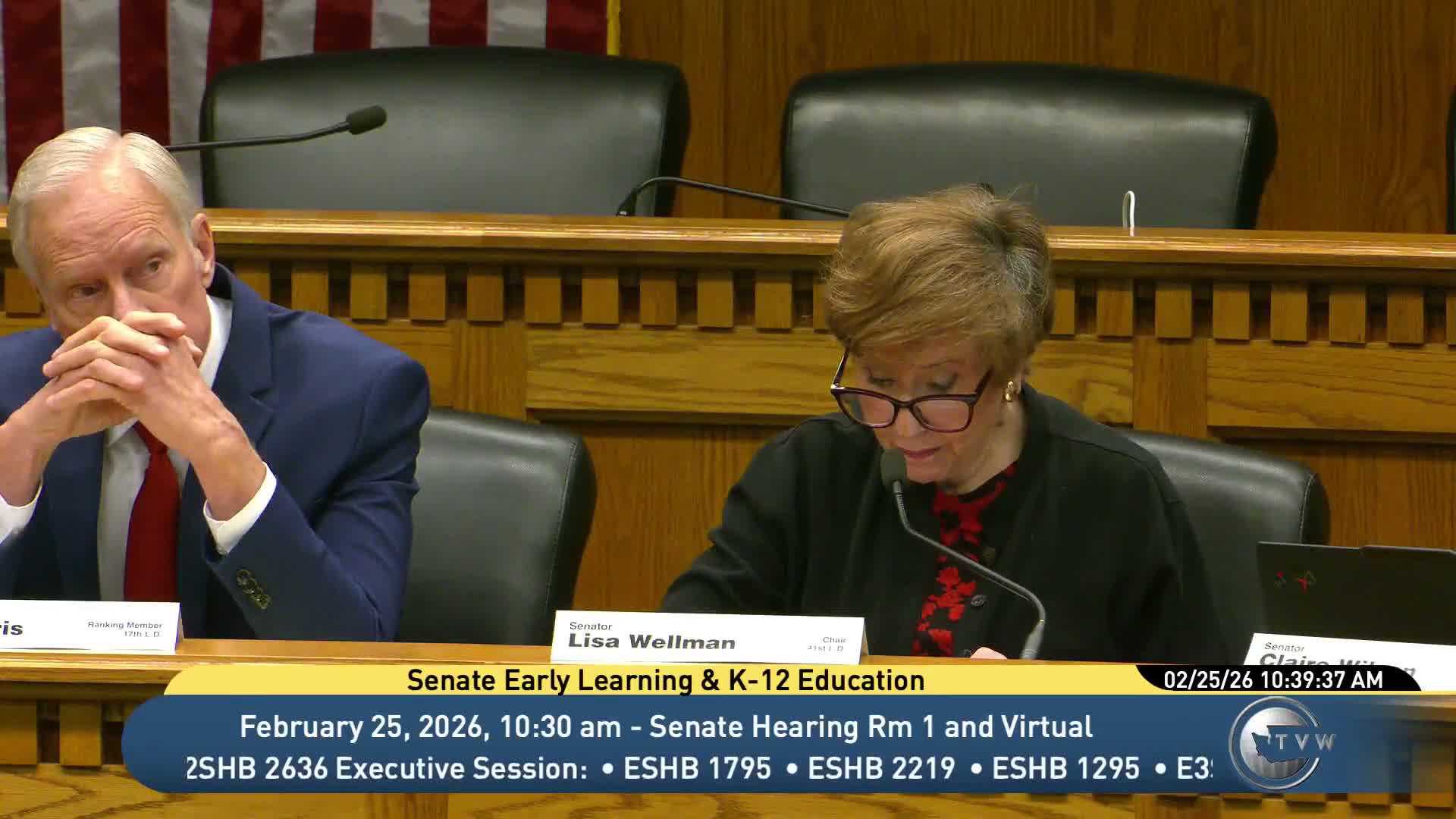
The Early Learning & K–12 Education Committee on Monday advanced Engrossed Substitute House Bill 2219, a bill directing the Department of Children, Youth, and Families (DCYF) to require licensed childcare premises to be free of controlled substances and to address related staffing and operational requirements.
Committee staff described the bill as directing DCYF to ensure licensed childcare settings are "absent of high potency synthetic opioids, fentanyl residue, drug paraphernalia, and manufacturing equipment." The summary also said the bill would authorize limited periods when childcare centers may combine different ages of children in care and permit DCYF to waive orientation requirements for individuals who previously completed the applicable orientation and meet other requirements.
Three amendments were noted. The striking amendment B (offered by Senator Wilson) cross‑references existing definitions for high‑potency synthetic opioids and drug paraphernalia and directs immediate summary suspension for licensees when a zero‑tolerance policy for imminent physical harm is violated, while stating the section does not create a private right of action. Senator McCune offered two amendments (B1 and B2) that would expand drug‑testing requirements and require facilities to be free of controlled substances without a valid prescription; both B1 and B2 failed on voice votes.
Senator McKeown described the drug‑testing amendment as "a very simple amendment about drug testing," arguing that drug screening is common in many jobs and that an initial test at hiring adds a layer of safety for children in day care centers. Senator Wilson characterized the striker as a clarity measure that reinforces existing processes for background checks and investigations and urged support.
A fiscal note was available and DCYF estimated no fiscal impact on the agency for the version summarized to the committee.
The committee voted to recommend that the bill as amended by the striking amendment B receive a due‑pass recommendation and be sent to the rules committee; the chair announced the bill "has passed subject to signatures." Votes in the transcript were recorded by voice; specific roll‑call tallies were not recorded.
Next steps: HB 2219 was forwarded to the rules committee with a due‑pass recommendation.
Committee staff described the bill as directing DCYF to ensure licensed childcare settings are "absent of high potency synthetic opioids, fentanyl residue, drug paraphernalia, and manufacturing equipment." The summary also said the bill would authorize limited periods when childcare centers may combine different ages of children in care and permit DCYF to waive orientation requirements for individuals who previously completed the applicable orientation and meet other requirements.
Three amendments were noted. The striking amendment B (offered by Senator Wilson) cross‑references existing definitions for high‑potency synthetic opioids and drug paraphernalia and directs immediate summary suspension for licensees when a zero‑tolerance policy for imminent physical harm is violated, while stating the section does not create a private right of action. Senator McCune offered two amendments (B1 and B2) that would expand drug‑testing requirements and require facilities to be free of controlled substances without a valid prescription; both B1 and B2 failed on voice votes.
Senator McKeown described the drug‑testing amendment as "a very simple amendment about drug testing," arguing that drug screening is common in many jobs and that an initial test at hiring adds a layer of safety for children in day care centers. Senator Wilson characterized the striker as a clarity measure that reinforces existing processes for background checks and investigations and urged support.
A fiscal note was available and DCYF estimated no fiscal impact on the agency for the version summarized to the committee.
The committee voted to recommend that the bill as amended by the striking amendment B receive a due‑pass recommendation and be sent to the rules committee; the chair announced the bill "has passed subject to signatures." Votes in the transcript were recorded by voice; specific roll‑call tallies were not recorded.
Next steps: HB 2219 was forwarded to the rules committee with a due‑pass recommendation.
View the Full Meeting & All Its Details
This article offers just a summary. Unlock complete video, transcripts, and insights as a Founder Member.
✓
Watch full, unedited meeting videos
✓
Search every word spoken in unlimited transcripts
✓
AI summaries & real-time alerts (all government levels)
✓
Permanent access to expanding government content
30-day money-back guarantee
