Neighbors challenge ADU at 1746 East Beardsley; BZA fails to reach unanimous decision, tables the case
February 21, 2026 | Elkhart City, Elkhart County, Indiana
This article was created by AI summarizing key points discussed. AI makes mistakes, so for full details and context, please refer to the video of the full meeting. Please report any errors so we can fix them. Report an error »
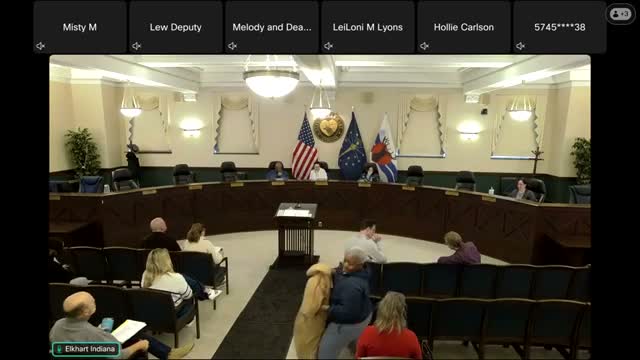
A petition to allow a detached accessory dwelling unit (ADU) at 1746 East Beardsley dominated the Elkhart City Board of Zoning Appeals' Feb. 21 special meeting, drawing sustained public opposition, legal and procedural questions and a split board that left the case unresolved.
Petitioner Nicole Hogan Dobler told the board she had already paid to install the unit for her mother and described the hardship: "My mom has chronic health conditions that are going to worsen over time and require to have more assistance as she ages," she said, explaining why proximity for family care drove the request. Staff described the requested use variance as allowing a 748-square-foot detached ADU that would be secondary to the main dwelling, would share utility connections with the primary residence, and would be subject to a deed restriction requiring owner-occupancy of the primary structure and prohibiting future subdivision of the lot. Staff recommended approval with conditions, and added a supplemental requirement that the homeowner provide a survey to confirm correct placement.
Neighbors and local stakeholders strongly opposed the ADU. City Councilman David Henke said the notification process had failed and argued that work had proceeded without neighbors' input: "The lack of notification to neighbors, the lack of timely notification, the lack of neighbors public input... When there was a known notification problem, a cease and desist should have been issued." Numerous residents raised similar concerns in-person and in written letters, arguing the structure is a HUD/manufactured-style unit placed too close to property lines, that it was installed before neighbors were properly notified, and that its presence would reduce property values, worsen parking and set an unwelcome precedent for single-family blocks.
Neighbors and organized groups asked the board to revoke the earlier approval or deny the use variance, citing Indiana statutory standards for variances and arguing the petitioner had not demonstrated a property-specific hardship required under Indiana law (citing Indiana code referenced by the petitioner). The board's attorney reiterated that today's hearing was being treated as a new petition to correct notice defects but advised members to limit public comments to the three variance questions before the board.
After extended public comment and staff responses, a board member moved to deny variance 25UV10, arguing the petition failed to meet the standards that the approval "will not be injurious to the public health, safety, morals and general welfare" and that "the use and value" of adjacent property would be harmed. A second was recorded. In the roll call the motion produced two votes in favor of denial and one opposed; because the special meeting had only three members present the board requires unanimity for final action. The vote was therefore not a final approval or denial and the matter was tabled for the next meeting. The board's attorney and staff said they will contact the building department about ceasing further construction activity in the interim; staff indicated the case will return to a subsequent hearing (board indicated March 12 as the next meeting date).
Why this matters: The ADU item raised two distinct issues for the board: whether the facts and legal standards for a variance are satisfied, and whether the earlier notification and subsequent on-site construction require a different remedy. Neighbors pressed for revocation and stronger enforcement; the petitioner emphasized urgent family-care needs and substantial financial investment.
What happens next: The BZA will reconsider the item at its next meeting. Staff will (per the record) provide additional verification regarding inspections and permits, the building department will be consulted about ongoing work, and the petitioner will be subject to the deed-restriction and survey conditions staff outlined if the board ultimately approves the variance.
Ending: With the board unable to reach unanimous action at the special session, the petition remains unresolved; the board directed staff to follow up with the building department and scheduled the matter for another hearing.
Petitioner Nicole Hogan Dobler told the board she had already paid to install the unit for her mother and described the hardship: "My mom has chronic health conditions that are going to worsen over time and require to have more assistance as she ages," she said, explaining why proximity for family care drove the request. Staff described the requested use variance as allowing a 748-square-foot detached ADU that would be secondary to the main dwelling, would share utility connections with the primary residence, and would be subject to a deed restriction requiring owner-occupancy of the primary structure and prohibiting future subdivision of the lot. Staff recommended approval with conditions, and added a supplemental requirement that the homeowner provide a survey to confirm correct placement.
Neighbors and local stakeholders strongly opposed the ADU. City Councilman David Henke said the notification process had failed and argued that work had proceeded without neighbors' input: "The lack of notification to neighbors, the lack of timely notification, the lack of neighbors public input... When there was a known notification problem, a cease and desist should have been issued." Numerous residents raised similar concerns in-person and in written letters, arguing the structure is a HUD/manufactured-style unit placed too close to property lines, that it was installed before neighbors were properly notified, and that its presence would reduce property values, worsen parking and set an unwelcome precedent for single-family blocks.
Neighbors and organized groups asked the board to revoke the earlier approval or deny the use variance, citing Indiana statutory standards for variances and arguing the petitioner had not demonstrated a property-specific hardship required under Indiana law (citing Indiana code referenced by the petitioner). The board's attorney reiterated that today's hearing was being treated as a new petition to correct notice defects but advised members to limit public comments to the three variance questions before the board.
After extended public comment and staff responses, a board member moved to deny variance 25UV10, arguing the petition failed to meet the standards that the approval "will not be injurious to the public health, safety, morals and general welfare" and that "the use and value" of adjacent property would be harmed. A second was recorded. In the roll call the motion produced two votes in favor of denial and one opposed; because the special meeting had only three members present the board requires unanimity for final action. The vote was therefore not a final approval or denial and the matter was tabled for the next meeting. The board's attorney and staff said they will contact the building department about ceasing further construction activity in the interim; staff indicated the case will return to a subsequent hearing (board indicated March 12 as the next meeting date).
Why this matters: The ADU item raised two distinct issues for the board: whether the facts and legal standards for a variance are satisfied, and whether the earlier notification and subsequent on-site construction require a different remedy. Neighbors pressed for revocation and stronger enforcement; the petitioner emphasized urgent family-care needs and substantial financial investment.
What happens next: The BZA will reconsider the item at its next meeting. Staff will (per the record) provide additional verification regarding inspections and permits, the building department will be consulted about ongoing work, and the petitioner will be subject to the deed-restriction and survey conditions staff outlined if the board ultimately approves the variance.
Ending: With the board unable to reach unanimous action at the special session, the petition remains unresolved; the board directed staff to follow up with the building department and scheduled the matter for another hearing.
View the Full Meeting & All Its Details
This article offers just a summary. Unlock complete video, transcripts, and insights as a Founder Member.
✓
Watch full, unedited meeting videos
✓
Search every word spoken in unlimited transcripts
✓
AI summaries & real-time alerts (all government levels)
✓
Permanent access to expanding government content
30-day money-back guarantee
