Environmental groups urge caution on SEQRA exemptions, call for narrower standards and floodplain protections
February 25, 2026 | 2026 Legislature NY, New York
This article was created by AI summarizing key points discussed. AI makes mistakes, so for full details and context, please refer to the video of the full meeting. Please report any errors so we can fix them. Report an error »
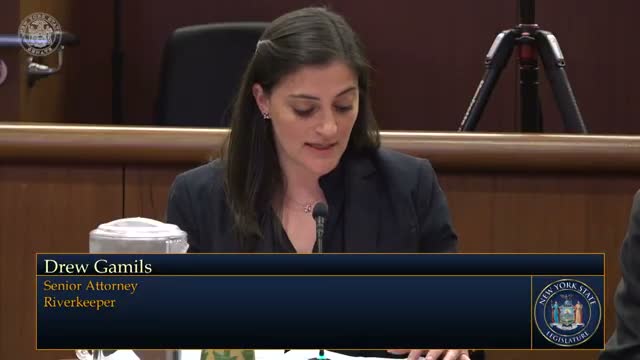
Environmental groups told the joint hearing they support streamlining where appropriate but warned that the governor’s proposed SEQRA exemptions—if written too broadly—could bypass critical, holistic environmental review and lead to construction in floodplains, sensitive habitats and locations lacking adequate infrastructure.
Drew Gammels of Riverkeeper, who has worked with SEQRA from municipal and advocacy perspectives, said the SEQRA process requires a holistic analysis of traffic, noise, cumulative impacts and mitigation options that local permit reviews do not necessarily cover. He urged targeted revisions including a narrower definition of "previously disturbed" land and an explicit exclusion for projects in FEMA 100‑year floodplains and other sensitive areas.
"Eliminating SEQRA review for larger housing projects without guardrails risks creating long term harms," Gammels said in testimony. Environmental witnesses also recommended that any streamlining include modest, flexible affordability requirements so exemptions do not simply enable market‑rate development that increases displacement pressure in some communities.
Legislators asked technical questions about where the line should be drawn and whether a tiered approach tied to community size and infrastructure capacity could achieve both speed and protections. Several sponsors signaled willingness to negotiate targeted amendments — for example, revising definitions for disturbed land, adding floodplain carveouts, and clarifying a shot‑clock for reviews as one compromise pathway.
Drew Gammels of Riverkeeper, who has worked with SEQRA from municipal and advocacy perspectives, said the SEQRA process requires a holistic analysis of traffic, noise, cumulative impacts and mitigation options that local permit reviews do not necessarily cover. He urged targeted revisions including a narrower definition of "previously disturbed" land and an explicit exclusion for projects in FEMA 100‑year floodplains and other sensitive areas.
"Eliminating SEQRA review for larger housing projects without guardrails risks creating long term harms," Gammels said in testimony. Environmental witnesses also recommended that any streamlining include modest, flexible affordability requirements so exemptions do not simply enable market‑rate development that increases displacement pressure in some communities.
Legislators asked technical questions about where the line should be drawn and whether a tiered approach tied to community size and infrastructure capacity could achieve both speed and protections. Several sponsors signaled willingness to negotiate targeted amendments — for example, revising definitions for disturbed land, adding floodplain carveouts, and clarifying a shot‑clock for reviews as one compromise pathway.
Don't Miss a Word: See the Full Meeting!
Go beyond summaries. Unlock every video, transcript, and key insight with a Founder Membership.
✓
Get instant access to full meeting videos
✓
Search and clip any phrase from complete transcripts
✓
Receive AI-powered summaries & custom alerts
✓
Enjoy lifetime, unrestricted access to government data
30-day money-back guarantee
