Corrections director warns of capacity limits, rising costs and contraband threats; requests funds for staffing and new housing units
February 25, 2026 | 2026 Legislative Meetings, South Carolina
This article was created by AI summarizing key points discussed. AI makes mistakes, so for full details and context, please refer to the video of the full meeting. Please report any errors so we can fix them. Report an error »
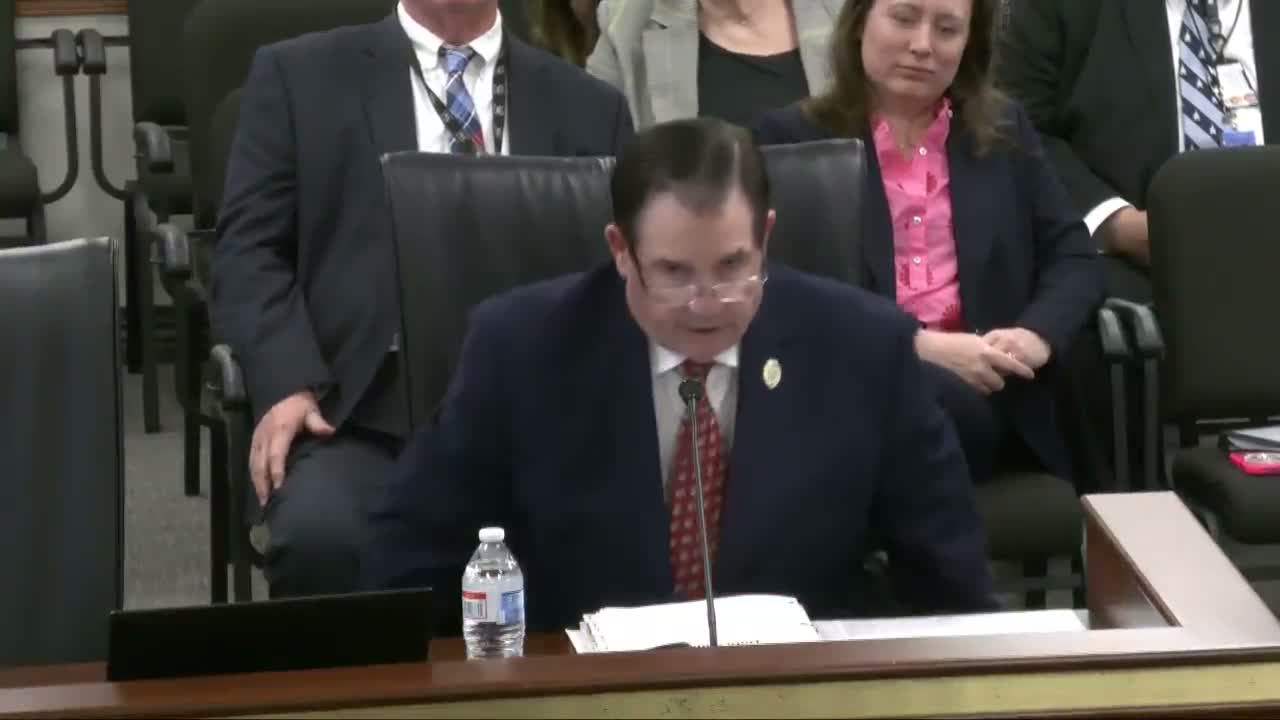
Joel Anderson, director of the South Carolina Department of Corrections, told the Senate subcommittee his first budget presentation to the Senate highlights a growing inmate population, acute staffing shortages and an expanding contraband threat that together require both recurring funds and sizable capital investment.
"Right now, today we have about 17,200 inmates in our prison system now," Anderson told senators, and he warned that at current growth rates the state will exhaust existing beds by about 2030 unless new capacity comes online. He said violent offenders make up roughly 75% of the maximum‑security population and that validated gang members outnumber officers on some national‑security units.
Anderson described contraband delivery by drones and said the department has captured thousands of illicit devices: "We've shut down 933 cell phones," he said, and recounted a drone payload incident that included 464 grams of fentanyl in one bag. To counter illicit devices, DOC plans proof‑of‑concept managed‑access (iNAC) tests at three institutions with academic and industry partners and requested recurring and one‑time funding to expand the technology statewide (recurring $5.1M; nonrecurring ~$15M equipment).
Priority spending requests include $30M in recurring operating funds to cover workers' compensation increases, care services and inflationary pressures; funding for 134 security officer vacancies and specialized positions (palliative care and mental‑health counselors); $500K for risk/needs case‑management software maintenance; and capital requests to build one secure housing unit per year for three years at about $35M each (256 beds per unit) at Kirkland Correctional Institution.
Anderson also outlined IT modernization needs: DOC plans to move off a legacy mainframe to a web‑based case management system, which requires significant up‑front staffing and data migration work. He said the DOC is progressing on the 2021 mental‑health settlement and anticipates reaching resolution this year, which would reduce oversight costs.
Senators asked about recruitment and retention; Anderson said deputy directors and HR staff now actively recruit and that several academy classes are underway. He emphasized the high cost of corrections operations and asked the committee for help in securing the proposed recurring and capital funding.
The committee did not vote on any items during the presentation; Anderson said he would be available for follow‑up as budget deliberations advance.
"Right now, today we have about 17,200 inmates in our prison system now," Anderson told senators, and he warned that at current growth rates the state will exhaust existing beds by about 2030 unless new capacity comes online. He said violent offenders make up roughly 75% of the maximum‑security population and that validated gang members outnumber officers on some national‑security units.
Anderson described contraband delivery by drones and said the department has captured thousands of illicit devices: "We've shut down 933 cell phones," he said, and recounted a drone payload incident that included 464 grams of fentanyl in one bag. To counter illicit devices, DOC plans proof‑of‑concept managed‑access (iNAC) tests at three institutions with academic and industry partners and requested recurring and one‑time funding to expand the technology statewide (recurring $5.1M; nonrecurring ~$15M equipment).
Priority spending requests include $30M in recurring operating funds to cover workers' compensation increases, care services and inflationary pressures; funding for 134 security officer vacancies and specialized positions (palliative care and mental‑health counselors); $500K for risk/needs case‑management software maintenance; and capital requests to build one secure housing unit per year for three years at about $35M each (256 beds per unit) at Kirkland Correctional Institution.
Anderson also outlined IT modernization needs: DOC plans to move off a legacy mainframe to a web‑based case management system, which requires significant up‑front staffing and data migration work. He said the DOC is progressing on the 2021 mental‑health settlement and anticipates reaching resolution this year, which would reduce oversight costs.
Senators asked about recruitment and retention; Anderson said deputy directors and HR staff now actively recruit and that several academy classes are underway. He emphasized the high cost of corrections operations and asked the committee for help in securing the proposed recurring and capital funding.
The committee did not vote on any items during the presentation; Anderson said he would be available for follow‑up as budget deliberations advance.
Don't Miss a Word: See the Full Meeting!
Go beyond summaries. Unlock every video, transcript, and key insight with a Founder Membership.
✓
Get instant access to full meeting videos
✓
Search and clip any phrase from complete transcripts
✓
Receive AI-powered summaries & custom alerts
✓
Enjoy lifetime, unrestricted access to government data
30-day money-back guarantee
