Staff recommends council certify EIR and approve Avalon Homes coastal permit despite unmitigable traffic impact
February 26, 2026 | Oxnard City, Ventura County, California
This article was created by AI summarizing key points discussed. AI makes mistakes, so for full details and context, please refer to the video of the full meeting. Please report any errors so we can fix them. Report an error »
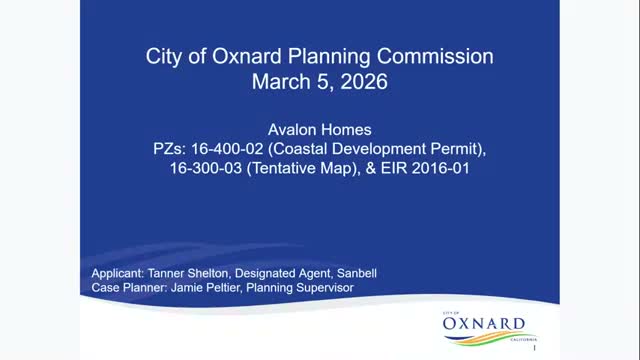
Planning staff told the Oxnard Planning Commission on March 5, 2026, that it recommends the City Council certify the final environmental impact report and approve permits for the Avalon Homes subdivision, a proposed 56‑single‑family home development paired with 30 acres of preserved dune habitat.
Jamie Peltier, planning supervisor, said the project includes a coastal development permit (No. 164002) and a tentative subdivision map (No. 163003) covering 10 lots (about 8.75 acres for residential development and seven lots reserved for open space and related improvements). "VMT impacts were found in the transportation analysis and cannot be mitigated to less than significant," Peltier said, noting that the EIR includes a statement of overriding considerations to explain the basis for approving the project despite the transportation impact.
Why it matters: The staff recommendation asks the council to weigh housing production, coastal habitat preservation and a finding that vehicle‑miles‑traveled (VMT) impacts are significant. The project would add 56 detached single‑family units in clustered four‑unit groupings with private streets and a homeowners association, while preserving and restoring dune habitat to offset development impacts.
The project site, in the Oxnard Dunes neighborhood on the west side of Oxnard City between 5th Street, Woolly Road, Harbour Boulevard and the Edison Canal, has a mix of zoning and land‑use designations the proposal is intended to respect. Peltier told commissioners the site plan complies with the Coastal Multiple Family (R2C) standards for height, lot area, setbacks, lot coverage and parking, and that connecting Dune Street and Canal Street completes a previously stubbed street network.
The presentation summarized the environmental review history: a draft EIR circulated in 2019 analyzed alternatives including a 56‑unit option; in 2021 the applicant shifted to that 56‑unit alternative and the EIR was updated in 2024 and recirculated in 2025 under current CEQA guidance. "The final EIR attached to the resolution contains the response to comments on the draft EIR," Peltier said.
On affordability, staff said the project is subject to the city's inclusionary housing ordinance. The applicant requested an in‑lieu payment rather than providing the ordinance's 10% low‑income units at the project level; Peltier said the in‑lieu fee in this year's schedule is $43,808.91 per single‑family unit and recommended including an in‑lieu fee condition in the resolution.
Mitigation and conditions: Peltier listed mitigation measures across air quality, biological resources, cultural resources, geology and soils, greenhouse gases, noise and transportation. Key permit conditions recommended for approval include a requirement that 50% occupancy of residential units be achieved before open‑space improvements are approved and constructed, and that the applicant post a bond to ensure habitat restoration is initiated within one year and monitored for a minimum of five years. For the tentative map, staff recommended assigning long‑term maintenance, monitoring and restoration responsibilities and preparing a deed restriction permanently restricting the open space prior to map recordation.
What the commission will do next: Staff recommended the Planning Commission adopt resolutions recommending the City Council certify the final EIR and approve the two planning and zoning permits (tentative map 163003 and coastal development permit 164002), and noted the commission takes final action on the coastal development permit while making recommendations to the City Council on the other items.
The staff presentation concluded with the recommendation materials and the final EIR exhibits available to commissioners and the public; the commission's hearing on the item will advance those recommendations to the council if it concurs with staff.
Jamie Peltier, planning supervisor, said the project includes a coastal development permit (No. 164002) and a tentative subdivision map (No. 163003) covering 10 lots (about 8.75 acres for residential development and seven lots reserved for open space and related improvements). "VMT impacts were found in the transportation analysis and cannot be mitigated to less than significant," Peltier said, noting that the EIR includes a statement of overriding considerations to explain the basis for approving the project despite the transportation impact.
Why it matters: The staff recommendation asks the council to weigh housing production, coastal habitat preservation and a finding that vehicle‑miles‑traveled (VMT) impacts are significant. The project would add 56 detached single‑family units in clustered four‑unit groupings with private streets and a homeowners association, while preserving and restoring dune habitat to offset development impacts.
The project site, in the Oxnard Dunes neighborhood on the west side of Oxnard City between 5th Street, Woolly Road, Harbour Boulevard and the Edison Canal, has a mix of zoning and land‑use designations the proposal is intended to respect. Peltier told commissioners the site plan complies with the Coastal Multiple Family (R2C) standards for height, lot area, setbacks, lot coverage and parking, and that connecting Dune Street and Canal Street completes a previously stubbed street network.
The presentation summarized the environmental review history: a draft EIR circulated in 2019 analyzed alternatives including a 56‑unit option; in 2021 the applicant shifted to that 56‑unit alternative and the EIR was updated in 2024 and recirculated in 2025 under current CEQA guidance. "The final EIR attached to the resolution contains the response to comments on the draft EIR," Peltier said.
On affordability, staff said the project is subject to the city's inclusionary housing ordinance. The applicant requested an in‑lieu payment rather than providing the ordinance's 10% low‑income units at the project level; Peltier said the in‑lieu fee in this year's schedule is $43,808.91 per single‑family unit and recommended including an in‑lieu fee condition in the resolution.
Mitigation and conditions: Peltier listed mitigation measures across air quality, biological resources, cultural resources, geology and soils, greenhouse gases, noise and transportation. Key permit conditions recommended for approval include a requirement that 50% occupancy of residential units be achieved before open‑space improvements are approved and constructed, and that the applicant post a bond to ensure habitat restoration is initiated within one year and monitored for a minimum of five years. For the tentative map, staff recommended assigning long‑term maintenance, monitoring and restoration responsibilities and preparing a deed restriction permanently restricting the open space prior to map recordation.
What the commission will do next: Staff recommended the Planning Commission adopt resolutions recommending the City Council certify the final EIR and approve the two planning and zoning permits (tentative map 163003 and coastal development permit 164002), and noted the commission takes final action on the coastal development permit while making recommendations to the City Council on the other items.
The staff presentation concluded with the recommendation materials and the final EIR exhibits available to commissioners and the public; the commission's hearing on the item will advance those recommendations to the council if it concurs with staff.
Don't Miss a Word: See the Full Meeting!
Go beyond summaries. Unlock every video, transcript, and key insight with a Founder Membership.
✓
Get instant access to full meeting videos
✓
Search and clip any phrase from complete transcripts
✓
Receive AI-powered summaries & custom alerts
✓
Enjoy lifetime, unrestricted access to government data
30-day money-back guarantee
