House hearing on Project 1005 debates easing rules to let buyers rehabilitate blighted properties for affordable housing
February 25, 2026 | House of Representatives, House, Committees, Legislative, Puerto Rico, International
This article was created by AI summarizing key points discussed. AI makes mistakes, so for full details and context, please refer to the video of the full meeting. Please report any errors so we can fix them. Report an error »
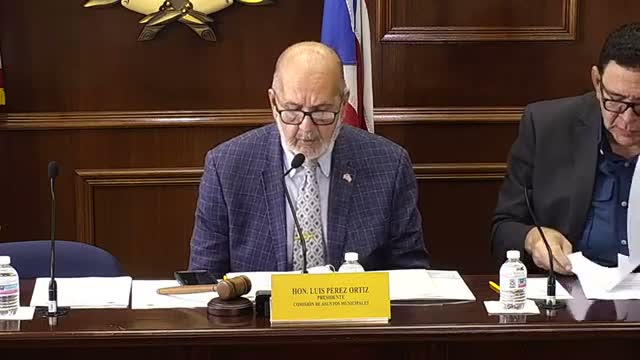
A House committee held a public hearing Feb. 24 on Projecto de la Cámara 1005, which would amend articles 4.012a and 4.014 of Law 107 (the Municipal Code) to permit natural and juridical persons — with or without profit motive — to acquire properties declared estorbos públicos provided they certify the properties will be rehabilitated as primary housing for low, moderate or middle‑income families.
Vanessa Jiménez Cuevas, director of legal affairs for the Municipality of San Juan, told the committee San Juan supports the measure as a tool to address both the public‑safety harms of abandoned structures and the shortage of affordable housing. "La medida fortalece la capacidad de los municipios para atender de manera simultánea el problema de estorbos públicos y la crisis de vivienda," she said, and described the city’s public portal that tracks complaints, ownership and up to four acquisition intentions per property.
The Department of Justice, represented by María del Mar López Latorre, said the department "avala la continuación del trámite legislativo" but recommended statutory minimums to avoid arbitrary or disparate application among municipalities. DOJ asked the Legislature to add objective, quantifiable compliance metrics — for example, phased rehabilitation milestones — and a uniform statutory reference for what constitutes "ingresos bajos, moderados o de clase media," so municipal ordinances will not diverge in ways that risk litigation and unequal outcomes.
Omar Alexis Figueroa Vázquez, Secretary of Housing, voiced caution. He said the proposal "altera elementos estructurales del régimen vigente" by broadening the class of eligible acquirers and warned that relying on a later exercise of retracto convencional to correct noncompliance could be "tardío, litigioso y operacionalmente complejo" unless the law requires pre‑recorded encumbrances, periodic reporting, clear enforcement triggers and objective standards for fulfillment.
San Juan provided preliminary operational figures to illustrate the scale: the municipality reported more than 1,000 querellas (complaints) in its system, with roughly 400–500 active administrative cases and about 500 properties in later stages toward sale or expropriation. Jiménez Cuevas said the current administrative process, appraisal costs and the need for upfront cash limit access by lower‑income buyers: "ningún banco financia una propiedad como esa" until it is rehabilitated and mortgage-eligible.
Witnesses and committee members recommended legislative changes and complementary measures to reduce risks and increase practical access. Suggestions included: statutory minimum definitions and reference indices for income bands (for example, using the Department of Housing’s annual tables), mandatory municipal ordinances to specify eligibility and enforcement mechanisms, recording contractual encumbrances (gravámenes) in the property registry, and developing financing products or revolving funds to support rehabilitation by or for low‑income households.
Housing and others pointed to existing models and a pilot as examples. Figueroa cited a Vega Baja pilot with the Centro para la Reconstrucción del Hábitat in which a rehabilitated house was made available for households using R3 vouchers (up to $200,000) and the landbank model (article 4.5) as ways to scale rehabilitation while controlling ownership transfers.
Committee members asked San Juan and the Department of Housing to provide additional statistics and written positions within five days. No formal amendment or vote occurred at the hearing; the bill remains under committee consideration with requests to incorporate DOJ and Housing recommendations before further action.
Vanessa Jiménez Cuevas, director of legal affairs for the Municipality of San Juan, told the committee San Juan supports the measure as a tool to address both the public‑safety harms of abandoned structures and the shortage of affordable housing. "La medida fortalece la capacidad de los municipios para atender de manera simultánea el problema de estorbos públicos y la crisis de vivienda," she said, and described the city’s public portal that tracks complaints, ownership and up to four acquisition intentions per property.
The Department of Justice, represented by María del Mar López Latorre, said the department "avala la continuación del trámite legislativo" but recommended statutory minimums to avoid arbitrary or disparate application among municipalities. DOJ asked the Legislature to add objective, quantifiable compliance metrics — for example, phased rehabilitation milestones — and a uniform statutory reference for what constitutes "ingresos bajos, moderados o de clase media," so municipal ordinances will not diverge in ways that risk litigation and unequal outcomes.
Omar Alexis Figueroa Vázquez, Secretary of Housing, voiced caution. He said the proposal "altera elementos estructurales del régimen vigente" by broadening the class of eligible acquirers and warned that relying on a later exercise of retracto convencional to correct noncompliance could be "tardío, litigioso y operacionalmente complejo" unless the law requires pre‑recorded encumbrances, periodic reporting, clear enforcement triggers and objective standards for fulfillment.
San Juan provided preliminary operational figures to illustrate the scale: the municipality reported more than 1,000 querellas (complaints) in its system, with roughly 400–500 active administrative cases and about 500 properties in later stages toward sale or expropriation. Jiménez Cuevas said the current administrative process, appraisal costs and the need for upfront cash limit access by lower‑income buyers: "ningún banco financia una propiedad como esa" until it is rehabilitated and mortgage-eligible.
Witnesses and committee members recommended legislative changes and complementary measures to reduce risks and increase practical access. Suggestions included: statutory minimum definitions and reference indices for income bands (for example, using the Department of Housing’s annual tables), mandatory municipal ordinances to specify eligibility and enforcement mechanisms, recording contractual encumbrances (gravámenes) in the property registry, and developing financing products or revolving funds to support rehabilitation by or for low‑income households.
Housing and others pointed to existing models and a pilot as examples. Figueroa cited a Vega Baja pilot with the Centro para la Reconstrucción del Hábitat in which a rehabilitated house was made available for households using R3 vouchers (up to $200,000) and the landbank model (article 4.5) as ways to scale rehabilitation while controlling ownership transfers.
Committee members asked San Juan and the Department of Housing to provide additional statistics and written positions within five days. No formal amendment or vote occurred at the hearing; the bill remains under committee consideration with requests to incorporate DOJ and Housing recommendations before further action.
Don't Miss a Word: See the Full Meeting!
Go beyond summaries. Unlock every video, transcript, and key insight with a Founder Membership.
✓
Get instant access to full meeting videos
✓
Search and clip any phrase from complete transcripts
✓
Receive AI-powered summaries & custom alerts
✓
Enjoy lifetime, unrestricted access to government data
30-day money-back guarantee
