Senate housing panel hears data showing rising evictions and a 100,000‑home shortfall; advocates push rental assistance and bonds
February 25, 2026 | 2026 Legislature MN, Minnesota
This article was created by AI summarizing key points discussed. AI makes mistakes, so for full details and context, please refer to the video of the full meeting. Please report any errors so we can fix them. Report an error »
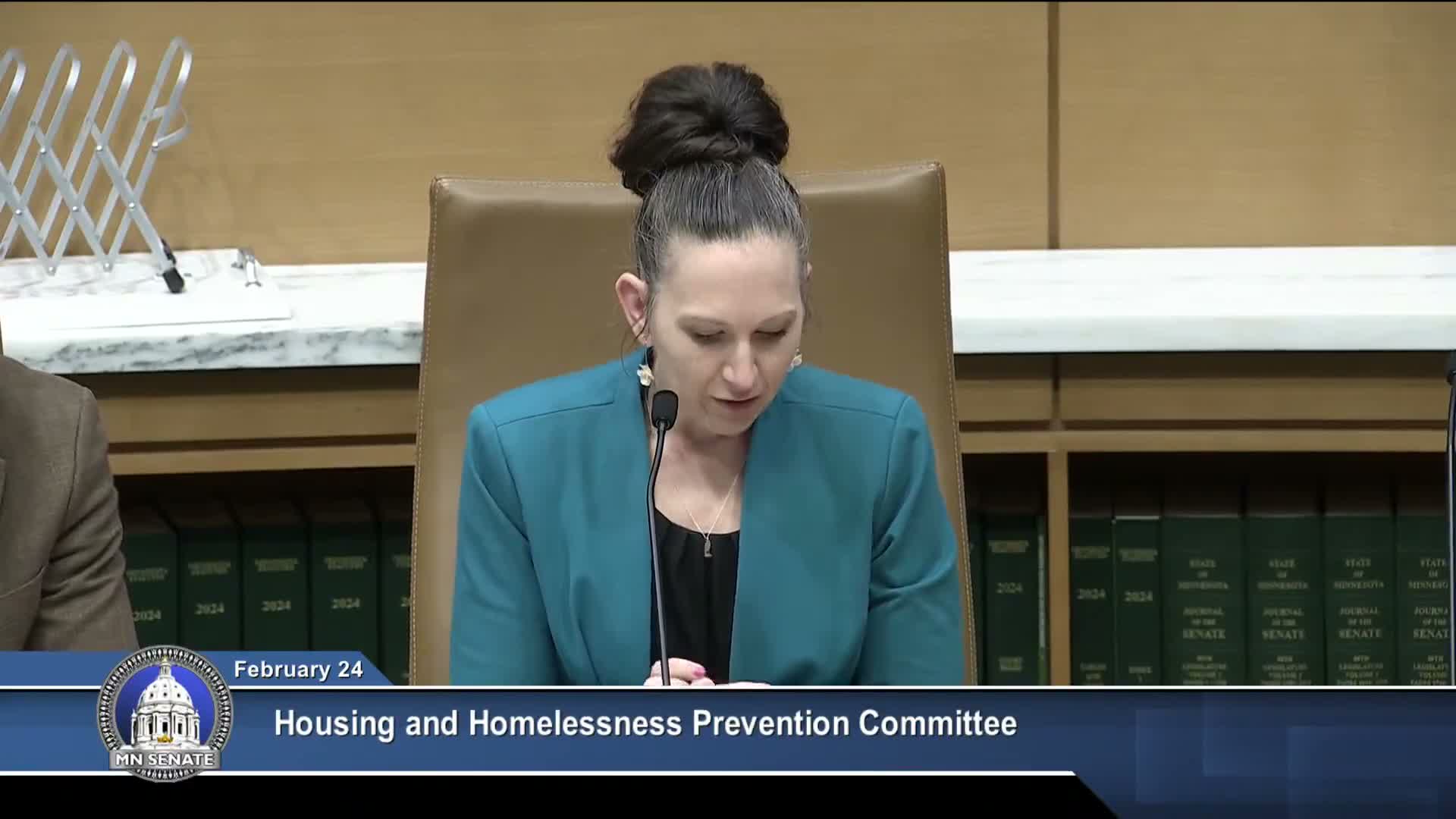
Tuesday, Feb. 24 — The Senate Committee on Housing and Homelessness Prevention heard updated data showing eviction filings have risen above pre-pandemic levels and that Minnesota faces a sizable housing shortfall, prompting members and witnesses to press for expanded rental assistance and infrastructure investments.
Michael Dahl, public policy director at tenant-advocacy group Homeline, told the committee that pre-pandemic residential evictions ran at about 13,000 per year and that "right now, we're at a number of around 25,000 per year." That figure prompted senators to ask for more precise baseline data for Hennepin, Ramsey and other counties and to debate definitions of an "eviction crisis."
The Minnesota Housing Partnership's executive director, Anne Mavity, framed the problem as threefold: "we don't have enough homes for everyone who needs them," many households are paying more for housing than they can afford, and available resources fall short. Mavity said Minnesota is "about 100,000 homes short" and pointed to a downward trend in building permits as evidence the shortfall will persist without policy changes.
Mavity and members emphasized rental assistance as a cost‑effective way to keep families housed and preserve revenue for housing providers. She noted the metro sales tax program produced about 5,000 new rental assistance vouchers for the Twin Cities metro area and urged expansion of similar resources statewide. "Rental assistance is a win‑win," she said, because it helps tenants afford homes while allowing providers to maintain revenue.
Commissioner Jennifer Ho of Minnesota Housing described the agency's recent investments and program activity, saying the agency made "$166,000,000 in investments" in a consolidated December RFP cycle that selected 51 proposals representing roughly 1,400 units. Ho said roughly $1.3 billion authorized in 2023 is now about 90% committed and about 40% spent, and that selections to date will benefit roughly 70,000 households.
Senators debated policy tradeoffs. Senator Lucero warned that short moratoriums can simply "grow the bubble," shifting costs and delaying resolution for nonpaying tenants. By contrast, Senator Mohammed urged immediate action to keep families in housing, saying lawmakers must "step up" and pressing for rapid emergency rental assistance. Senator Gruenhagen raised concerns about regulatory costs and said lawmakers should compare Minnesota to other states that have increased housing supply.
Committee members asked agency and staff for additional data, including longer time series on the age of first‑time homebuyers and regional permit/unit breakdowns. Several members emphasized that supply expansions (zoning, permitting and incentives) are a necessary long‑term response while rental assistance helps households in the near term.
The committee did not vote on the eviction or moratorium proposals during the hearing. Members were scheduled to meet next on March 3 for continued consideration of housing items.
Michael Dahl, public policy director at tenant-advocacy group Homeline, told the committee that pre-pandemic residential evictions ran at about 13,000 per year and that "right now, we're at a number of around 25,000 per year." That figure prompted senators to ask for more precise baseline data for Hennepin, Ramsey and other counties and to debate definitions of an "eviction crisis."
The Minnesota Housing Partnership's executive director, Anne Mavity, framed the problem as threefold: "we don't have enough homes for everyone who needs them," many households are paying more for housing than they can afford, and available resources fall short. Mavity said Minnesota is "about 100,000 homes short" and pointed to a downward trend in building permits as evidence the shortfall will persist without policy changes.
Mavity and members emphasized rental assistance as a cost‑effective way to keep families housed and preserve revenue for housing providers. She noted the metro sales tax program produced about 5,000 new rental assistance vouchers for the Twin Cities metro area and urged expansion of similar resources statewide. "Rental assistance is a win‑win," she said, because it helps tenants afford homes while allowing providers to maintain revenue.
Commissioner Jennifer Ho of Minnesota Housing described the agency's recent investments and program activity, saying the agency made "$166,000,000 in investments" in a consolidated December RFP cycle that selected 51 proposals representing roughly 1,400 units. Ho said roughly $1.3 billion authorized in 2023 is now about 90% committed and about 40% spent, and that selections to date will benefit roughly 70,000 households.
Senators debated policy tradeoffs. Senator Lucero warned that short moratoriums can simply "grow the bubble," shifting costs and delaying resolution for nonpaying tenants. By contrast, Senator Mohammed urged immediate action to keep families in housing, saying lawmakers must "step up" and pressing for rapid emergency rental assistance. Senator Gruenhagen raised concerns about regulatory costs and said lawmakers should compare Minnesota to other states that have increased housing supply.
Committee members asked agency and staff for additional data, including longer time series on the age of first‑time homebuyers and regional permit/unit breakdowns. Several members emphasized that supply expansions (zoning, permitting and incentives) are a necessary long‑term response while rental assistance helps households in the near term.
The committee did not vote on the eviction or moratorium proposals during the hearing. Members were scheduled to meet next on March 3 for continued consideration of housing items.
Don't Miss a Word: See the Full Meeting!
Go beyond summaries. Unlock every video, transcript, and key insight with a Founder Membership.
✓
Get instant access to full meeting videos
✓
Search and clip any phrase from complete transcripts
✓
Receive AI-powered summaries & custom alerts
✓
Enjoy lifetime, unrestricted access to government data
30-day money-back guarantee
