Residents and commissioners debate SB 1066 and Rodman Reservoir’s local impacts
February 25, 2026 | Putnam County, Florida
This article was created by AI summarizing key points discussed. AI makes mistakes, so for full details and context, please refer to the video of the full meeting. Please report any errors so we can fix them. Report an error »
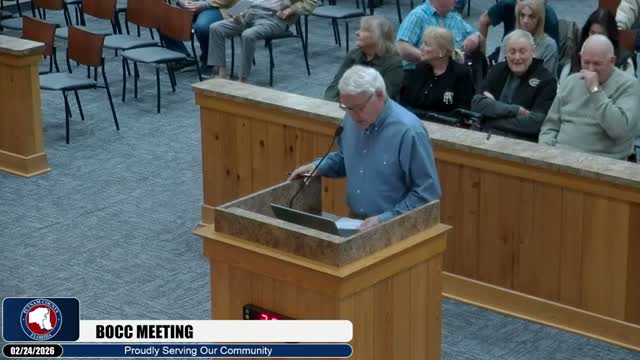
Putnam County commissioners heard extended public comment Feb. 24 on Senate Bill 1066 (and companion House Bill 981), with residents and former officials urging the board to support state legislation to restore river connectivity, invest in local recreation and economy, and address safety risks related to the Kirkpatrick Dam (Rodman Reservoir). The board did not take a formal position at the meeting.
Vernon Myers, a Putnam County resident and former Palatka mayor, told commissioners, “Senate Bill 1066 does not take water away from Putnam. It strengthens water security by restoring springs, reviving the floodplain forest that naturally stores and filters water, and reducing reliance on an aging, high risk dam and reservoir.” He urged the commission to support the legislation and noted the bill would give the county a formal seat at transition planning.
Linda Myers, who has served locally as tax collector, commissioner and chamber president, told the board the bill “was written with Putnam in mind” and listed three ways it would benefit the county: public-safety and resiliency measures, a targeted economic investment program for Putnam and Marion counties, and investments in recreation infrastructure. She cited an independent economic analysis she said projected “nearly $200,000,000 in net benefits over 20 years.”
During commissioner comments later in the meeting, the chair raised hydrological and safety concerns, referencing two long-term government studies and a 1990 U.S. Geological Survey that, the chair said, showed drawdown of Rodman Reservoir can reduce Upper Floridian aquifer levels and affect wells within a 15-mile radius. “We can't risk the 19,000 wells that are within a 15 mile radius of Rodman Reservoir,” the chair said, framing the concern as a public-safety and water-supply risk for rural well users.
Other commissioners and community speakers emphasized the bill’s potential to protect springs, increase local recreation access, and guide state investments in economic transition for communities adjacent to the reservoir. County staff referenced a 2021 inspection report prepared for the Florida Department of Environmental Protection by Mead & Hunt that rated the structure’s condition as satisfactory and noted no immediate dam safety deficiencies observed during that inspection.
The board heard competing claims — economic projections and community advisory roles on one side, and scientific caution about groundwater effects and well impacts on the other — but did not take a formal vote or adopt a position during the Feb. 24 meeting. Several speakers urged the commission to continue engaging with state legislators and to seek clear, updated empirical studies on aquifer impacts before making a formal policy decision.
Vernon Myers, a Putnam County resident and former Palatka mayor, told commissioners, “Senate Bill 1066 does not take water away from Putnam. It strengthens water security by restoring springs, reviving the floodplain forest that naturally stores and filters water, and reducing reliance on an aging, high risk dam and reservoir.” He urged the commission to support the legislation and noted the bill would give the county a formal seat at transition planning.
Linda Myers, who has served locally as tax collector, commissioner and chamber president, told the board the bill “was written with Putnam in mind” and listed three ways it would benefit the county: public-safety and resiliency measures, a targeted economic investment program for Putnam and Marion counties, and investments in recreation infrastructure. She cited an independent economic analysis she said projected “nearly $200,000,000 in net benefits over 20 years.”
During commissioner comments later in the meeting, the chair raised hydrological and safety concerns, referencing two long-term government studies and a 1990 U.S. Geological Survey that, the chair said, showed drawdown of Rodman Reservoir can reduce Upper Floridian aquifer levels and affect wells within a 15-mile radius. “We can't risk the 19,000 wells that are within a 15 mile radius of Rodman Reservoir,” the chair said, framing the concern as a public-safety and water-supply risk for rural well users.
Other commissioners and community speakers emphasized the bill’s potential to protect springs, increase local recreation access, and guide state investments in economic transition for communities adjacent to the reservoir. County staff referenced a 2021 inspection report prepared for the Florida Department of Environmental Protection by Mead & Hunt that rated the structure’s condition as satisfactory and noted no immediate dam safety deficiencies observed during that inspection.
The board heard competing claims — economic projections and community advisory roles on one side, and scientific caution about groundwater effects and well impacts on the other — but did not take a formal vote or adopt a position during the Feb. 24 meeting. Several speakers urged the commission to continue engaging with state legislators and to seek clear, updated empirical studies on aquifer impacts before making a formal policy decision.
View the Full Meeting & All Its Details
This article offers just a summary. Unlock complete video, transcripts, and insights as a Founder Member.
✓
Watch full, unedited meeting videos
✓
Search every word spoken in unlimited transcripts
✓
AI summaries & real-time alerts (all government levels)
✓
Permanent access to expanding government content
30-day money-back guarantee
