Pitkin County holds first reading of Colorado Wildfire Resiliency Code, plans mapping and exemptions
February 25, 2026 | Pitkin County, Colorado
This article was created by AI summarizing key points discussed. AI makes mistakes, so for full details and context, please refer to the video of the full meeting. Please report any errors so we can fix them. Report an error »
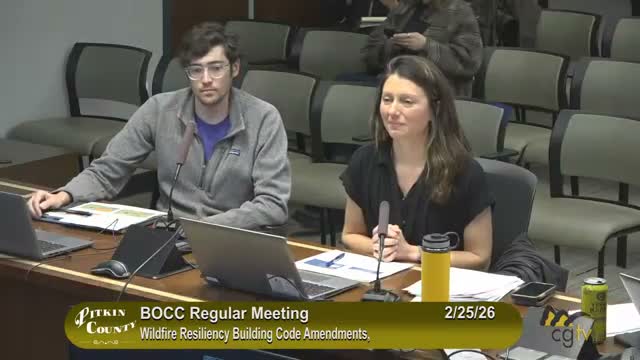
Pitkin County staff presented proposed local adoption of the Colorado Wildfire Resiliency Code (CWRC) and companion land-use code amendments on Feb. 25, describing changes to building-material standards, defensible-space zones and mapping procedures that staff said are required or recommended by the state.
John Houghton, Nicole Rebeck Stout and Jeff Erickson explained that the CWRC draws on the International Wildland-Urban Interface Code and the Colorado State Forest Service Home Ignition Zone guidance. They told the board that the county will regulate two classes of structure hardening: Class 1 (basic ember protection: Class A roofs, gutter materials, ember-resistant vents) and Class 2 (more prescriptive exterior-wall and glazing rules that apply in moderate and high intensity mapped areas). "If you replace more than 25% of your roof, your full roof has to comply" with the new code, Houghton said, adding that additions over 500 square feet and other defined triggers would require compliance.
Staff showed the state's wildfire hazard map and a county GIS layer that aligns state classifications to parcel boundaries. Commissioners asked about unmapped parcels, parcel-level accuracy for insurance purposes, and the county's decision to apply moderate-class requirements in unmapped areas. Staff said the map adoption will be part of the ordinance and that ground-truthing (private expert reports that can contest map classification for specific building permits) would remain available.
The board discussed specific technical provisions: permitted wall coverings, tempered glazing vs. double-pane options, allowable materials for gutters and fencing (some commissioners urged avoiding vinyl products), driveway defensible-space rules, and slope-based expansions of defensible zones. Staff said the CWRC is designed to be triggered by building permits (not retroactive to existing houses unless work triggers the code) and that fire districts will assist with guidance and free assessment visits.
Commissioners approved first reading of the building-code ordinance and moved corresponding land-use amendments (first reading) with a scheduled continuation and public hearing on March 25, when mapping and public comments will be reopened for final consideration.
John Houghton, Nicole Rebeck Stout and Jeff Erickson explained that the CWRC draws on the International Wildland-Urban Interface Code and the Colorado State Forest Service Home Ignition Zone guidance. They told the board that the county will regulate two classes of structure hardening: Class 1 (basic ember protection: Class A roofs, gutter materials, ember-resistant vents) and Class 2 (more prescriptive exterior-wall and glazing rules that apply in moderate and high intensity mapped areas). "If you replace more than 25% of your roof, your full roof has to comply" with the new code, Houghton said, adding that additions over 500 square feet and other defined triggers would require compliance.
Staff showed the state's wildfire hazard map and a county GIS layer that aligns state classifications to parcel boundaries. Commissioners asked about unmapped parcels, parcel-level accuracy for insurance purposes, and the county's decision to apply moderate-class requirements in unmapped areas. Staff said the map adoption will be part of the ordinance and that ground-truthing (private expert reports that can contest map classification for specific building permits) would remain available.
The board discussed specific technical provisions: permitted wall coverings, tempered glazing vs. double-pane options, allowable materials for gutters and fencing (some commissioners urged avoiding vinyl products), driveway defensible-space rules, and slope-based expansions of defensible zones. Staff said the CWRC is designed to be triggered by building permits (not retroactive to existing houses unless work triggers the code) and that fire districts will assist with guidance and free assessment visits.
Commissioners approved first reading of the building-code ordinance and moved corresponding land-use amendments (first reading) with a scheduled continuation and public hearing on March 25, when mapping and public comments will be reopened for final consideration.
View the Full Meeting & All Its Details
This article offers just a summary. Unlock complete video, transcripts, and insights as a Founder Member.
✓
Watch full, unedited meeting videos
✓
Search every word spoken in unlimited transcripts
✓
AI summaries & real-time alerts (all government levels)
✓
Permanent access to expanding government content
30-day money-back guarantee
