City operations pitches street-use fee, environmental crew to protect streets and free general-fund dollars
February 26, 2026 | San Angelo, Tom Green County, Texas
This article was created by AI summarizing key points discussed. AI makes mistakes, so for full details and context, please refer to the video of the full meeting. Please report any errors so we can fix them. Report an error »
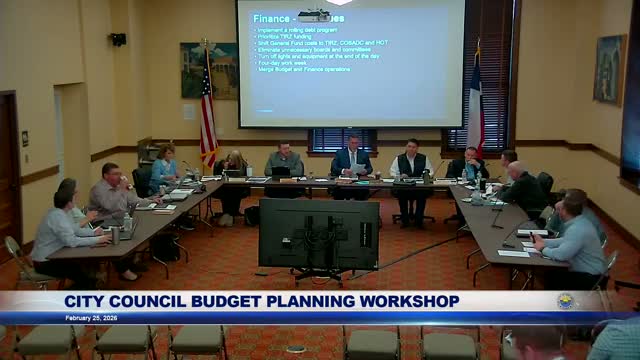
Patrick (Operations Director) told council the city's street preservation program is underfunded and proposed a comprehensive street-use fee: a small monthly charge, assessed by property type and traffic generation, that would create a dedicated enterprise fund for street and traffic operations, equipment replacement and PAYGO rehabilitation projects. Patrick said the fee could generate several million dollars a year and free up $8–9 million in general-fund obligations now used for street preservation.
"Basically what a street-use fee is, is it's a fee assessed to all properties...based on the type of structure they are, the type of use...a monthly fee assessed to that particular property," Patrick said, describing a structure with 47 categories and adjustable annual increases to keep pace with costs. He emphasized the need for legal vetting and clear public communication because the charge would apply broadly, potentially including nonprofits and churches unless exemptions were adopted.
Patrick also proposed creating an Environmental Division of roughly 15 staff to perform mission-critical cross-cutting tasks now done ad hoc by operations and other departments: dangerous-building demolitions, homeless camp cleanup, code abatement, illegal dumping response, stormwater and mosquito control, and support for fire-marshal actions. He estimated the division would require about $1.8 million annually but argued that consolidating these services would increase efficiency and free other departments to focus on core services.
Several council members supported further study and asked staff to provide rate models, exemption scenarios (seniors, churches, nonprofits) and phased options so the council can consider both revenue yield and distributional impacts. No vote was taken; staff will return with refined financial modeling.
"Basically what a street-use fee is, is it's a fee assessed to all properties...based on the type of structure they are, the type of use...a monthly fee assessed to that particular property," Patrick said, describing a structure with 47 categories and adjustable annual increases to keep pace with costs. He emphasized the need for legal vetting and clear public communication because the charge would apply broadly, potentially including nonprofits and churches unless exemptions were adopted.
Patrick also proposed creating an Environmental Division of roughly 15 staff to perform mission-critical cross-cutting tasks now done ad hoc by operations and other departments: dangerous-building demolitions, homeless camp cleanup, code abatement, illegal dumping response, stormwater and mosquito control, and support for fire-marshal actions. He estimated the division would require about $1.8 million annually but argued that consolidating these services would increase efficiency and free other departments to focus on core services.
Several council members supported further study and asked staff to provide rate models, exemption scenarios (seniors, churches, nonprofits) and phased options so the council can consider both revenue yield and distributional impacts. No vote was taken; staff will return with refined financial modeling.
View the Full Meeting & All Its Details
This article offers just a summary. Unlock complete video, transcripts, and insights as a Founder Member.
✓
Watch full, unedited meeting videos
✓
Search every word spoken in unlimited transcripts
✓
AI summaries & real-time alerts (all government levels)
✓
Permanent access to expanding government content
30-day money-back guarantee
