Tribal leaders and IHS kick off PERCDA expansion study, flag data, funding and access concerns
October 12, 2025 | Indian Health Service, Department of Health and Human Services (HHS), Executive, Federal
This article was created by AI summarizing key points discussed. AI makes mistakes, so for full details and context, please refer to the video of the full meeting. Please report any errors so we can fix them. Report an error »
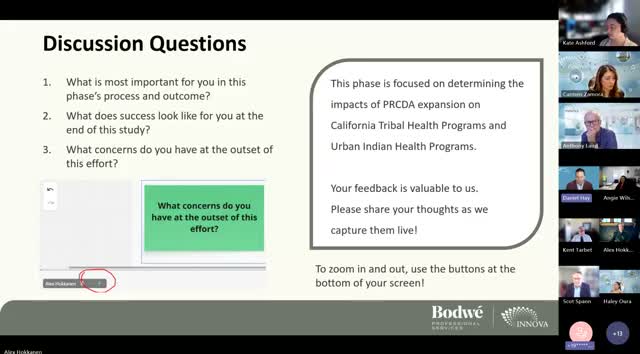
A diverse group of Indian Health Service officials, tribal and urban Indian health leaders and contractors met to launch the PERCDA (Purchase Referred Care Delivery Area) expansion study and to identify priorities and risks for the project.
Project leads from Bowdoin Professional Services and the Inova Group described a three-part study: (1) a detailed PRC analysis to quantify population counts, unmet needs and medical priority levels; (2) a cost-implication analysis; and (3) geographic and eligibility mapping, including county-level projections for areas not currently in California's PERCDA. The team said the phase will be data-driven, roughly a year long and that they aim to receive initial data by early November.
Tribal and urban leaders raised three overarching concerns. Angie Wilson, a Pit River tribal member who serves on the Pit River Health Authority board, said tribes need clear framing to avoid alarm. "I think there's a concern that tribes will be worried, like, 'oh my gosh. What does this study do to us?'", she said, noting fears that expanding PERCDA could be interpreted as redistributing already limited PRC dollars.
Several participants described serious data problems at IHS and in federal reporting systems. Virginia Hedrick, executive director of the California Consortium for Urban Indian Health, said the data rules used by the Indian Health Service assign patients by residence rather than by where care is actually provided, which she called a major source of inaccurate workload and user-population reports: "IHS already has what I would consider a very flawed data rules book on how they assign patients," Hedrick said. Participants said those reporting errors make it hard for urban programs and tribes to document actual service volumes and to plan for funding needs.
Dr. Mark Clabo, who works with the California Rural Indian Health Board, emphasized California's long history of PRC underfunding and noted that other states (Arizona, North Dakota and South Dakota) are farther along with feasibility studies. He said a judicial ruling has "verified inequitable funding" for California but did not name the case during the meeting; he asked whether methodologies used in other states should inform California's study.
Speakers from urban programs described geographic access challenges. Angel Galvez, CEO of the Bakersfield American Indian Health Project, said some communities face multi-hour drives or seasonal road closures that make alternative clinics impractical, and that Bakersfield American Indian Health often functions as the only accessible urban clinic in Kern County.
Project staff and consultants outlined next steps: they will distribute a draft data-request checklist to work group members for feedback, Christine Brennan (IHS associate director of public health and area statistical officer) will be the point of contact for returning data, and the team said it will consult with participants on refining the request. Christine also said she would reach out to IHS headquarters to obtain copies of feasibility studies referenced by participants once they are available.
Participants urged the study team to prioritize accurate, verifiable data, transparency about funding assumptions (including whether expansion would be unfunded at the IHS level), and careful communication with tribes and urban programs so stakeholders understand implications for services and budgets. The meeting concluded with a commitment to share meeting notes, the recording and the data questions for review.
Project leads from Bowdoin Professional Services and the Inova Group described a three-part study: (1) a detailed PRC analysis to quantify population counts, unmet needs and medical priority levels; (2) a cost-implication analysis; and (3) geographic and eligibility mapping, including county-level projections for areas not currently in California's PERCDA. The team said the phase will be data-driven, roughly a year long and that they aim to receive initial data by early November.
Tribal and urban leaders raised three overarching concerns. Angie Wilson, a Pit River tribal member who serves on the Pit River Health Authority board, said tribes need clear framing to avoid alarm. "I think there's a concern that tribes will be worried, like, 'oh my gosh. What does this study do to us?'", she said, noting fears that expanding PERCDA could be interpreted as redistributing already limited PRC dollars.
Several participants described serious data problems at IHS and in federal reporting systems. Virginia Hedrick, executive director of the California Consortium for Urban Indian Health, said the data rules used by the Indian Health Service assign patients by residence rather than by where care is actually provided, which she called a major source of inaccurate workload and user-population reports: "IHS already has what I would consider a very flawed data rules book on how they assign patients," Hedrick said. Participants said those reporting errors make it hard for urban programs and tribes to document actual service volumes and to plan for funding needs.
Dr. Mark Clabo, who works with the California Rural Indian Health Board, emphasized California's long history of PRC underfunding and noted that other states (Arizona, North Dakota and South Dakota) are farther along with feasibility studies. He said a judicial ruling has "verified inequitable funding" for California but did not name the case during the meeting; he asked whether methodologies used in other states should inform California's study.
Speakers from urban programs described geographic access challenges. Angel Galvez, CEO of the Bakersfield American Indian Health Project, said some communities face multi-hour drives or seasonal road closures that make alternative clinics impractical, and that Bakersfield American Indian Health often functions as the only accessible urban clinic in Kern County.
Project staff and consultants outlined next steps: they will distribute a draft data-request checklist to work group members for feedback, Christine Brennan (IHS associate director of public health and area statistical officer) will be the point of contact for returning data, and the team said it will consult with participants on refining the request. Christine also said she would reach out to IHS headquarters to obtain copies of feasibility studies referenced by participants once they are available.
Participants urged the study team to prioritize accurate, verifiable data, transparency about funding assumptions (including whether expansion would be unfunded at the IHS level), and careful communication with tribes and urban programs so stakeholders understand implications for services and budgets. The meeting concluded with a commitment to share meeting notes, the recording and the data questions for review.
View the Full Meeting & All Its Details
This article offers just a summary. Unlock complete video, transcripts, and insights as a Founder Member.
✓
Watch full, unedited meeting videos
✓
Search every word spoken in unlimited transcripts
✓
AI summaries & real-time alerts (all government levels)
✓
Permanent access to expanding government content
30-day money-back guarantee
