Committee advances constitutional amendment limiting eminent domain after prolonged debate
February 25, 2026 | 2026 Legislature SD, South Dakota
This article was created by AI summarizing key points discussed. AI makes mistakes, so for full details and context, please refer to the video of the full meeting. Please report any errors so we can fix them. Report an error »
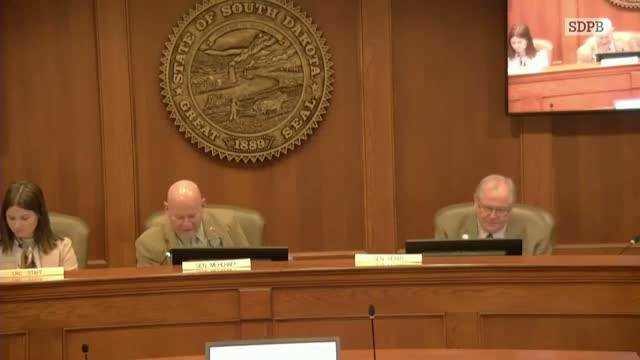
Lawmakers in a lengthy session voted to forward an amended constitutional resolution that would narrow the definition of "public use" and require a public declaration of necessity before a taking under eminent domain.
Sponsor Mark Lopke and other proponents framed HJR 5001/E as a voter-driven safeguard responding to the U.S. Supreme Court’s Kelo v. City of New London decision and recent high-profile private-condemnation disputes in South Dakota. "This resolution draws a clear constitutional line in the sand," Representative Liz May said, urging that voters decide whether to protect private-property rights against takings for private economic gain.
Supporters — including farmers who faced condemnation litigation, property-rights groups and the Pacific Legal Foundation — said the amendment mirrors language adopted in other states and would preserve utility and public-works takings while blocking condemnations for private development and economic growth calculations.
Opponents — including pipelines, investor-owned utilities, rural electric cooperatives, energy associations, chambers of commerce and several trade groups — warned the amendment uses vague phrases such as "general economic health" and could create legal uncertainty that raises litigation and service-delivery risks for electricity, pipelines and other infrastructure. The Midwest American Petroleum Institute and utility representatives said eminent domain is rarely used but often necessary to route infrastructure that serves broad public needs.
Sponsors argued the amendment’s wording was carefully drafted and modeled on other states (for example North Dakota) and that placing the language in the constitution gives voters the final say and long-term protection. Opponents countered that constitutional language cannot be easily tuned and could spur litigation about ambiguous terms.
After extended questioning and rebuttal, the committee voted to send the amendment to the floor with a due-pass recommendation. The matter will now be decided by voters only if the legislature adopts and places the measure on the ballot following the normal constitutional amendment process.
What happens next: HJR 5001/E advances to the full chamber for floor consideration; if approved there, the measure would be placed before voters as a constitutional amendment.
Sponsor Mark Lopke and other proponents framed HJR 5001/E as a voter-driven safeguard responding to the U.S. Supreme Court’s Kelo v. City of New London decision and recent high-profile private-condemnation disputes in South Dakota. "This resolution draws a clear constitutional line in the sand," Representative Liz May said, urging that voters decide whether to protect private-property rights against takings for private economic gain.
Supporters — including farmers who faced condemnation litigation, property-rights groups and the Pacific Legal Foundation — said the amendment mirrors language adopted in other states and would preserve utility and public-works takings while blocking condemnations for private development and economic growth calculations.
Opponents — including pipelines, investor-owned utilities, rural electric cooperatives, energy associations, chambers of commerce and several trade groups — warned the amendment uses vague phrases such as "general economic health" and could create legal uncertainty that raises litigation and service-delivery risks for electricity, pipelines and other infrastructure. The Midwest American Petroleum Institute and utility representatives said eminent domain is rarely used but often necessary to route infrastructure that serves broad public needs.
Sponsors argued the amendment’s wording was carefully drafted and modeled on other states (for example North Dakota) and that placing the language in the constitution gives voters the final say and long-term protection. Opponents countered that constitutional language cannot be easily tuned and could spur litigation about ambiguous terms.
After extended questioning and rebuttal, the committee voted to send the amendment to the floor with a due-pass recommendation. The matter will now be decided by voters only if the legislature adopts and places the measure on the ballot following the normal constitutional amendment process.
What happens next: HJR 5001/E advances to the full chamber for floor consideration; if approved there, the measure would be placed before voters as a constitutional amendment.
View the Full Meeting & All Its Details
This article offers just a summary. Unlock complete video, transcripts, and insights as a Founder Member.
✓
Watch full, unedited meeting videos
✓
Search every word spoken in unlimited transcripts
✓
AI summaries & real-time alerts (all government levels)
✓
Permanent access to expanding government content
30-day money-back guarantee
