Committee backs funding to scale biocontrol response for Queensland Longhorn Beetle
February 25, 2026 | House Committee on Agriculture & Food Systems, House of Representatives, Legislative , Hawaii
This article was created by AI summarizing key points discussed. AI makes mistakes, so for full details and context, please refer to the video of the full meeting. Please report any errors so we can fix them. Report an error »
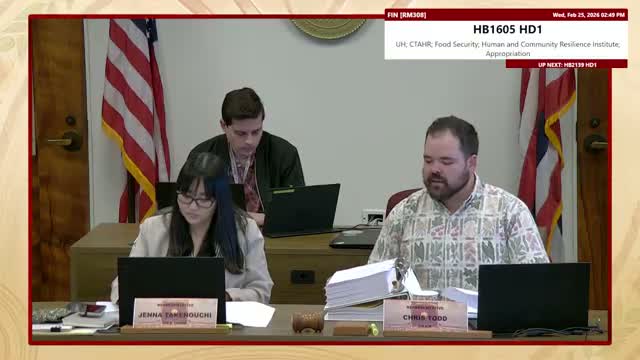
The House Committee on Finance voted Feb. 25 to advance HB2139, HD1, a measure designed to expand the state's capacity to research and scale nematode biocontrol and other treatments to contain the Queensland Longhorn Beetle (QLB).
Stephanie Easley of the Coordinating Group on Alien Pest Species described the beetle as having more than 20 known host species, including agriculturally and culturally important trees, and urged proactive treatment to prevent spread to other islands (SEG 902-910). Researchers and farmers told the committee that early investment in nematode biocontrol has delivered measurable results at pilot sites.
Lila Shapiro, testifying for an ag research group, recounted field observations and said the bill would support ongoing outreach, community involvement and research to scale effective tools (SEG 918-930). Farmer Carrie Yost described repeated reinfestations and urged steady funding rather than intermittent support, noting firewood and stacked cut wood can spread the pest between areas (SEG 975-1001).
University researchers and extension staff recommended funding for scale-up and outreach. Emma Steerhoff of the University of Hawaii said QLB is still geographically limited to the east side of Hawaii Island, creating an important window for prevention and that upfront investment is far cheaper than later remediation (SEG 1041-1060).
The chair described the bill as critical and the committee's recommendation to pass HB2139 as drafted was adopted. Committee members and witnesses emphasized the need for reliable multi-year funding, clearer benchmarks for deployment and coordination with farmers and community groups.
The bill will proceed with committee recommendations and with notes in the report to address long-term funding and program benchmarks.
Stephanie Easley of the Coordinating Group on Alien Pest Species described the beetle as having more than 20 known host species, including agriculturally and culturally important trees, and urged proactive treatment to prevent spread to other islands (SEG 902-910). Researchers and farmers told the committee that early investment in nematode biocontrol has delivered measurable results at pilot sites.
Lila Shapiro, testifying for an ag research group, recounted field observations and said the bill would support ongoing outreach, community involvement and research to scale effective tools (SEG 918-930). Farmer Carrie Yost described repeated reinfestations and urged steady funding rather than intermittent support, noting firewood and stacked cut wood can spread the pest between areas (SEG 975-1001).
University researchers and extension staff recommended funding for scale-up and outreach. Emma Steerhoff of the University of Hawaii said QLB is still geographically limited to the east side of Hawaii Island, creating an important window for prevention and that upfront investment is far cheaper than later remediation (SEG 1041-1060).
The chair described the bill as critical and the committee's recommendation to pass HB2139 as drafted was adopted. Committee members and witnesses emphasized the need for reliable multi-year funding, clearer benchmarks for deployment and coordination with farmers and community groups.
The bill will proceed with committee recommendations and with notes in the report to address long-term funding and program benchmarks.
Don't Miss a Word: See the Full Meeting!
Go beyond summaries. Unlock every video, transcript, and key insight with a Founder Membership.
✓
Get instant access to full meeting videos
✓
Search and clip any phrase from complete transcripts
✓
Receive AI-powered summaries & custom alerts
✓
Enjoy lifetime, unrestricted access to government data
30-day money-back guarantee
