Senate committee advances draft housing bill 1.1 while flagging funding, treasury pilot and HOA impacts
February 25, 2026 | Economic Development, Housing & General Affairs, SENATE, Committees, Legislative , Vermont
This article was created by AI summarizing key points discussed. AI makes mistakes, so for full details and context, please refer to the video of the full meeting. Please report any errors so we can fix them. Report an error »
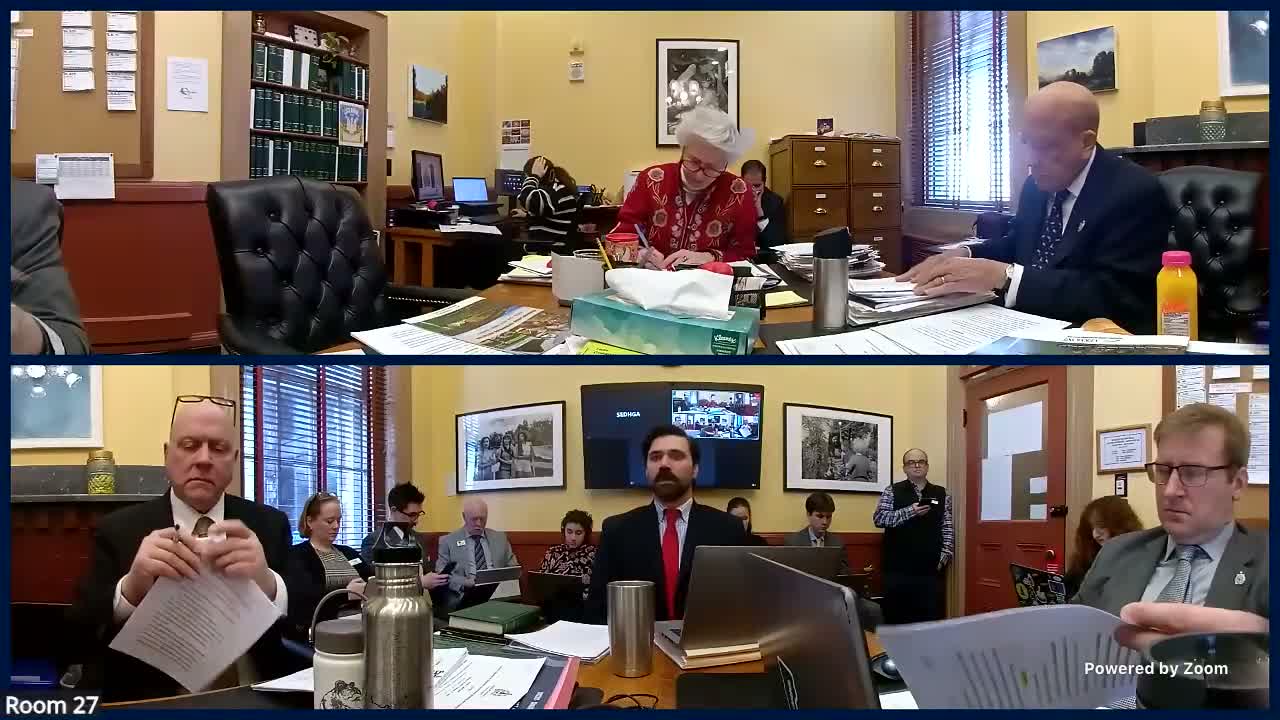
The Senate Economic Development, Housing & General Affairs Committee on Feb. 24 reviewed draft 1.1 of a comprehensive housing bill that would add new municipal-plan duties, extend down-payment tax credits and authorize treasurer-run credit facilities and a housing special fund.
Cameron Wood of the Office of Legislative Counsel told the committee that Section 1 would add to Title 24 a requirement that “municipal plan shall include an analysis of regulatory and physical constraints preventing the municipality from developing sufficient housing to meet the regional housing targets developed pursuant to” the statewide housing-needs assessment. He said the requirement would apply when a municipality updates its plan and suggested cleanup language tying the duty more clearly to the housing element.
Committee members voiced concern about small towns’ capacity to comply and asked staff to consult the Vermont League of Cities and Towns (VLCT) and regional planning commissions (RPCs). The chair said those technical supports and a conversation with administration staff would be sought before finalizing the text.
On financing, the committee discussed the down-payment assistance tax credit in Section 2. The current draft extends the credit five years at $250,000 per year; members said there was an administration request to increase annual authority by $100,000. The chair summarized the program’s impact, noting the program supports first-time buyers and preserves a benefit “up to $10,000.” The committee asked fiscal staff to show which requests would be within the baseline budget and which would be additional asks.
Members then reviewed new language that would expand the treasurer’s credit authority from a 10% cap to 12.5% of the state’s average cash balance and authorize a separate, purpose-limited credit facility of up to 1% specifically for bulk purchasing or purchasing off-site constructed housing. Wood explained the idea would also create a Vermont Housing Special Fund to hold interest earnings from those loans and provide capital for housing projects. He said: “the treasurer may use the funds for…bulk purchasing of off-site constructed housing.”
Several senators raised risk concerns about subsidized lending and whether the state should hold preconstructed units that might be hard to site or sell. One member put the concern succinctly: issuing loans for this purpose does not guarantee timely repayment. Others supported a modest pilot if the treasurer returns with underwriting standards and mitigation plans. The committee asked staff to invite treasurer or administration witnesses (Alex Farrell and others were referenced) and Peter Tremblay back to explain the operational details of any pilot.
A substantial portion of the discussion focused on changes to common-interest community law in Section 6 and 7. The draft would render certain HOA or declaration provisions void to the extent they “effectively prohibit or unreasonably restrict” leasing of units, with an added exemption intended to preserve housing-subsidy covenants that were properly recorded and authorized. Wood read from a VHFA memo summarized in committee materials, warning that if some covenants are voided, “the affected mortgages could become ineligible for purchase on the secondary market,” which could raise borrowing costs or reduce lender availability. Wood and lenders recommended retaining narrow exemptions and asked VHFA, credit unions and mortgage-banking representatives to testify; the Champlain Housing Trust urged preserving tools that allow it to make mortgages to low- and moderate-income buyers.
The committee also considered a new provision aimed at accessory dwelling units (ADUs): prohibiting deed or HOA restrictions in planned communities that stop a unit owner from building an ADU for the exclusive use of the owner on lots meeting a minimum size threshold (committee discussion centered on whether that threshold should be one-quarter acre or smaller, and on how to define “exclusive use” in planned-community contexts). A resident proponent, Megan Sullivan of Jericho, spoke in favor of including ADUs to expand housing options for detached single-family settings.
Members asked for additional legal and lender input about three things before final action: (1) the interaction between the condo/HOA changes and recorded housing-subsidy covenants; (2) whether lender underwriting or secondary-market rules (Fannie Mae/Freddie Mac) would be jeopardized; and (3) how ADU and family-childcare exemptions would interact with mortgage program affidavits limiting in-home business use. The chair directed staff to assemble testimony from VLCT, RPCs, VHFA, mortgage bankers, and the HOA attorney (Christina Jensen was named as an attorney to invite).
No formal motions or votes on the bill occurred during the session; members generally signaled support for keeping the sections if the technical concerns are resolved. The committee scheduled additional testimony and anticipated reconvening with the requested experts before committing to final language.
Next steps: staff will coordinate expert testimony on secondary-market impacts, HOA-law implications and pilot risk mitigation; the treasurer and administration staff will be asked to return with operational details on any credit facility pilot; and fiscal staff will detail which spending is within baseline appropriations and which would be an above‑budget ask.
Cameron Wood of the Office of Legislative Counsel told the committee that Section 1 would add to Title 24 a requirement that “municipal plan shall include an analysis of regulatory and physical constraints preventing the municipality from developing sufficient housing to meet the regional housing targets developed pursuant to” the statewide housing-needs assessment. He said the requirement would apply when a municipality updates its plan and suggested cleanup language tying the duty more clearly to the housing element.
Committee members voiced concern about small towns’ capacity to comply and asked staff to consult the Vermont League of Cities and Towns (VLCT) and regional planning commissions (RPCs). The chair said those technical supports and a conversation with administration staff would be sought before finalizing the text.
On financing, the committee discussed the down-payment assistance tax credit in Section 2. The current draft extends the credit five years at $250,000 per year; members said there was an administration request to increase annual authority by $100,000. The chair summarized the program’s impact, noting the program supports first-time buyers and preserves a benefit “up to $10,000.” The committee asked fiscal staff to show which requests would be within the baseline budget and which would be additional asks.
Members then reviewed new language that would expand the treasurer’s credit authority from a 10% cap to 12.5% of the state’s average cash balance and authorize a separate, purpose-limited credit facility of up to 1% specifically for bulk purchasing or purchasing off-site constructed housing. Wood explained the idea would also create a Vermont Housing Special Fund to hold interest earnings from those loans and provide capital for housing projects. He said: “the treasurer may use the funds for…bulk purchasing of off-site constructed housing.”
Several senators raised risk concerns about subsidized lending and whether the state should hold preconstructed units that might be hard to site or sell. One member put the concern succinctly: issuing loans for this purpose does not guarantee timely repayment. Others supported a modest pilot if the treasurer returns with underwriting standards and mitigation plans. The committee asked staff to invite treasurer or administration witnesses (Alex Farrell and others were referenced) and Peter Tremblay back to explain the operational details of any pilot.
A substantial portion of the discussion focused on changes to common-interest community law in Section 6 and 7. The draft would render certain HOA or declaration provisions void to the extent they “effectively prohibit or unreasonably restrict” leasing of units, with an added exemption intended to preserve housing-subsidy covenants that were properly recorded and authorized. Wood read from a VHFA memo summarized in committee materials, warning that if some covenants are voided, “the affected mortgages could become ineligible for purchase on the secondary market,” which could raise borrowing costs or reduce lender availability. Wood and lenders recommended retaining narrow exemptions and asked VHFA, credit unions and mortgage-banking representatives to testify; the Champlain Housing Trust urged preserving tools that allow it to make mortgages to low- and moderate-income buyers.
The committee also considered a new provision aimed at accessory dwelling units (ADUs): prohibiting deed or HOA restrictions in planned communities that stop a unit owner from building an ADU for the exclusive use of the owner on lots meeting a minimum size threshold (committee discussion centered on whether that threshold should be one-quarter acre or smaller, and on how to define “exclusive use” in planned-community contexts). A resident proponent, Megan Sullivan of Jericho, spoke in favor of including ADUs to expand housing options for detached single-family settings.
Members asked for additional legal and lender input about three things before final action: (1) the interaction between the condo/HOA changes and recorded housing-subsidy covenants; (2) whether lender underwriting or secondary-market rules (Fannie Mae/Freddie Mac) would be jeopardized; and (3) how ADU and family-childcare exemptions would interact with mortgage program affidavits limiting in-home business use. The chair directed staff to assemble testimony from VLCT, RPCs, VHFA, mortgage bankers, and the HOA attorney (Christina Jensen was named as an attorney to invite).
No formal motions or votes on the bill occurred during the session; members generally signaled support for keeping the sections if the technical concerns are resolved. The committee scheduled additional testimony and anticipated reconvening with the requested experts before committing to final language.
Next steps: staff will coordinate expert testimony on secondary-market impacts, HOA-law implications and pilot risk mitigation; the treasurer and administration staff will be asked to return with operational details on any credit facility pilot; and fiscal staff will detail which spending is within baseline appropriations and which would be an above‑budget ask.
View the Full Meeting & All Its Details
This article offers just a summary. Unlock complete video, transcripts, and insights as a Founder Member.
✓
Watch full, unedited meeting videos
✓
Search every word spoken in unlimited transcripts
✓
AI summaries & real-time alerts (all government levels)
✓
Permanent access to expanding government content
30-day money-back guarantee
