TCOLE posts multiple rule proposals to implement HB33 (Uvalde Strong Act) and SB1818; PIO certificate and school-safety equipment among items
February 21, 2026 | Texas Commission on Law Enforcement, Boards & Commissions, Executive, Texas
This article was created by AI summarizing key points discussed. AI makes mistakes, so for full details and context, please refer to the video of the full meeting. Please report any errors so we can fix them. Report an error »
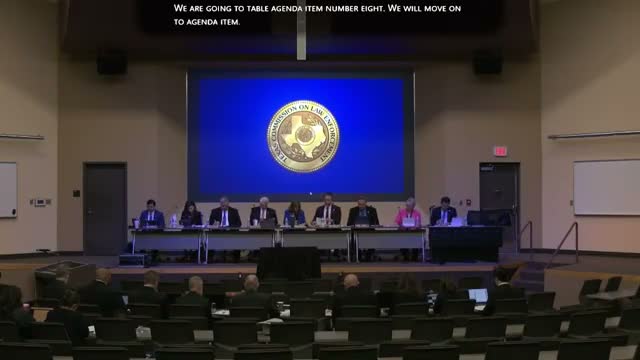
The Texas Commission on Law Enforcement voted to post for public comment a suite of proposed rule changes designed to implement statutory changes from the last legislative session.
Assistant General Counsel Aaron Heath and staff walked commissioners through the first-reading items. The proposals include an amendment to Rule 211.1 to add a PIO (public information officer) definition consistent with House Bill 33 (the Uvalde Strong Act) and an administrative-duty pay-status definition; a proposed amendment to Rule 217.1 to allow 180-day provisional licensing for military members or their spouses with valid out-of-state occupational licenses (Senate Bill 1818); and the creation of a new PIO proficiency certificate rule (221.48) and a PIO continuing-education requirement. The commission approved posting these proposals to the Texas Register for public comment.
Staff explained that certain agencies (a municipal police department, a sheriff's office, a county constable's office, a school-district police department and the Texas Department of Public Safety) would be required to have an assigned PIO, and that the assigned PIO would have one year to obtain the certificate after assignment. The proposed amendment to rule 211.16 (previewed for April) would also reflect HB33 provisions requiring active-shooter policies and require at least one breaching tool and one ballistic shield to be available at each campus of a school-district or open-enrollment charter school.
Deputy Chief Colin Grissom and Aaron Heath also presented new and amended proficiency rules including a proposed mental-health telecommunicator proficiency certificate (rule 221.12) recommended by the Meadows Mental Health Policy Institute, and an amendment clarifying instructor requalification requirements for standardized field-sobriety-testing instructors (rule 221.33). Commissioners moved and passed staff motions to post the items for public comment.
Commissioners asked staff about implementation details and definitions — for example, how 'military veteran' will be interpreted for provisional licensing — and staff said they will seek clarification and provide more detailed language as the rules proceed through the Texas Register and public-comment period.
The first readings and motions mark the start of the rulemaking process; staff said several items will return in April for additional review and to be formally proposed in the Texas Register.
Assistant General Counsel Aaron Heath and staff walked commissioners through the first-reading items. The proposals include an amendment to Rule 211.1 to add a PIO (public information officer) definition consistent with House Bill 33 (the Uvalde Strong Act) and an administrative-duty pay-status definition; a proposed amendment to Rule 217.1 to allow 180-day provisional licensing for military members or their spouses with valid out-of-state occupational licenses (Senate Bill 1818); and the creation of a new PIO proficiency certificate rule (221.48) and a PIO continuing-education requirement. The commission approved posting these proposals to the Texas Register for public comment.
Staff explained that certain agencies (a municipal police department, a sheriff's office, a county constable's office, a school-district police department and the Texas Department of Public Safety) would be required to have an assigned PIO, and that the assigned PIO would have one year to obtain the certificate after assignment. The proposed amendment to rule 211.16 (previewed for April) would also reflect HB33 provisions requiring active-shooter policies and require at least one breaching tool and one ballistic shield to be available at each campus of a school-district or open-enrollment charter school.
Deputy Chief Colin Grissom and Aaron Heath also presented new and amended proficiency rules including a proposed mental-health telecommunicator proficiency certificate (rule 221.12) recommended by the Meadows Mental Health Policy Institute, and an amendment clarifying instructor requalification requirements for standardized field-sobriety-testing instructors (rule 221.33). Commissioners moved and passed staff motions to post the items for public comment.
Commissioners asked staff about implementation details and definitions — for example, how 'military veteran' will be interpreted for provisional licensing — and staff said they will seek clarification and provide more detailed language as the rules proceed through the Texas Register and public-comment period.
The first readings and motions mark the start of the rulemaking process; staff said several items will return in April for additional review and to be formally proposed in the Texas Register.
Don't Miss a Word: See the Full Meeting!
Go beyond summaries. Unlock every video, transcript, and key insight with a Founder Membership.
✓
Get instant access to full meeting videos
✓
Search and clip any phrase from complete transcripts
✓
Receive AI-powered summaries & custom alerts
✓
Enjoy lifetime, unrestricted access to government data
30-day money-back guarantee
