Mexican Teachers Cohort links added sugars to higher premenopausal breast cancer risk, researchers report
September 06, 2024 | National Cancer Institute (NCI), National Institutes of Health (NIH), Department of Health and Human Services (HHS), Executive, Federal
This article was created by AI summarizing key points discussed. AI makes mistakes, so for full details and context, please refer to the video of the full meeting. Please report any errors so we can fix them. Report an error »
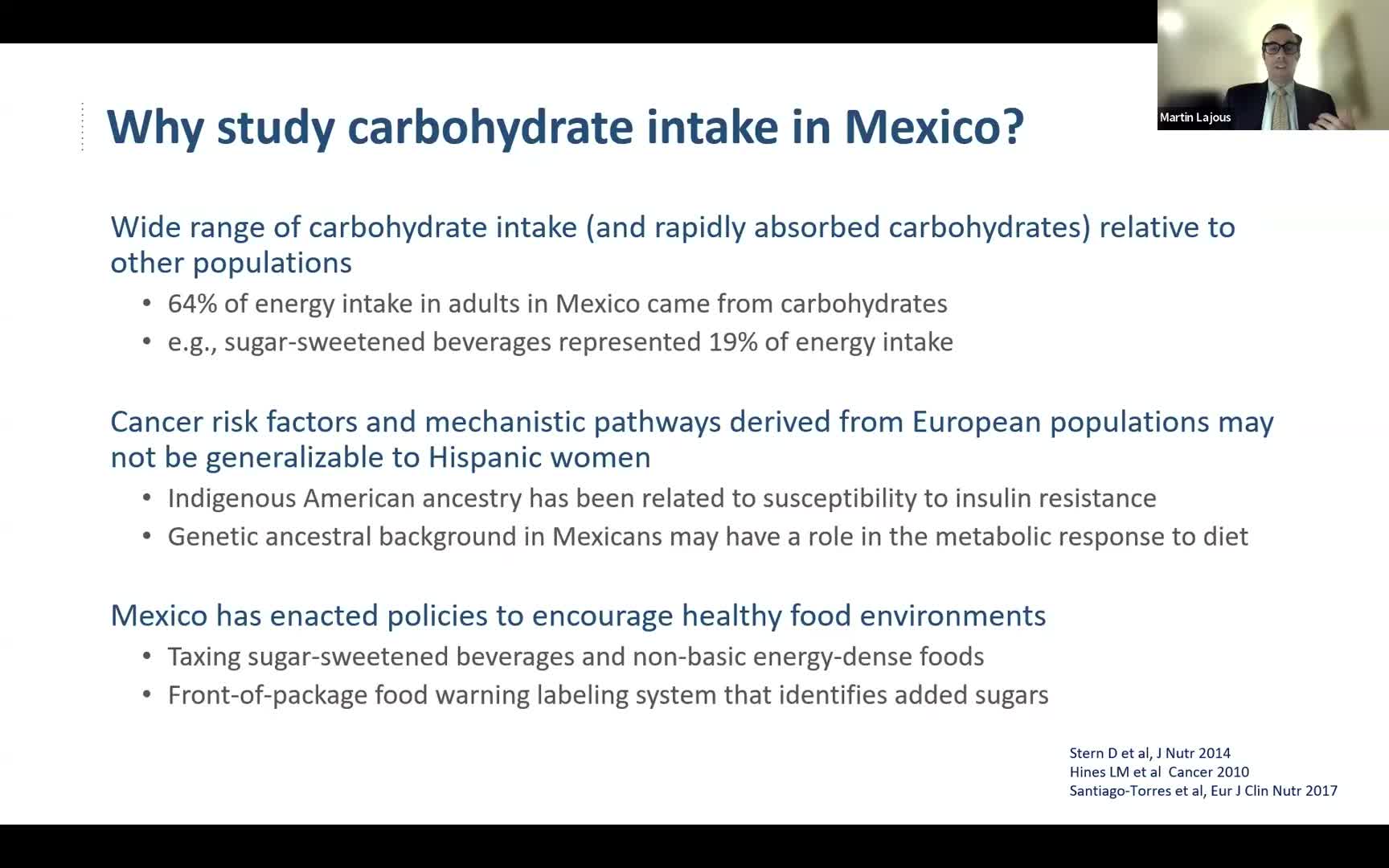
Dr. Martin Leju, a faculty researcher at the National Institute of Public Health in Mexico, told an NCI Center for Global Health seminar that analyses of the Mexican Teachers Cohort show an association between added-sugar intake and breast cancer, particularly in premenopausal women.
The Mexican Teachers Cohort enrolled roughly 115,000 women in 2006–2008 and combines questionnaire data with a clinical subcohort and a biospecimen repository of about 7,000 participants. Using multiple data sources—mortality registries, self-report and linked electronic health records—investigators validated an ascertainment algorithm and confirmed about 1,300 breast cancer cases from 2006 through 2019, though Leju said the team likely still underestimates cases that have not yet been validated.
"We found an association between added sugars and particularly premenopausal breast cancer," Leju said, describing analyses that focused on glycemic load/index and, for public messaging, on added sugars. He noted the cohort’s relatively wide distribution of carbohydrate intake ("64% of energy intake in adults comes from carbohydrates," he said) makes the population useful for studying dietary effects that are harder to detect elsewhere.
Leju framed the decision to prioritize added sugars as practical: unlike glycemic index or load, added-sugars thresholds are easier to translate into public guidance and align with Mexico’s existing policy environment—taxes on sugar-sweetened beverages and front-of-package warnings.
The presenter contrasted results with other cohorts: the Women’s Health Initiative reported no association for added sugars, while the French NutriNet-Santé cohort found an association. He said more prospective research is needed, especially to assess dose-response at low intake levels and to extend analyses to ovarian, colorectal and endometrial cancers.
Leju also emphasized limitations. The cohort’s follow-up schedule has been irregular because of funding limits, and investigators are actively validating additional case reports. "We probably are underestimating, or have missed some cases," he said, adding that the cohort’s linkage to social security medical records (estimated ~96% coverage for EHR data) improves case finding but does not eliminate gaps.
Next steps include further validation work, targeted prospective analyses of added sugars and breast cancer subgroups (especially premenopausal women), and broader dissemination to participant communities. Leju said the team currently disseminates findings mainly to clinicians, policymakers and cohort participants (monthly videoconferences for teacher participants) and is working to expand outreach to the public and to agricultural stakeholders.
The presentation and Q&A underlined both the cohort’s research potential and remaining uncertainties: investigators reported a reproducible association in this population but warned against overinterpretation until additional prospective and replication studies clarify dose-response and causal pathways.
The seminar recording and slides are available on the NCI Center for Global Health website; investigators said they welcome queries and collaboration via contact points provided during the session.
The Mexican Teachers Cohort enrolled roughly 115,000 women in 2006–2008 and combines questionnaire data with a clinical subcohort and a biospecimen repository of about 7,000 participants. Using multiple data sources—mortality registries, self-report and linked electronic health records—investigators validated an ascertainment algorithm and confirmed about 1,300 breast cancer cases from 2006 through 2019, though Leju said the team likely still underestimates cases that have not yet been validated.
"We found an association between added sugars and particularly premenopausal breast cancer," Leju said, describing analyses that focused on glycemic load/index and, for public messaging, on added sugars. He noted the cohort’s relatively wide distribution of carbohydrate intake ("64% of energy intake in adults comes from carbohydrates," he said) makes the population useful for studying dietary effects that are harder to detect elsewhere.
Leju framed the decision to prioritize added sugars as practical: unlike glycemic index or load, added-sugars thresholds are easier to translate into public guidance and align with Mexico’s existing policy environment—taxes on sugar-sweetened beverages and front-of-package warnings.
The presenter contrasted results with other cohorts: the Women’s Health Initiative reported no association for added sugars, while the French NutriNet-Santé cohort found an association. He said more prospective research is needed, especially to assess dose-response at low intake levels and to extend analyses to ovarian, colorectal and endometrial cancers.
Leju also emphasized limitations. The cohort’s follow-up schedule has been irregular because of funding limits, and investigators are actively validating additional case reports. "We probably are underestimating, or have missed some cases," he said, adding that the cohort’s linkage to social security medical records (estimated ~96% coverage for EHR data) improves case finding but does not eliminate gaps.
Next steps include further validation work, targeted prospective analyses of added sugars and breast cancer subgroups (especially premenopausal women), and broader dissemination to participant communities. Leju said the team currently disseminates findings mainly to clinicians, policymakers and cohort participants (monthly videoconferences for teacher participants) and is working to expand outreach to the public and to agricultural stakeholders.
The presentation and Q&A underlined both the cohort’s research potential and remaining uncertainties: investigators reported a reproducible association in this population but warned against overinterpretation until additional prospective and replication studies clarify dose-response and causal pathways.
The seminar recording and slides are available on the NCI Center for Global Health website; investigators said they welcome queries and collaboration via contact points provided during the session.
Don't Miss a Word: See the Full Meeting!
Go beyond summaries. Unlock every video, transcript, and key insight with a Founder Membership.
✓
Get instant access to full meeting videos
✓
Search and clip any phrase from complete transcripts
✓
Receive AI-powered summaries & custom alerts
✓
Enjoy lifetime, unrestricted access to government data
30-day money-back guarantee
