Pilot testing finds widespread aflatoxin detection in parts of Mexico; homemade maize tortillas implicated
September 06, 2024 | National Cancer Institute (NCI), National Institutes of Health (NIH), Department of Health and Human Services (HHS), Executive, Federal
This article was created by AI summarizing key points discussed. AI makes mistakes, so for full details and context, please refer to the video of the full meeting. Please report any errors so we can fix them. Report an error »
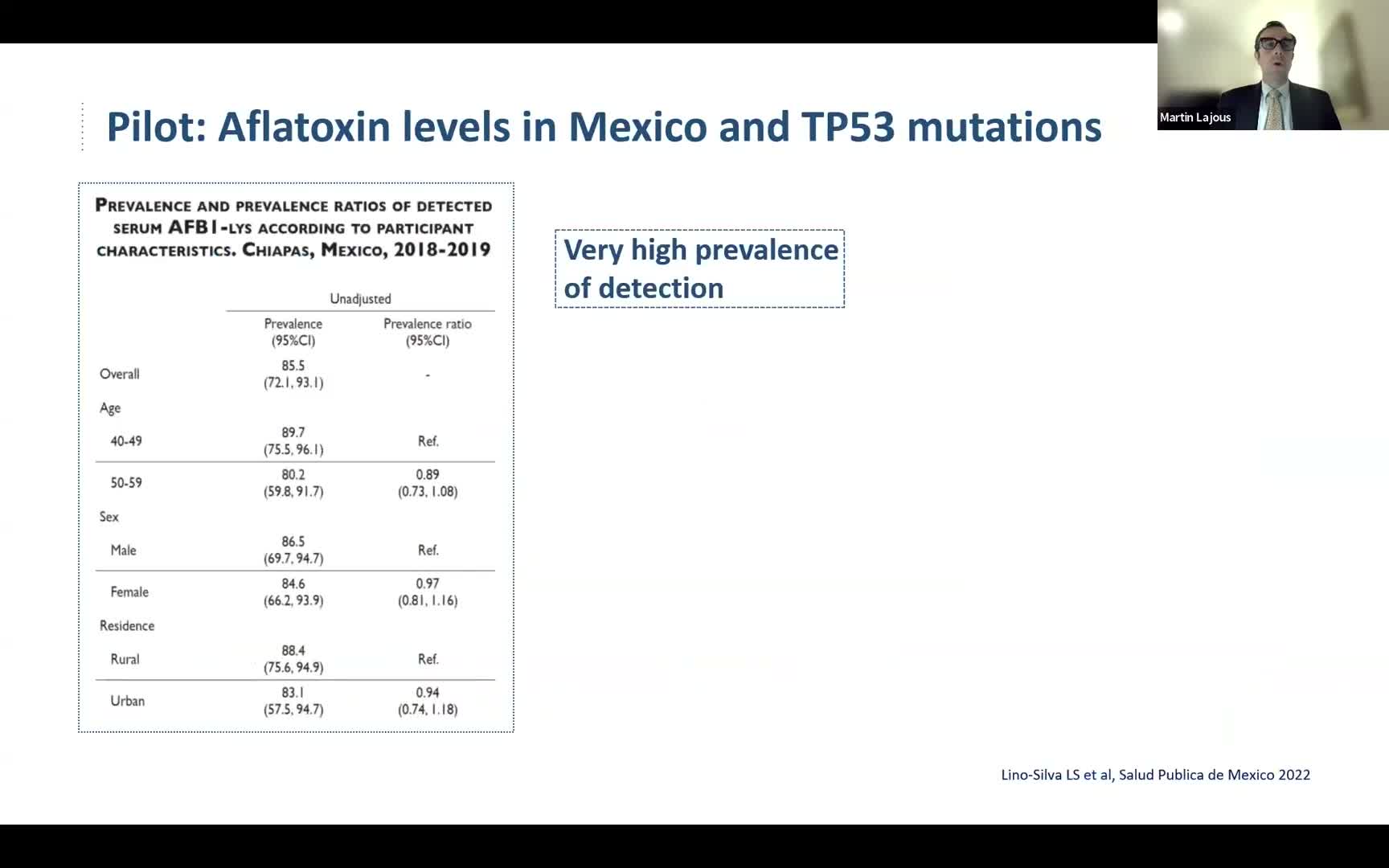
Dr. Martin Leju described small-scale and survey-based analyses showing substantial human aflatoxin detection in parts of Mexico and urged stepped-up monitoring and community-focused mitigation.
Leju reviewed older regional work that found an aflatoxin-associated mutation in liver tumor samples from northern Mexico, then summarized a pilot study using archived samples from the National Health and Nutrition Survey. In Chiapas—a state bordering Guatemala—the team found a high prevalence of detection (about 86% in the tested sample), while measured circulating levels were overall lower than those reported in Guatemala but comparable in some states such as Veracruz.
"We demonstrate that [aflatoxin exposure] is ubiquitous," Leju said, adding that laboratory determinations were performed by collaborators in Baltimore using state-of-the-art assays. He emphasized heterogeneity across states and higher levels among rural and lower socioeconomic groups and older individuals.
To seek sources, the team compared aflatoxin detection to dietary patterns and found a direct relationship with maize intake; Leju said roughly 80% of maize consumption was in the form of tortillas and that homemade masa tortillas appeared to be the primary driver of higher exposure in rural populations who prepare masa at home.
Aflatoxin is classified as a carcinogen by IARC and has been strongly implicated in liver cancer elsewhere. Leju said viral factors (hepatitis) are relatively uncommon contributors in Mexico and that metabolic disease and fatty liver are rising as important risk factors, complicating attribution.
Public-health implications discussed included the need for systematic monitoring of human exposure, defining effective post-harvest and storage interventions (dry storage, community-based post-harvest management) and consideration of biological control approaches. He warned that climate variability and shifting rainy seasons could worsen contamination risks and make mitigation harder.
Leju said investigators have engaged Mexico’s Ministry of Agriculture and some incoming administration officials but acknowledged that broader public dissemination remains limited; he recommended targeted engagement with affected communities, food producers and health authorities to design feasible interventions.
The presenter described the results as an initial ‘‘photograph’’ of exposure levels and emphasized the need for longitudinal monitoring and expanded sampling before drawing definitive public-health action plans.
Leju reviewed older regional work that found an aflatoxin-associated mutation in liver tumor samples from northern Mexico, then summarized a pilot study using archived samples from the National Health and Nutrition Survey. In Chiapas—a state bordering Guatemala—the team found a high prevalence of detection (about 86% in the tested sample), while measured circulating levels were overall lower than those reported in Guatemala but comparable in some states such as Veracruz.
"We demonstrate that [aflatoxin exposure] is ubiquitous," Leju said, adding that laboratory determinations were performed by collaborators in Baltimore using state-of-the-art assays. He emphasized heterogeneity across states and higher levels among rural and lower socioeconomic groups and older individuals.
To seek sources, the team compared aflatoxin detection to dietary patterns and found a direct relationship with maize intake; Leju said roughly 80% of maize consumption was in the form of tortillas and that homemade masa tortillas appeared to be the primary driver of higher exposure in rural populations who prepare masa at home.
Aflatoxin is classified as a carcinogen by IARC and has been strongly implicated in liver cancer elsewhere. Leju said viral factors (hepatitis) are relatively uncommon contributors in Mexico and that metabolic disease and fatty liver are rising as important risk factors, complicating attribution.
Public-health implications discussed included the need for systematic monitoring of human exposure, defining effective post-harvest and storage interventions (dry storage, community-based post-harvest management) and consideration of biological control approaches. He warned that climate variability and shifting rainy seasons could worsen contamination risks and make mitigation harder.
Leju said investigators have engaged Mexico’s Ministry of Agriculture and some incoming administration officials but acknowledged that broader public dissemination remains limited; he recommended targeted engagement with affected communities, food producers and health authorities to design feasible interventions.
The presenter described the results as an initial ‘‘photograph’’ of exposure levels and emphasized the need for longitudinal monitoring and expanded sampling before drawing definitive public-health action plans.
Don't Miss a Word: See the Full Meeting!
Go beyond summaries. Unlock every video, transcript, and key insight with a Founder Membership.
✓
Get instant access to full meeting videos
✓
Search and clip any phrase from complete transcripts
✓
Receive AI-powered summaries & custom alerts
✓
Enjoy lifetime, unrestricted access to government data
30-day money-back guarantee
