Regulation Review panel approves scheduling kratom as Schedule I; agency cites federal constraint and lab limits
February 24, 2026 | Regulation Review, House of Representatives, Committees, Legislative, Connecticut
This article was created by AI summarizing key points discussed. AI makes mistakes, so for full details and context, please refer to the video of the full meeting. Please report any errors so we can fix them. Report an error »
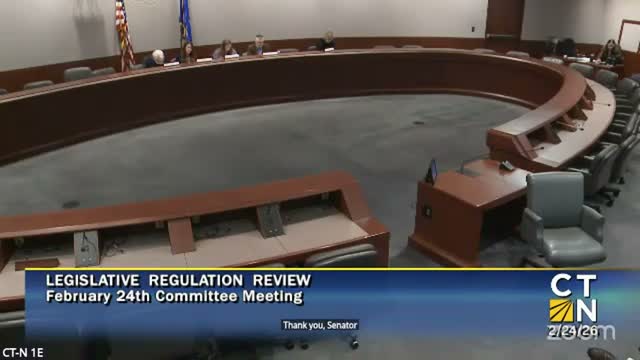
The Regulation Review Committee voted to accept the LCO recommendation approving proposed regulation 2026003 from the Department of Consumer Protection to classify kratom (and related alkaloids) as Schedule I under state rules.
Caitlin Anderson, chief of legal and regulatory affairs for the Department of Consumer Protection, told the committee the agency followed the statutory framework established for schedule classification and that the U.S. Food and Drug Administration has listed no approved medical use for kratom. "Because the FDA still has listed no approved medical use for kratom," Anderson said, the agency determined state rules required a Schedule I classification. Anderson also noted the regulation contains a reclassification provision so state law would automatically follow any future federal change.
Troy Ruff, director of the state Drug Control Division, said toxicology reporting from the Office of the Chief Medical Examiner often lists mitragynine but does not consistently separate plant-based kratom from synthetic analogs. "A lot of our labs are unable to test for mitragynine," Ruff said, and the data the agency had showed "about nine" recent deaths in which mitragynine appeared in combination with other substances, but not a clear count for plant-based kratom alone.
Lawmakers split on the policy but largely supported the measure at the hearing. Madam Chair, urging urgency on youth protection, said, "Kratom should be nowhere near any of our kids — it's dangerous." Representative Kissel said he was "hesitant to just automatically put things as Schedule I" without proven medical benefit for plant-based substances, describing a distinction between plant and synthetic forms but saying he would vote yes for now. Representative Fishbein cited national reporting and an FDA warning and said she was "very happy to vote yes." Senator Summers, speaking from a public-health perspective, described constituent addiction cases and international bans on kratom as supporting context for the action.
Members asked about enforcement and outreach. Anderson said, once the regulation is final and published, possession and sale would be criminalized and enforcement would rest largely with local law enforcement; the Department of Consumer Protection would provide education and coordinate with the attorney general's office and local agencies. Anderson also said the department has reached out to the Department of Mental Health and Addiction Services to identify supports for people who may be affected by the change.
The committee recorded the motion to accept the LCO recommendation of approval in whole with technical corrections and proceeded with a roll call; members on the record voted in the affirmative and the motion carried. The regulation includes a reclassification clause to mirror any future federal scheduling updates. The rulemaking process will continue with publication and the department indicated it will run targeted outreach and enforcement-education efforts for retailers and local law enforcement.
Caitlin Anderson, chief of legal and regulatory affairs for the Department of Consumer Protection, told the committee the agency followed the statutory framework established for schedule classification and that the U.S. Food and Drug Administration has listed no approved medical use for kratom. "Because the FDA still has listed no approved medical use for kratom," Anderson said, the agency determined state rules required a Schedule I classification. Anderson also noted the regulation contains a reclassification provision so state law would automatically follow any future federal change.
Troy Ruff, director of the state Drug Control Division, said toxicology reporting from the Office of the Chief Medical Examiner often lists mitragynine but does not consistently separate plant-based kratom from synthetic analogs. "A lot of our labs are unable to test for mitragynine," Ruff said, and the data the agency had showed "about nine" recent deaths in which mitragynine appeared in combination with other substances, but not a clear count for plant-based kratom alone.
Lawmakers split on the policy but largely supported the measure at the hearing. Madam Chair, urging urgency on youth protection, said, "Kratom should be nowhere near any of our kids — it's dangerous." Representative Kissel said he was "hesitant to just automatically put things as Schedule I" without proven medical benefit for plant-based substances, describing a distinction between plant and synthetic forms but saying he would vote yes for now. Representative Fishbein cited national reporting and an FDA warning and said she was "very happy to vote yes." Senator Summers, speaking from a public-health perspective, described constituent addiction cases and international bans on kratom as supporting context for the action.
Members asked about enforcement and outreach. Anderson said, once the regulation is final and published, possession and sale would be criminalized and enforcement would rest largely with local law enforcement; the Department of Consumer Protection would provide education and coordinate with the attorney general's office and local agencies. Anderson also said the department has reached out to the Department of Mental Health and Addiction Services to identify supports for people who may be affected by the change.
The committee recorded the motion to accept the LCO recommendation of approval in whole with technical corrections and proceeded with a roll call; members on the record voted in the affirmative and the motion carried. The regulation includes a reclassification clause to mirror any future federal scheduling updates. The rulemaking process will continue with publication and the department indicated it will run targeted outreach and enforcement-education efforts for retailers and local law enforcement.
View the Full Meeting & All Its Details
This article offers just a summary. Unlock complete video, transcripts, and insights as a Founder Member.
✓
Watch full, unedited meeting videos
✓
Search every word spoken in unlimited transcripts
✓
AI summaries & real-time alerts (all government levels)
✓
Permanent access to expanding government content
30-day money-back guarantee
