Equal Justice Works CEO Urges More Fellowship and Advising Support to Close U.S. Justice Gap
February 24, 2026 | Legal Services Corporation, Independent Federal Agency, Executive, Federal
This article was created by AI summarizing key points discussed. AI makes mistakes, so for full details and context, please refer to the video of the full meeting. Please report any errors so we can fix them. Report an error »
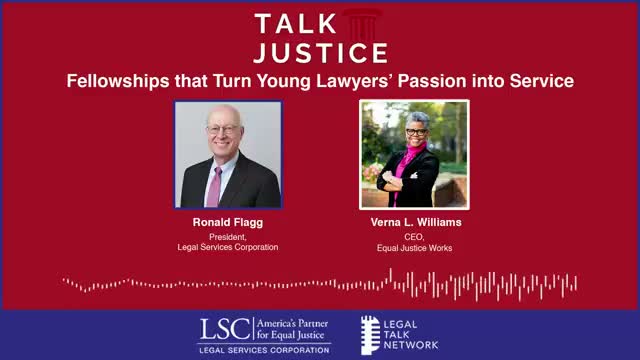
Ron Flagg, president of the Legal Services Corporation, welcomed Verna Williams, CEO of Equal Justice Works, to the podcast Talk Justice and asked how the organization recruits and retains lawyers for public-interest work.
"Equal access to justice is a core American value," an episode announcer said at the top of the episode. Williams described Equal Justice Works as the country’s largest postgraduate legal fellowship program and said the organization has "over 2,700 alums," a network she said has expanded capacity at host legal aid organizations and strengthened pro bono relationships.
Williams and Flagg discussed a summer fellowship program that the episode refers to as the "Bridal Summer Legal Corps," which places law students with legal services organizations in underserved rural counties. Williams said the immersive placements expose students to communities with "few and often no lawyers" and can increase the likelihood that participants later pursue legal aid or pro bono work.
Addressing the broader workforce problem, Williams cited American Bar Association figures and workforce and debt data: "The ABA tells us that of 1,300,000 attorneys in the U.S., only 1% are paid legal aid attorneys," she said, and added that average law school debt was "$200,000 on average," a burden she said falls especially heavily on students of color and discourages them from public-interest careers.
To counter what host Ron Flagg framed as "public interest drift," Williams proposed three broad strategies: better and earlier public-interest career advising for students, more resources for public-interest employers so they can offer competitive salaries, and curricular and experiential programs to show students that a public-interest career can be a long arc rather than a one-time choice.
Williams also cited a figure about unmet legal needs: "If they realized that 92% of low income people's legal needs are going unmet, they would be more than willing to step up," she said, arguing that wider awareness among students could create a "groundswell" of interest in public-interest work.
Throughout the episode Williams emphasized coalition-building across law schools, public-interest organizations, government and private-sector partners as the "secret sauce" for scaling impact. She closed by describing fellow participants as bringing "fresh rage to the table," a phrase she used to express her admiration for their energy and commitment.
Flagg thanked Williams for joining the program and highlighted the organizations’ partnership. The episode concluded with a standard podcast disclaimer that guest views are the speaker’s own and that the content is informational rather than legal advice.
Next steps described on the episode included continued collaboration between the Legal Services Corporation and Equal Justice Works on fellowship placements and Williams’s suggestion to study fellowship alumni outcomes to measure longer-term impact.
"Equal access to justice is a core American value," an episode announcer said at the top of the episode. Williams described Equal Justice Works as the country’s largest postgraduate legal fellowship program and said the organization has "over 2,700 alums," a network she said has expanded capacity at host legal aid organizations and strengthened pro bono relationships.
Williams and Flagg discussed a summer fellowship program that the episode refers to as the "Bridal Summer Legal Corps," which places law students with legal services organizations in underserved rural counties. Williams said the immersive placements expose students to communities with "few and often no lawyers" and can increase the likelihood that participants later pursue legal aid or pro bono work.
Addressing the broader workforce problem, Williams cited American Bar Association figures and workforce and debt data: "The ABA tells us that of 1,300,000 attorneys in the U.S., only 1% are paid legal aid attorneys," she said, and added that average law school debt was "$200,000 on average," a burden she said falls especially heavily on students of color and discourages them from public-interest careers.
To counter what host Ron Flagg framed as "public interest drift," Williams proposed three broad strategies: better and earlier public-interest career advising for students, more resources for public-interest employers so they can offer competitive salaries, and curricular and experiential programs to show students that a public-interest career can be a long arc rather than a one-time choice.
Williams also cited a figure about unmet legal needs: "If they realized that 92% of low income people's legal needs are going unmet, they would be more than willing to step up," she said, arguing that wider awareness among students could create a "groundswell" of interest in public-interest work.
Throughout the episode Williams emphasized coalition-building across law schools, public-interest organizations, government and private-sector partners as the "secret sauce" for scaling impact. She closed by describing fellow participants as bringing "fresh rage to the table," a phrase she used to express her admiration for their energy and commitment.
Flagg thanked Williams for joining the program and highlighted the organizations’ partnership. The episode concluded with a standard podcast disclaimer that guest views are the speaker’s own and that the content is informational rather than legal advice.
Next steps described on the episode included continued collaboration between the Legal Services Corporation and Equal Justice Works on fellowship placements and Williams’s suggestion to study fellowship alumni outcomes to measure longer-term impact.
View the Full Meeting & All Its Details
This article offers just a summary. Unlock complete video, transcripts, and insights as a Founder Member.
✓
Watch full, unedited meeting videos
✓
Search every word spoken in unlimited transcripts
✓
AI summaries & real-time alerts (all government levels)
✓
Permanent access to expanding government content
30-day money-back guarantee
