Unions tell lawmakers staffing shortages and safety failures are driving recruitment and retention crisis
February 25, 2026 | 2026 Legislature NY, New York
This article was created by AI summarizing key points discussed. AI makes mistakes, so for full details and context, please refer to the video of the full meeting. Please report any errors so we can fix them. Report an error »
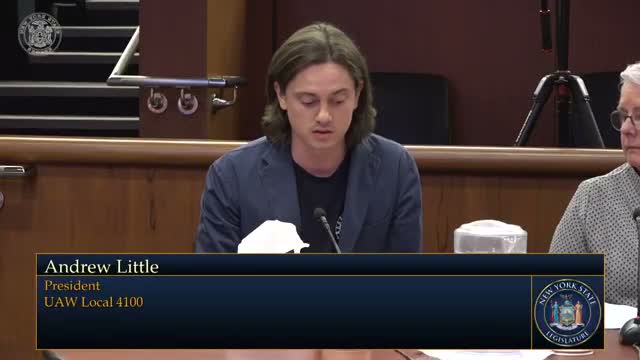
Unions representing state and local public employees told the joint fiscal committees that a persistent shortage of public-sector workers has produced unsafe workplaces and reduced service delivery.
Speakers from CSEA, PEF, OMCE and retired public-employee representatives highlighted a range of problems: chronic vacancies (committee members cited an agency estimate of roughly 10,000'plus open positions), high overtime costs, unsafe working conditions in corrections and residential treatment facilities, and retiree financial strain. Testimony described a recent assault on a civilian teacher at an OCFS facility as an example of frontline-safety risks and urged statutory and budgetary steps to reduce threats to staff.
Unions urged tier reforms (capping Tier 6 contributions at 3% or other changes), workplace-safety measures (panic buttons for social-service caseworkers, expanded work-zone cameras, body scanners for secure facilities where contraband is an identified risk), and stronger enforcement of returned wages and penalties. Witnesses said the state has spent large sums on overtime, the National Guard and consultants to cover staffing gaps and that structural changes are required to retain employees.
Lawmakers and witnesses also discussed retirees' benefits: the Retired Public Employees Association asked to protect retiree healthcare, adjust the COLA baseline and raise the earnings cap for retirees who return to work. Several members suggested increasing the post-retirement earnings cap (current rule referenced in testimony as $35,000) to allow more retirees to come back where local governments cannot recruit replacements.
Follow-up requested: unions and legislators asked for more granular data on vacancies by title and region, overtime costs, and the civil-service compensation study results so policy options can be revisited during the budget process.
Speakers from CSEA, PEF, OMCE and retired public-employee representatives highlighted a range of problems: chronic vacancies (committee members cited an agency estimate of roughly 10,000'plus open positions), high overtime costs, unsafe working conditions in corrections and residential treatment facilities, and retiree financial strain. Testimony described a recent assault on a civilian teacher at an OCFS facility as an example of frontline-safety risks and urged statutory and budgetary steps to reduce threats to staff.
Unions urged tier reforms (capping Tier 6 contributions at 3% or other changes), workplace-safety measures (panic buttons for social-service caseworkers, expanded work-zone cameras, body scanners for secure facilities where contraband is an identified risk), and stronger enforcement of returned wages and penalties. Witnesses said the state has spent large sums on overtime, the National Guard and consultants to cover staffing gaps and that structural changes are required to retain employees.
Lawmakers and witnesses also discussed retirees' benefits: the Retired Public Employees Association asked to protect retiree healthcare, adjust the COLA baseline and raise the earnings cap for retirees who return to work. Several members suggested increasing the post-retirement earnings cap (current rule referenced in testimony as $35,000) to allow more retirees to come back where local governments cannot recruit replacements.
Follow-up requested: unions and legislators asked for more granular data on vacancies by title and region, overtime costs, and the civil-service compensation study results so policy options can be revisited during the budget process.
Don't Miss a Word: See the Full Meeting!
Go beyond summaries. Unlock every video, transcript, and key insight with a Founder Membership.
✓
Get instant access to full meeting videos
✓
Search and clip any phrase from complete transcripts
✓
Receive AI-powered summaries & custom alerts
✓
Enjoy lifetime, unrestricted access to government data
30-day money-back guarantee
