Glynn County planning commission reviews sweeping zoning rewrite; beachfront lighting and traffic studies draw pushback
February 25, 2026 | Glynn County, Georgia
This article was created by AI summarizing key points discussed. AI makes mistakes, so for full details and context, please refer to the video of the full meeting. Please report any errors so we can fix them. Report an error »
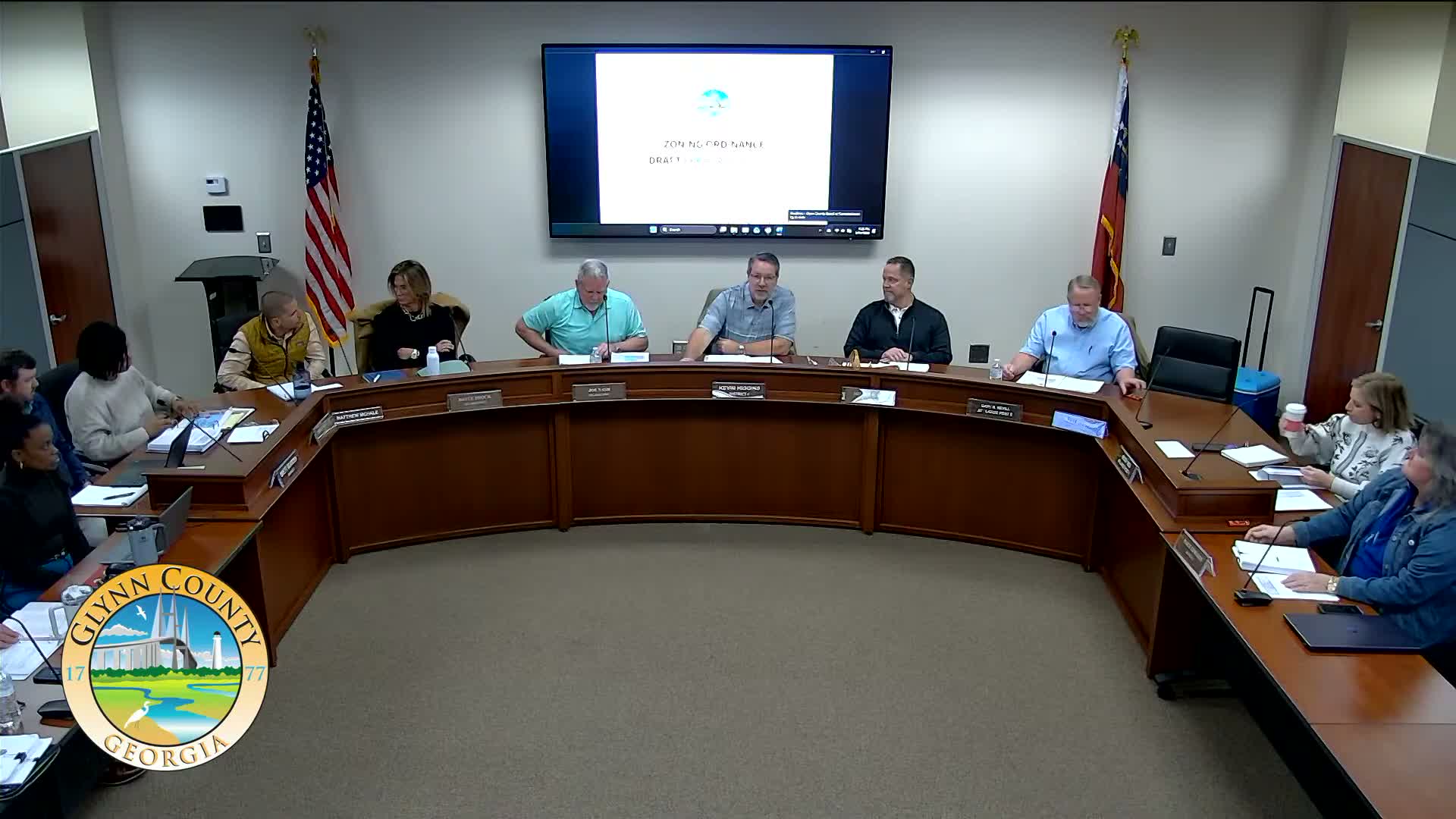
Glynn County planning staff presented a comprehensive rewrite of the county's zoning and subdivision ordinances at a Feb. 24 joint work session, outlining wide‑ranging changes intended to update decades of amendments and clarify current practice.
The rewrite separates use tables for residential and commercial zones, refines definitions for manufactured, modular and mobile homes, and adds accessory dwelling unit (ADU) rules. Staff said the draft adds an official zoning map and includes an option to delay an ordinance's effective date (one proposal described a 90‑day gap) so the county can educate the public and allow staff time to implement the new rules.
"This is a complete rewrite," staff said when introducing the document, and planners repeatedly described the draft as a "living, breathing" document that will be revised after further public comment and legal review.
Major substantive changes highlighted by staff include revisions to parking standards (short‑term rental parking set at one space per bedroom; multifamily parking in some unit sizes reduced to 1.5–1.7 spaces; retail standard moved from 1 per 200 sq ft to 1 per 300 sq ft) and new rules for parcels under common ownership intended to reduce nonconforming situations when buildings cross older lot lines.
Environmental protections were adjusted: a new 7‑foot setback is proposed for wetlands delineated by the U.S. Army Corps of Engineers, while marsh buffers remain a 15‑foot development setback with clarified limits on pools, decks and structures. Staff also moved screening rules for dumpsters and mechanical equipment into a separate section and added requirements that fences installed by choice be set back so the required landscape buffer may be planted on the exterior side.
The draft updates the tree ordinance on islands, reducing the required number of trees from 12 per acre to 8 per acre and preserving mature live‑oak review and tree‑removal permits managed by the county arborist.
Two items prompted especially long exchanges: beachfront/exterior lighting and new traffic‑study thresholds. Staff moved beachfront lighting rules into the exterior lighting section and proposed that fixtures visible from the beach meet wavelength limits (the draft references light sources "not less than 560 nanometers" or fixtures authorized by the Department of Natural Resources). Commissioners pressed staff about enforcement, grandfathering for existing fixtures and whether making only renovations comply would be fair to homeowners.
On administration, staff proposed traffic‑study triggers to give applicants certainty: a study would be required for residential projects of 50 or more units and for commercial projects of 10,000 gross square feet or more; state ERI thresholds would also apply. Commissioners warned mandatory studies add cost that could deter affordable and workforce housing, and asked staff to refine when (preliminary plat vs. rezoning) and how studies would be required.
The commission approved prior meeting minutes unanimously as a procedural action. Staff said the draft will go back to county attorneys for final review, another public draft will be circulated, and a formal public hearing is scheduled for March 18 at 6 p.m. (Brunswick/Glynn library location). Another work session was scheduled for March 2 at 6 p.m. to continue the review.
Why it matters: the rewrite consolidates decades of amendments and aims to make zoning clearer for residents, developers and staff, but choices about enforcement windows, grandfathering, and thresholds (especially lighting and traffic studies) will shape who bears costs and how consistently the rules can be applied.
Next steps: staff will circulate a revised draft and seek public comment before formal public hearings; county legal review may change some draft language before the board of commissioners considers ordinance readings.
The rewrite separates use tables for residential and commercial zones, refines definitions for manufactured, modular and mobile homes, and adds accessory dwelling unit (ADU) rules. Staff said the draft adds an official zoning map and includes an option to delay an ordinance's effective date (one proposal described a 90‑day gap) so the county can educate the public and allow staff time to implement the new rules.
"This is a complete rewrite," staff said when introducing the document, and planners repeatedly described the draft as a "living, breathing" document that will be revised after further public comment and legal review.
Major substantive changes highlighted by staff include revisions to parking standards (short‑term rental parking set at one space per bedroom; multifamily parking in some unit sizes reduced to 1.5–1.7 spaces; retail standard moved from 1 per 200 sq ft to 1 per 300 sq ft) and new rules for parcels under common ownership intended to reduce nonconforming situations when buildings cross older lot lines.
Environmental protections were adjusted: a new 7‑foot setback is proposed for wetlands delineated by the U.S. Army Corps of Engineers, while marsh buffers remain a 15‑foot development setback with clarified limits on pools, decks and structures. Staff also moved screening rules for dumpsters and mechanical equipment into a separate section and added requirements that fences installed by choice be set back so the required landscape buffer may be planted on the exterior side.
The draft updates the tree ordinance on islands, reducing the required number of trees from 12 per acre to 8 per acre and preserving mature live‑oak review and tree‑removal permits managed by the county arborist.
Two items prompted especially long exchanges: beachfront/exterior lighting and new traffic‑study thresholds. Staff moved beachfront lighting rules into the exterior lighting section and proposed that fixtures visible from the beach meet wavelength limits (the draft references light sources "not less than 560 nanometers" or fixtures authorized by the Department of Natural Resources). Commissioners pressed staff about enforcement, grandfathering for existing fixtures and whether making only renovations comply would be fair to homeowners.
On administration, staff proposed traffic‑study triggers to give applicants certainty: a study would be required for residential projects of 50 or more units and for commercial projects of 10,000 gross square feet or more; state ERI thresholds would also apply. Commissioners warned mandatory studies add cost that could deter affordable and workforce housing, and asked staff to refine when (preliminary plat vs. rezoning) and how studies would be required.
The commission approved prior meeting minutes unanimously as a procedural action. Staff said the draft will go back to county attorneys for final review, another public draft will be circulated, and a formal public hearing is scheduled for March 18 at 6 p.m. (Brunswick/Glynn library location). Another work session was scheduled for March 2 at 6 p.m. to continue the review.
Why it matters: the rewrite consolidates decades of amendments and aims to make zoning clearer for residents, developers and staff, but choices about enforcement windows, grandfathering, and thresholds (especially lighting and traffic studies) will shape who bears costs and how consistently the rules can be applied.
Next steps: staff will circulate a revised draft and seek public comment before formal public hearings; county legal review may change some draft language before the board of commissioners considers ordinance readings.
View the Full Meeting & All Its Details
This article offers just a summary. Unlock complete video, transcripts, and insights as a Founder Member.
✓
Watch full, unedited meeting videos
✓
Search every word spoken in unlimited transcripts
✓
AI summaries & real-time alerts (all government levels)
✓
Permanent access to expanding government content
30-day money-back guarantee
