Planning commission presses for data before finalizing Water Use and Preservation element; member proposes overlay to protect sole‑source aquifers
February 24, 2026 | Grand County Planning Commission, Grand County Boards and Commissions, Grand County, Utah
This article was created by AI summarizing key points discussed. AI makes mistakes, so for full details and context, please refer to the video of the full meeting. Please report any errors so we can fix them. Report an error »
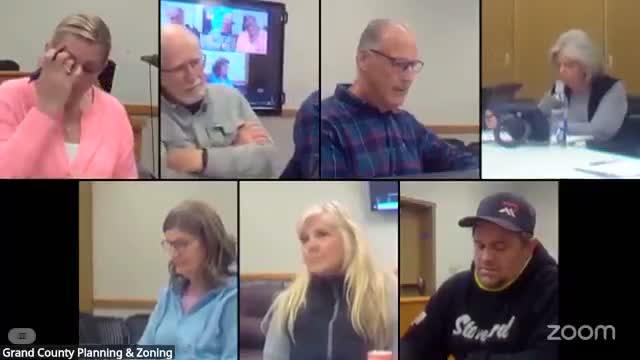
Grand County Planning Commission members spent the majority of their Feb. 23 meeting reviewing the draft Water Use and Preservation element and agreed to continue the discussion once technical studies arrive.
Speaker 8 summarized edits to the element and said the request for proposals for the land‑use code update had cleared legal review and would be released that week. Speaker 5 pressed for firm data: "How many water meters are left? How many can you put in?" (Speaker 5), arguing meter counts or capacity should be a first principle before approving plan language.
Speaker 9 replied that Sunrise Engineering is completing an engineering study and that a separate county‑commissioned modeling study by Utah State should be available by May to show aquifer capacity under low/medium/high growth and drought scenarios. Commissioners agreed to continue drafting work rather than tabling the element and discussed aiming for a hearing on March 23 if all data are ready and statutory posting deadlines can be met.
Separately, Speaker 4 proposed adding language to identify the Glen Canyon and Castle Valley aquifers as EPA‑designated sole‑source aquifers and to extend protections similar to the Water Source Protection Overlay (WSPO) to those recharge areas during the land‑use code update. Commissioners asked practical questions about where the overlay map would apply and how protections would affect private landowners (Speaker 1 asked whether private property owners could be restricted from changing land uses within an overlay). Speaker 4 noted the county’s existing WSPO (code section 4.5) already prohibits certain uses in overlay areas — for example, new underground storage tanks or hazardous‑materials storage — and said adapting similar protections to the two sole‑source aquifers would safeguard drinking water.
Chair (Speaker 3) recommended commissioners review the relevant code and maps (including section 4.5) ahead of a focused discussion at the next meeting. Staff were asked to circulate the code excerpt and maps; commissioners will reconvene on the water element after Sunrise Engineering and Utah State reports are available.
No final regulatory decision was made at the meeting; the commission scheduled additional review and outreach as next steps.
Speaker 8 summarized edits to the element and said the request for proposals for the land‑use code update had cleared legal review and would be released that week. Speaker 5 pressed for firm data: "How many water meters are left? How many can you put in?" (Speaker 5), arguing meter counts or capacity should be a first principle before approving plan language.
Speaker 9 replied that Sunrise Engineering is completing an engineering study and that a separate county‑commissioned modeling study by Utah State should be available by May to show aquifer capacity under low/medium/high growth and drought scenarios. Commissioners agreed to continue drafting work rather than tabling the element and discussed aiming for a hearing on March 23 if all data are ready and statutory posting deadlines can be met.
Separately, Speaker 4 proposed adding language to identify the Glen Canyon and Castle Valley aquifers as EPA‑designated sole‑source aquifers and to extend protections similar to the Water Source Protection Overlay (WSPO) to those recharge areas during the land‑use code update. Commissioners asked practical questions about where the overlay map would apply and how protections would affect private landowners (Speaker 1 asked whether private property owners could be restricted from changing land uses within an overlay). Speaker 4 noted the county’s existing WSPO (code section 4.5) already prohibits certain uses in overlay areas — for example, new underground storage tanks or hazardous‑materials storage — and said adapting similar protections to the two sole‑source aquifers would safeguard drinking water.
Chair (Speaker 3) recommended commissioners review the relevant code and maps (including section 4.5) ahead of a focused discussion at the next meeting. Staff were asked to circulate the code excerpt and maps; commissioners will reconvene on the water element after Sunrise Engineering and Utah State reports are available.
No final regulatory decision was made at the meeting; the commission scheduled additional review and outreach as next steps.
View the Full Meeting & All Its Details
This article offers just a summary. Unlock complete video, transcripts, and insights as a Founder Member.
✓
Watch full, unedited meeting videos
✓
Search every word spoken in unlimited transcripts
✓
AI summaries & real-time alerts (all government levels)
✓
Permanent access to expanding government content
30-day money-back guarantee
