Jacksonville council debates OGC memo that says board appointments rest with mayor
February 24, 2026 | Jacksonville, Duval County, Florida
This article was created by AI summarizing key points discussed. AI makes mistakes, so for full details and context, please refer to the video of the full meeting. Please report any errors so we can fix them. Report an error »
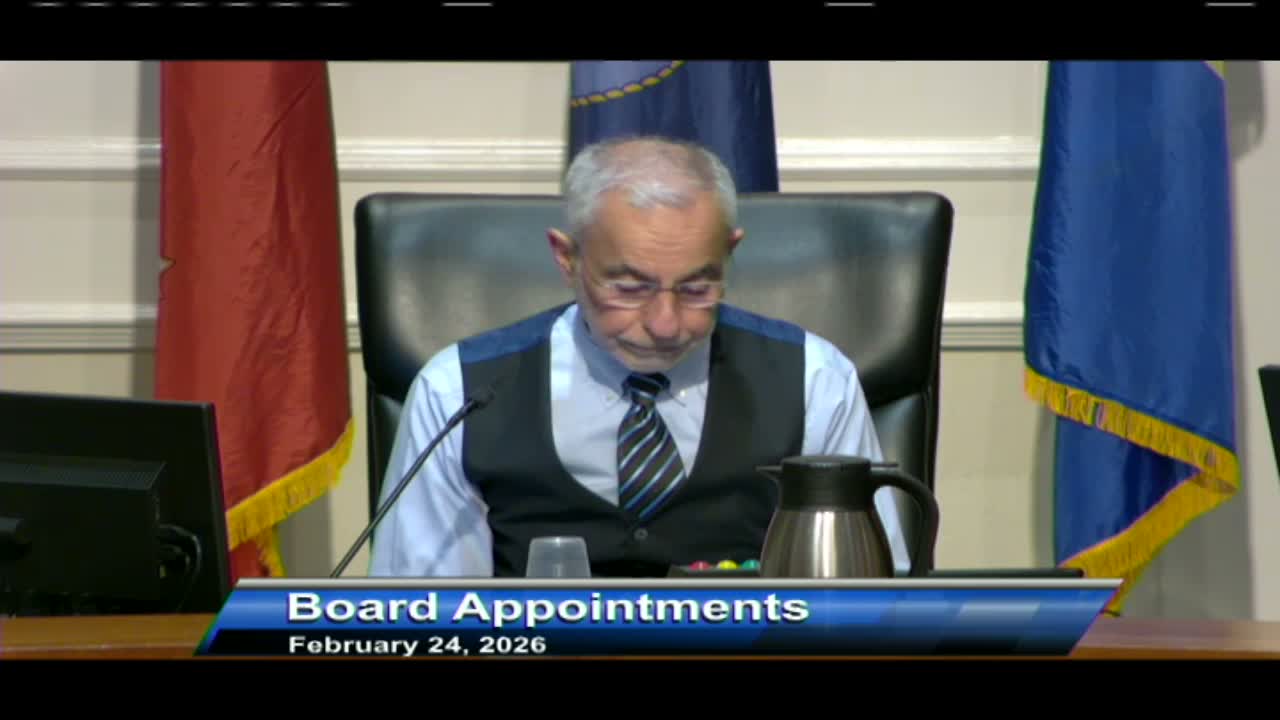
Jacksonville City Council members spent a meeting reviewing a memorandum from the Office of General Counsel (OGC) that concluded the power to appoint members to boards and commissions is executive in nature and therefore rests with the mayor.
Jason Teal, legislative council for the City Council, told members the memorandum — prepared by deputy counsel Regina Ross and confirmed by General Counsel Michael Fackler — takes a dictionary-style approach to define "executive" appointments and concludes those powers belong to the mayor. Teal said that interpretation conflicts with historical practice and other charter language: "The charter only expressly assigns the mayor sole appointment power over the directors and authorized deputy directors of each department and the various division chiefs," he said, adding that council appointments to boards have a long history dating to consolidation in 1968.
The disagreement centers on whether the charter and ordinance code leave appointment authority exclusively to the mayor or allow the council to create boards and determine their appointing mechanism. Teal cited ordinance code section 50.102 and other charter provisions as evidence that "when the city council creates a board or commission, the city council controls how appointments get made," and argued that case law and decades of practice support a shared or legislative role in appointments.
Dylan Rangel of OGC said the office expects legislative counsel and OGC to cooperate under chapter 14 but contended that the legislative council had not followed that collaborative process here. Regina Ross, who wrote the memorandum, told the council the memo was limited in scope to the proposed ordinance language affecting the KHA and the library board and "was not meant to be to create a bright line rule" across all boards; she described the document as advisory because the general counsel was not asked for a formal binding opinion in this matter.
Council members asked procedural and strategic questions about next steps. Teal outlined three main options: accept OGC's opinion, pass or reject the ordinance (which could lead to a mayoral veto), or seek judicial review by filing a declaratory judgment action. He said council could file a suit to have a court decide whether the general counsel's opinion is correct and that the charter text treating OGC opinions as binding until overturned by a court complicates the path forward. "You can accept the opinion as is," Teal said, "or you can amend it. But … the charter says that opinions issued by the general counsel are binding unless they're overturned by a court of competent jurisdiction." He added that the council could designate the legislative counsel to represent it in court.
Members debated timing and risk: some favored taking the proposal to voters via a charter amendment to settle the issue, while others argued litigation would be faster and preserve council authorities sooner. Questions surfaced about costs and standing; Teal said filing fees for a declaratory judgment are minimal and that the council would likely need to pass a resolution designating representation and authorizing litigation (a 10-vote resolution was discussed). Members also pressed on whether a binding OGC opinion typically is issued only after legislation is finalized, and whether a lawsuit could proceed if the mayor vetoed the bill.
Several councilors expressed frustration at what they called a widening disagreement between the legislative counsel and the general counsel. One council member characterized the situation as "dysfunctional" and recommended using the council's existing process to replace the general counsel if confidence cannot be restored.
The meeting closed with no formal vote recorded on the ordinance or a resolution to pursue litigation. Council members asked staff and counsel to provide options and next steps for either litigation, pursuing a charter amendment, or continuing legislative work on the ordinance.
Jason Teal, legislative council for the City Council, told members the memorandum — prepared by deputy counsel Regina Ross and confirmed by General Counsel Michael Fackler — takes a dictionary-style approach to define "executive" appointments and concludes those powers belong to the mayor. Teal said that interpretation conflicts with historical practice and other charter language: "The charter only expressly assigns the mayor sole appointment power over the directors and authorized deputy directors of each department and the various division chiefs," he said, adding that council appointments to boards have a long history dating to consolidation in 1968.
The disagreement centers on whether the charter and ordinance code leave appointment authority exclusively to the mayor or allow the council to create boards and determine their appointing mechanism. Teal cited ordinance code section 50.102 and other charter provisions as evidence that "when the city council creates a board or commission, the city council controls how appointments get made," and argued that case law and decades of practice support a shared or legislative role in appointments.
Dylan Rangel of OGC said the office expects legislative counsel and OGC to cooperate under chapter 14 but contended that the legislative council had not followed that collaborative process here. Regina Ross, who wrote the memorandum, told the council the memo was limited in scope to the proposed ordinance language affecting the KHA and the library board and "was not meant to be to create a bright line rule" across all boards; she described the document as advisory because the general counsel was not asked for a formal binding opinion in this matter.
Council members asked procedural and strategic questions about next steps. Teal outlined three main options: accept OGC's opinion, pass or reject the ordinance (which could lead to a mayoral veto), or seek judicial review by filing a declaratory judgment action. He said council could file a suit to have a court decide whether the general counsel's opinion is correct and that the charter text treating OGC opinions as binding until overturned by a court complicates the path forward. "You can accept the opinion as is," Teal said, "or you can amend it. But … the charter says that opinions issued by the general counsel are binding unless they're overturned by a court of competent jurisdiction." He added that the council could designate the legislative counsel to represent it in court.
Members debated timing and risk: some favored taking the proposal to voters via a charter amendment to settle the issue, while others argued litigation would be faster and preserve council authorities sooner. Questions surfaced about costs and standing; Teal said filing fees for a declaratory judgment are minimal and that the council would likely need to pass a resolution designating representation and authorizing litigation (a 10-vote resolution was discussed). Members also pressed on whether a binding OGC opinion typically is issued only after legislation is finalized, and whether a lawsuit could proceed if the mayor vetoed the bill.
Several councilors expressed frustration at what they called a widening disagreement between the legislative counsel and the general counsel. One council member characterized the situation as "dysfunctional" and recommended using the council's existing process to replace the general counsel if confidence cannot be restored.
The meeting closed with no formal vote recorded on the ordinance or a resolution to pursue litigation. Council members asked staff and counsel to provide options and next steps for either litigation, pursuing a charter amendment, or continuing legislative work on the ordinance.
View the Full Meeting & All Its Details
This article offers just a summary. Unlock complete video, transcripts, and insights as a Founder Member.
✓
Watch full, unedited meeting videos
✓
Search every word spoken in unlimited transcripts
✓
AI summaries & real-time alerts (all government levels)
✓
Permanent access to expanding government content
30-day money-back guarantee
