West Valley School Board highlights growth in special education and expansion of behavior-support staff
February 25, 2026 | West Valley School District (Yakima), School Districts, Washington
This article was created by AI summarizing key points discussed. AI makes mistakes, so for full details and context, please refer to the video of the full meeting. Please report any errors so we can fix them. Report an error »
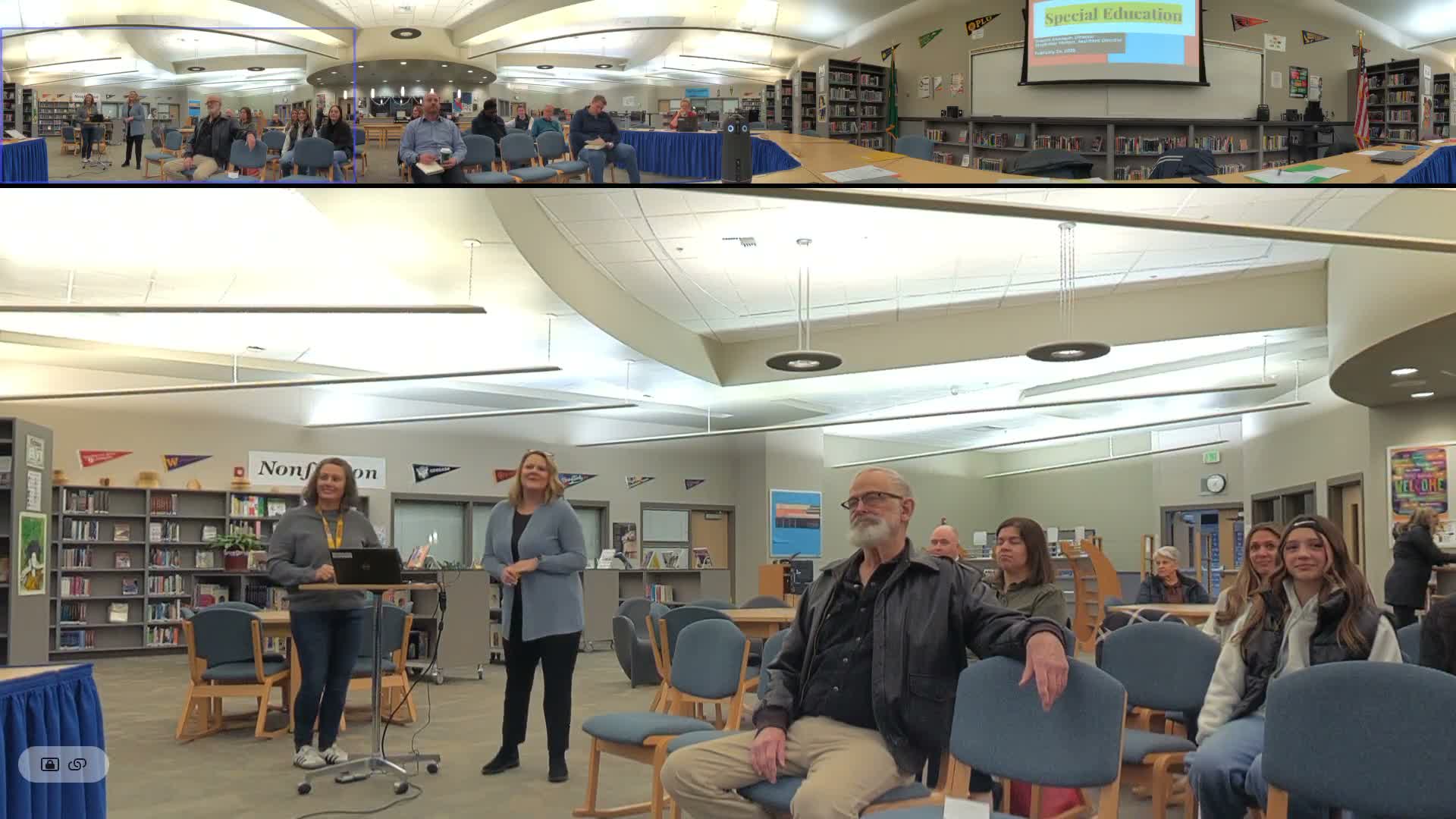
Assistant Director of Special Education Stephanie Milton told the West Valley School Board on Feb. 24 that the district has seen an increase in students receiving individualized special-education services, rising from roughly 780 at the start of the year to about 840 currently.
Milton said the district employs 133 special-education staff across certificated and classified roles and has launched a pilot procedure manual (about 172 pages) to standardize practice. She described an explicit push toward inclusion: district data show elementary schools typically have about 15–20% of students on individualized education programs (IEPs), while high schools are closer to 9–10%.
A central point of Milton’s presentation was the expansion of behavior-support staff. The district’s goal this year was to ensure each elementary school had a dedicated behavior specialist or access to a board‑certified behavior analyst (BCBA). Milton outlined BCBA certification requirements — master's‑level coursework, roughly 2,000 supervised field hours and a national certification exam — and named current staff by assignment, including Charity Caprillo (Apple Valley), Delaney Russell (Cottonwood), Megan Jennings, Starlet Burnett (floater) and Michelle Palmer (middle level). The district also hired behavior technicians; Milton noted Christine Hernandez at the high school holds a registered behavior‑technician certificate.
Milton said the change is intended to shift support from reactive crisis response to proactive intervention. She cited research from 2023 estimating an increase in students needing intensive (tier‑3) supports and said the district has used behavior staff to run small‑group social‑skills instruction, conduct functional behavior assessments and create behavior intervention plans. Principals reported having behavior staff in buildings has allowed them to be present for classroom coaching and to complete required teacher evaluations.
Milton told the board the district partners with Children's Village for birth‑to‑3 (Part C) referrals and provides consultation when families keep children in community preschools. She also emphasized that the published count of ~840 refers to students with IEPs; students with Section 504 plans and general-education students receiving preventive supports are not included in that IEP total.
Milton said the district will collect and analyze outcome data — including suspension, restraint/isolation and other discipline measures — at the end of the school year to assess whether the added behavior supports reduce high‑level interventions. She offered to return with more specific hard numbers at year end.
Board members asked about staffing ratios, the concentration of behavior resources at the elementary level, and whether the approach would expand to middle and high schools; Milton said the goal remains one behavior specialist per building and described differences in how middle‑level services are delivered (for example, teaching social‑skills classes). A parent and board member described an anecdote of a student who exited an IEP and is now a high‑school freshman doing well, which Milton cited as the intended outcome of early intervention.
The board did not take formal policy action on the special‑education presentation; Milton’s materials and the district’s plan for further data collection were presented for board review.
Milton said the district employs 133 special-education staff across certificated and classified roles and has launched a pilot procedure manual (about 172 pages) to standardize practice. She described an explicit push toward inclusion: district data show elementary schools typically have about 15–20% of students on individualized education programs (IEPs), while high schools are closer to 9–10%.
A central point of Milton’s presentation was the expansion of behavior-support staff. The district’s goal this year was to ensure each elementary school had a dedicated behavior specialist or access to a board‑certified behavior analyst (BCBA). Milton outlined BCBA certification requirements — master's‑level coursework, roughly 2,000 supervised field hours and a national certification exam — and named current staff by assignment, including Charity Caprillo (Apple Valley), Delaney Russell (Cottonwood), Megan Jennings, Starlet Burnett (floater) and Michelle Palmer (middle level). The district also hired behavior technicians; Milton noted Christine Hernandez at the high school holds a registered behavior‑technician certificate.
Milton said the change is intended to shift support from reactive crisis response to proactive intervention. She cited research from 2023 estimating an increase in students needing intensive (tier‑3) supports and said the district has used behavior staff to run small‑group social‑skills instruction, conduct functional behavior assessments and create behavior intervention plans. Principals reported having behavior staff in buildings has allowed them to be present for classroom coaching and to complete required teacher evaluations.
Milton told the board the district partners with Children's Village for birth‑to‑3 (Part C) referrals and provides consultation when families keep children in community preschools. She also emphasized that the published count of ~840 refers to students with IEPs; students with Section 504 plans and general-education students receiving preventive supports are not included in that IEP total.
Milton said the district will collect and analyze outcome data — including suspension, restraint/isolation and other discipline measures — at the end of the school year to assess whether the added behavior supports reduce high‑level interventions. She offered to return with more specific hard numbers at year end.
Board members asked about staffing ratios, the concentration of behavior resources at the elementary level, and whether the approach would expand to middle and high schools; Milton said the goal remains one behavior specialist per building and described differences in how middle‑level services are delivered (for example, teaching social‑skills classes). A parent and board member described an anecdote of a student who exited an IEP and is now a high‑school freshman doing well, which Milton cited as the intended outcome of early intervention.
The board did not take formal policy action on the special‑education presentation; Milton’s materials and the district’s plan for further data collection were presented for board review.
View the Full Meeting & All Its Details
This article offers just a summary. Unlock complete video, transcripts, and insights as a Founder Member.
✓
Watch full, unedited meeting videos
✓
Search every word spoken in unlimited transcripts
✓
AI summaries & real-time alerts (all government levels)
✓
Permanent access to expanding government content
30-day money-back guarantee
