Connecticut Office of Health Strategy webinar trains community health workers in active listening, closed-loop communication and OARS
November 01, 2025 | Office of Health Strategy, Departments and Agencies, Organizations, Executive, Connecticut
This article was created by AI summarizing key points discussed. AI makes mistakes, so for full details and context, please refer to the video of the full meeting. Please report any errors so we can fix them. Report an error »
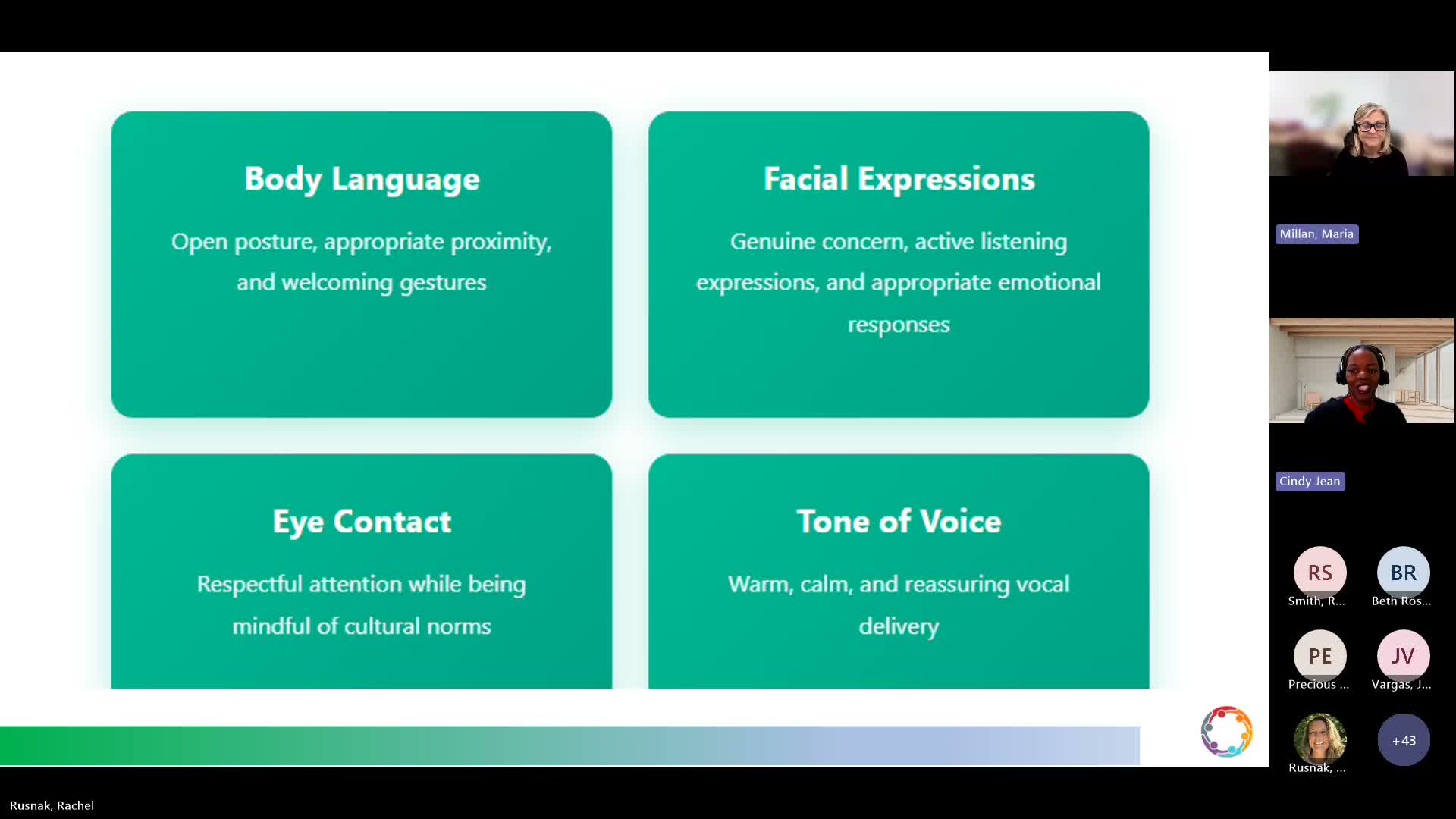
The Connecticut Office of Health Strategy hosted an online training for community health workers focused on communication skills, emphasizing active listening, closed-loop communication, and the OARS model (open questions, affirmations, reflective listening, summarizing). Rachel Rusnak, who opened the session on behalf of the Office of Health Strategy, said the webinar "will introduce concepts of communication and outline some components of clear health communication" and noted the recording and slide deck will be posted to the Office website.
Presenter Maria Milan framed communication as "the process of exchanging information, ideas, or feelings between people" and tied the skills to the national C3 core competencies for community health workers. Milan emphasized client-centered values — "honesty and integrity," respect, open-mindedness, support for self-determination, and building trust — as foundational to CHW practice.
Cynthia Jean Mary explained the role of nonverbal cues and taught techniques for reducing misunderstandings. She described closed-loop communication as a three-step practice in which the sender states a message, the receiver repeats it back to "confirm their understanding," and the sender confirms the accuracy. In a brief role play, a presenter reiterated an instruction about taking blood pressure medication with breakfast; the repetition and confirmation illustrated the closed-loop method in practice.
The session introduced OARS as practical, repeatable tools for client conversations: open-ended questions ("what, which, where, how, tell me"), affirmations to acknowledge strengths, reflective statements to demonstrate understanding, and summarizing to keep conversations focused on reasons for change and next steps. Panelists recommended using open-ended prompts such as "How is the job search going?" instead of yes/no queries to draw out more informative responses from clients.
Panelists also discussed cultural differences in nonverbal behavior. Cynthia noted that reduced eye contact can be culturally appropriate and cautioned CHWs to "be aware of how clients communicate with us" rather than assuming lack of engagement. Eve Berry, who joined the Q&A after a technical delay, gave field examples of closed-loop use in benefits counseling: restating a client's description of missing paperwork and asking "Did I get that right?" to confirm understanding.
Throughout the Q&A, presenters offered de-escalation strategies for repetitive or aggressive communication, including reflecting a client's frustration and using motivational interviewing prompts to encourage thinking about options rather than issuing directives. Panelists recommended supervisor or team support when a situation exceeds a worker's scope.
Rachel Rusnak closed the session by reminding attendees that the webinar counts for 1.5 continuing education hours for certified community health workers and that the Office will share the recording, slide deck, and a Q&A transcript on its website. Contact information for the presenters was provided for follow-up.
Presenter Maria Milan framed communication as "the process of exchanging information, ideas, or feelings between people" and tied the skills to the national C3 core competencies for community health workers. Milan emphasized client-centered values — "honesty and integrity," respect, open-mindedness, support for self-determination, and building trust — as foundational to CHW practice.
Cynthia Jean Mary explained the role of nonverbal cues and taught techniques for reducing misunderstandings. She described closed-loop communication as a three-step practice in which the sender states a message, the receiver repeats it back to "confirm their understanding," and the sender confirms the accuracy. In a brief role play, a presenter reiterated an instruction about taking blood pressure medication with breakfast; the repetition and confirmation illustrated the closed-loop method in practice.
The session introduced OARS as practical, repeatable tools for client conversations: open-ended questions ("what, which, where, how, tell me"), affirmations to acknowledge strengths, reflective statements to demonstrate understanding, and summarizing to keep conversations focused on reasons for change and next steps. Panelists recommended using open-ended prompts such as "How is the job search going?" instead of yes/no queries to draw out more informative responses from clients.
Panelists also discussed cultural differences in nonverbal behavior. Cynthia noted that reduced eye contact can be culturally appropriate and cautioned CHWs to "be aware of how clients communicate with us" rather than assuming lack of engagement. Eve Berry, who joined the Q&A after a technical delay, gave field examples of closed-loop use in benefits counseling: restating a client's description of missing paperwork and asking "Did I get that right?" to confirm understanding.
Throughout the Q&A, presenters offered de-escalation strategies for repetitive or aggressive communication, including reflecting a client's frustration and using motivational interviewing prompts to encourage thinking about options rather than issuing directives. Panelists recommended supervisor or team support when a situation exceeds a worker's scope.
Rachel Rusnak closed the session by reminding attendees that the webinar counts for 1.5 continuing education hours for certified community health workers and that the Office will share the recording, slide deck, and a Q&A transcript on its website. Contact information for the presenters was provided for follow-up.
View the Full Meeting & All Its Details
This article offers just a summary. Unlock complete video, transcripts, and insights as a Founder Member.
✓
Watch full, unedited meeting videos
✓
Search every word spoken in unlimited transcripts
✓
AI summaries & real-time alerts (all government levels)
✓
Permanent access to expanding government content
30-day money-back guarantee
