Rancho Mirage council directs staff to draft enforcement language for $7,500 campaign contribution limit
February 21, 2026 | Rancho Mirage City, Riverside County, California
This article was created by AI summarizing key points discussed. AI makes mistakes, so for full details and context, please refer to the video of the full meeting. Please report any errors so we can fix them. Report an error »
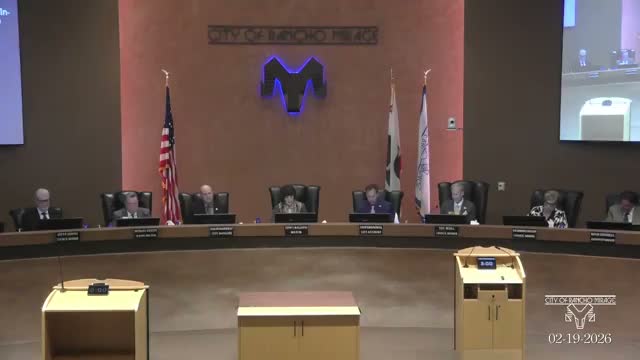
The Rancho Mirage City Council on Feb. 19 directed staff to amend a proposed resolution to establish a local campaign contribution limit of $7,500 per contributor per election and return at a future meeting with enforcement language, after a unanimous vote to give staff time to draft penalties and procedures.
City clerk Chrissy Ramos briefed the council on the California Political Reform Act, noting that since 2021 the law requires state campaign contribution limits to apply to local offices unless a city adopts its own limit. The state default limit cited in the staff report is $5,900 per contributor per election.
Council discussion featured two lines of argument. Council member Downs said a locally adopted limit that differs from the state's default eases administrative burdens for candidates and city staff, and proposed setting a local limit. Another council member, speaking from the perspective of a business attorney, said the state forms and reporting rules can be onerous and favored a higher local threshold to reduce paperwork; that council member suggested $7,500. Council member Downs said he was comfortable with a $7,500 level after hearing colleagues and public comments; another member had earlier suggested $6,000 to be distinct from the state number.
City attorney Colin Kirkpatrick and staff cautioned that adopting a local limit shifts enforcement responsibility to the city (the Fair Political Practices Commission enforces state default rules), so the resolution must include enforcement procedures and penalties. Staff said they would draft and return with an amended resolution incorporating enforcement language.
The council voted to adopt the direction to set $7,500 and to delay final action until staff returns with enforcement provisions; motion carried 5–0.
Why it matters: Changing from the state default to a city‑specific limit alters administrative procedures for candidates and places enforcement responsibility with local authorities. The council sought to balance lowering paperwork burdens against public perception and the need for transparency and penalties.
Next steps: Staff will draft enforcement provisions and return the amended resolution at a future meeting for final adoption.
City clerk Chrissy Ramos briefed the council on the California Political Reform Act, noting that since 2021 the law requires state campaign contribution limits to apply to local offices unless a city adopts its own limit. The state default limit cited in the staff report is $5,900 per contributor per election.
Council discussion featured two lines of argument. Council member Downs said a locally adopted limit that differs from the state's default eases administrative burdens for candidates and city staff, and proposed setting a local limit. Another council member, speaking from the perspective of a business attorney, said the state forms and reporting rules can be onerous and favored a higher local threshold to reduce paperwork; that council member suggested $7,500. Council member Downs said he was comfortable with a $7,500 level after hearing colleagues and public comments; another member had earlier suggested $6,000 to be distinct from the state number.
City attorney Colin Kirkpatrick and staff cautioned that adopting a local limit shifts enforcement responsibility to the city (the Fair Political Practices Commission enforces state default rules), so the resolution must include enforcement procedures and penalties. Staff said they would draft and return with an amended resolution incorporating enforcement language.
The council voted to adopt the direction to set $7,500 and to delay final action until staff returns with enforcement provisions; motion carried 5–0.
Why it matters: Changing from the state default to a city‑specific limit alters administrative procedures for candidates and places enforcement responsibility with local authorities. The council sought to balance lowering paperwork burdens against public perception and the need for transparency and penalties.
Next steps: Staff will draft enforcement provisions and return the amended resolution at a future meeting for final adoption.
View the Full Meeting & All Its Details
This article offers just a summary. Unlock complete video, transcripts, and insights as a Founder Member.
✓
Watch full, unedited meeting videos
✓
Search every word spoken in unlimited transcripts
✓
AI summaries & real-time alerts (all government levels)
✓
Permanent access to expanding government content
30-day money-back guarantee
