Richmond council introduces tighter tobacco retail rules, including 50-license cap and stronger enforcement
February 25, 2026 | Richmond, Contra Costa County, California
This article was created by AI summarizing key points discussed. AI makes mistakes, so for full details and context, please refer to the video of the full meeting. Please report any errors so we can fix them. Report an error »
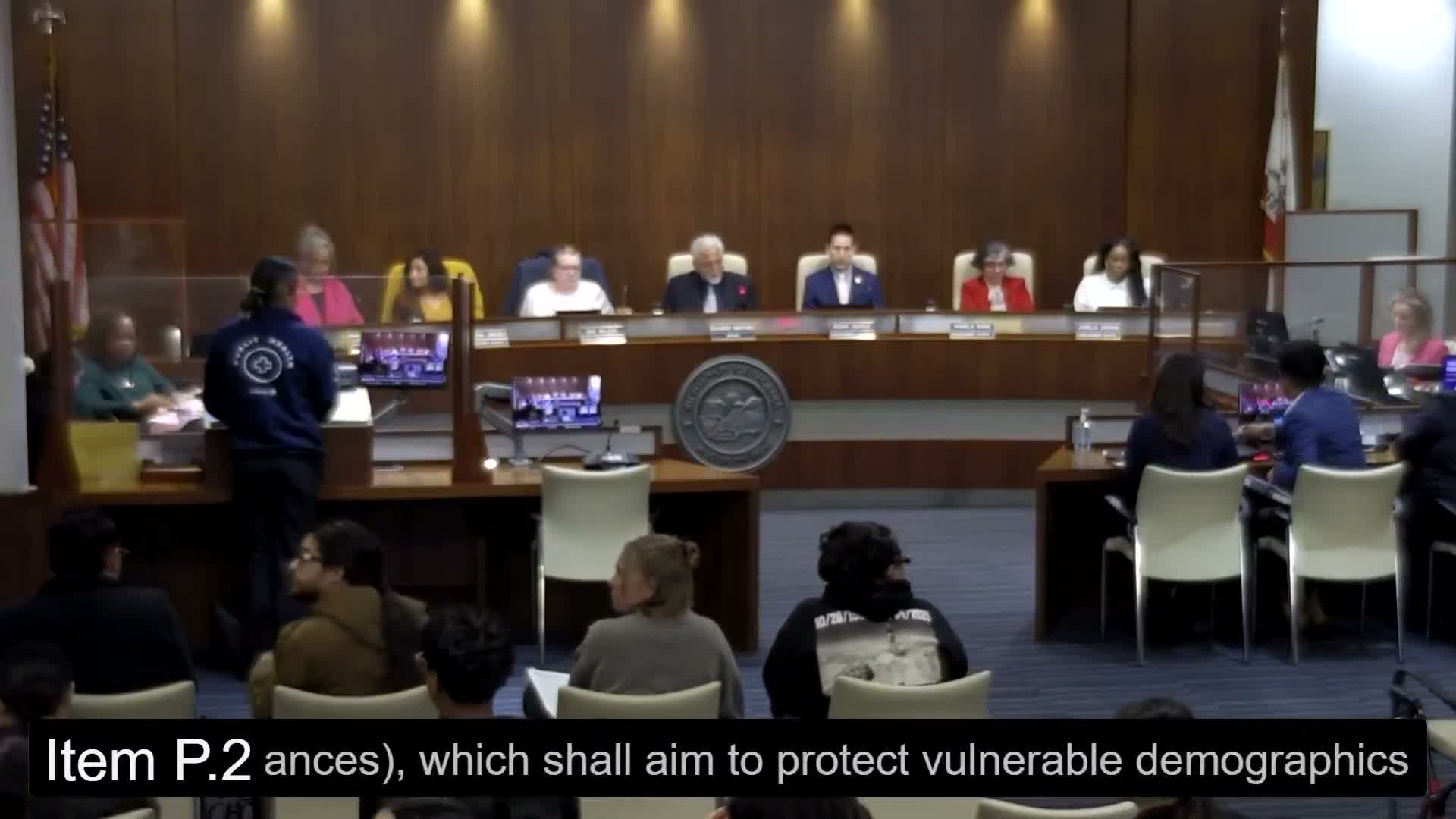
City of Richmond staff on Tuesday presented an ordinance update that would tighten local rules for tobacco retailers, aiming to reduce youth exposure and crack down on unlicensed sellers.
Planning Manager Avery Stark told the council the package would align Richmond with recent state law, preserve a 1,000-foot buffer from schools, parks and libraries, require 500-foot spacing between retailers, cap citywide tobacco retail licenses at 50, and make city tobacco retailer licenses nontransferable. The proposal limits new retailers so no more than 20% of a store’s display area may be devoted to tobacco and raises clerk minimum age and inspection requirements.
"Retailer density is one of the strongest predictors of youth tobacco use," Stark said, arguing the measures aim to "reduce exposure, protect youth and their health." County and code-enforcement staff detailed inspections finding flavored vapes, unstamped out-of-state tobacco and concealed compartments in some stores.
Public-health speakers, Richmond High students and community groups urged the strongest possible protections, while several convenience-store operators and market owners warned the rules could harm small, family-run businesses and asked for clear grandfathering pathways. Owner Carlo Shehade said his Family Market has sold tobacco at the same location for 30 years and requested an opportunity to continue that legacy use.
Staff and code enforcement described the enforcement toolbox the ordinance would create: graduated administrative citations, nuisance-abatement remedies, temporary suspensions and revocations, and authority to confiscate unlawful tobacco products consistent with state processes. Staff also noted administrative fines would escalate from roughly $500 up to $5,000 per violation in some cases.
Councilmember questions centered on enforcement capacity. Staff said the code-enforcement unit currently has six full‑time positions (eight total counting contractors), that one additional staffer was recently onboarded, and that the police department and state agencies would be partners for confiscation and criminal referrals.
Councilmember Wilson moved to introduce the ordinance for first reading and to ask staff to consider technical recommendations from public-health organizations, including the American Cancer Society and American Heart Association, and to study a possible base-price/pack-size requirement; Councilmember Brown seconded. The motion passed by roll call with Vice Mayor Robinson absent. If introduced, the second reading would occur March 3 with the ordinance effective in early April if adopted.
If adopted, the city would start targeted inspections and outreach to licensed and unlicensed retailers and provide education and application support to businesses seeking compliance.
Planning Manager Avery Stark told the council the package would align Richmond with recent state law, preserve a 1,000-foot buffer from schools, parks and libraries, require 500-foot spacing between retailers, cap citywide tobacco retail licenses at 50, and make city tobacco retailer licenses nontransferable. The proposal limits new retailers so no more than 20% of a store’s display area may be devoted to tobacco and raises clerk minimum age and inspection requirements.
"Retailer density is one of the strongest predictors of youth tobacco use," Stark said, arguing the measures aim to "reduce exposure, protect youth and their health." County and code-enforcement staff detailed inspections finding flavored vapes, unstamped out-of-state tobacco and concealed compartments in some stores.
Public-health speakers, Richmond High students and community groups urged the strongest possible protections, while several convenience-store operators and market owners warned the rules could harm small, family-run businesses and asked for clear grandfathering pathways. Owner Carlo Shehade said his Family Market has sold tobacco at the same location for 30 years and requested an opportunity to continue that legacy use.
Staff and code enforcement described the enforcement toolbox the ordinance would create: graduated administrative citations, nuisance-abatement remedies, temporary suspensions and revocations, and authority to confiscate unlawful tobacco products consistent with state processes. Staff also noted administrative fines would escalate from roughly $500 up to $5,000 per violation in some cases.
Councilmember questions centered on enforcement capacity. Staff said the code-enforcement unit currently has six full‑time positions (eight total counting contractors), that one additional staffer was recently onboarded, and that the police department and state agencies would be partners for confiscation and criminal referrals.
Councilmember Wilson moved to introduce the ordinance for first reading and to ask staff to consider technical recommendations from public-health organizations, including the American Cancer Society and American Heart Association, and to study a possible base-price/pack-size requirement; Councilmember Brown seconded. The motion passed by roll call with Vice Mayor Robinson absent. If introduced, the second reading would occur March 3 with the ordinance effective in early April if adopted.
If adopted, the city would start targeted inspections and outreach to licensed and unlicensed retailers and provide education and application support to businesses seeking compliance.
View the Full Meeting & All Its Details
This article offers just a summary. Unlock complete video, transcripts, and insights as a Founder Member.
✓
Watch full, unedited meeting videos
✓
Search every word spoken in unlimited transcripts
✓
AI summaries & real-time alerts (all government levels)
✓
Permanent access to expanding government content
30-day money-back guarantee
