Bonner County officials clarify ambulance-district finances, payroll and pension paperwork
February 25, 2026 | Bonner County, Idaho
This article was created by AI summarizing key points discussed. AI makes mistakes, so for full details and context, please refer to the video of the full meeting. Please report any errors so we can fix them. Report an error »
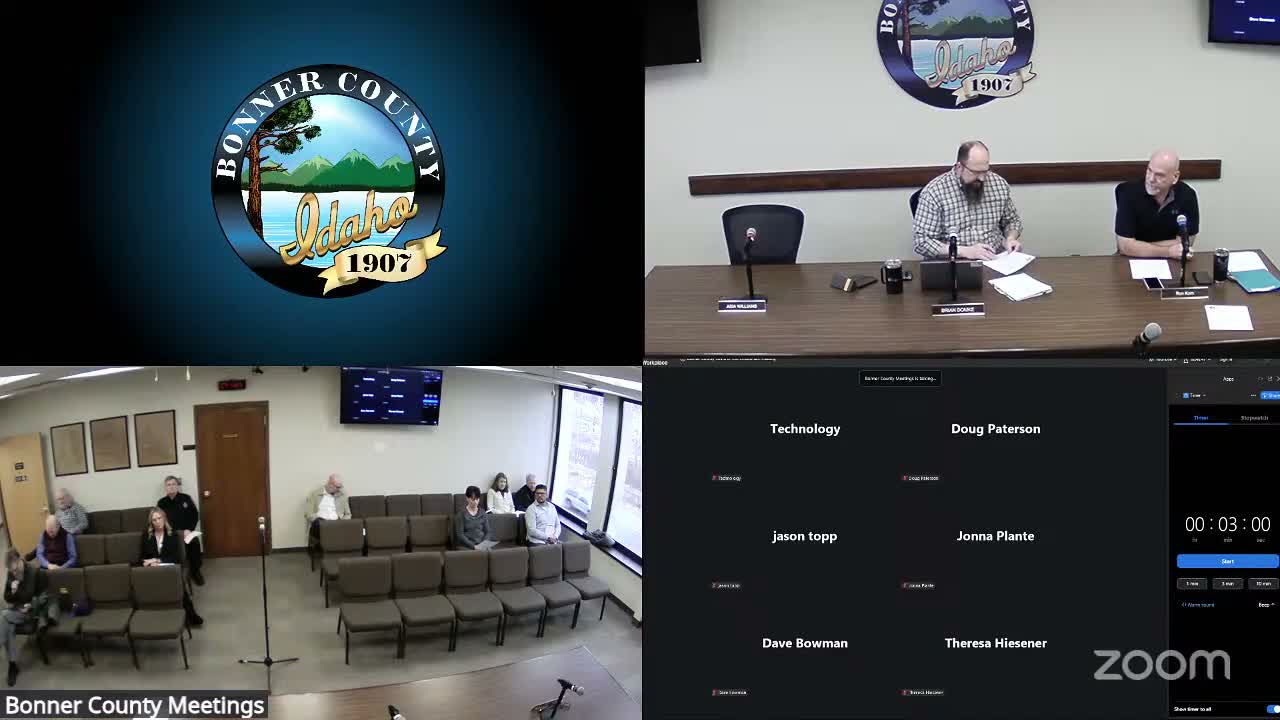
Bonner County officials spent an extended portion of their Feb. 24 meeting clarifying the county's financial relationship with the Bonner County Ambulance District and explaining payroll and pension paperwork problems the clerk's office has been working to correct.
The clerk told commissioners the county has provided roughly $5.8 million to the ambulance district since 2020 and that the district has returned about $3.2 million; the clerk read a figure the record described as leaving a deficit but several speakers acknowledged inconsistent arithmetic and phrasing in the discussion. The clerk characterized the $5.8 million figure as "what the county contributed to the taxing district since 2020," and later read the numbers as $5,847,143 given and $3,205,573 returned.
Auditor/Comptroller (unnamed) said the county's statutory duties focus on financial review, not operational policy. "We do not have the authority to audit departments' policy," the auditor stated when describing the limits of the office's internal-audit role. The auditor explained the clerk's office reviews claims for payment, monitors departmental spending against legally adopted budgets, and reconciles accounts monthly.
Officials also described a payroll and W-2 distribution problem. The clerk/auditor said the county's payroll system automatically posted documents to an employee self-service portal and an email announcing W-2 availability on Jan. 27 inadvertently included people still listed in the county group; as a result, the county manually removed EMS employee W-2s when it discovered the issue. The clerk noted the IRS this year did not require a qualified-overtime number in Box 14 and that the county chose to include total overtime in that field to help employees.
On PERSI (public employee retirement) filings, the clerk said EMS had been provided payroll information and PERSI contacts months before an organizational transition but did not file in time; she said the late filing occurred roughly a week before transition, making timely processing by PERSI impossible. The clerk said the county has opened help tickets with the payroll software vendor (Tyler) and sought additional training to allow staff to correct incorrect W-2s in the system.
Several residents and commissioners urged clearer communication and earlier invitations to meetings where EMS matters are discussed. The clerk and auditor said they had not intentionally excluded EMS bookkeepers from communications and recommended stronger processes to remove access for terminated employees in the future.
What happens next: commissioners asked that the county and ambulance-district representatives meet to reconcile the numbers and outstanding questions. The record contains multiple reported figures and phrasing inconsistencies; the county's clerk and auditor said they will provide further detail to the board in follow-up correspondence and recommended in-person training with the payroll vendor to fix system access issues.
The clerk told commissioners the county has provided roughly $5.8 million to the ambulance district since 2020 and that the district has returned about $3.2 million; the clerk read a figure the record described as leaving a deficit but several speakers acknowledged inconsistent arithmetic and phrasing in the discussion. The clerk characterized the $5.8 million figure as "what the county contributed to the taxing district since 2020," and later read the numbers as $5,847,143 given and $3,205,573 returned.
Auditor/Comptroller (unnamed) said the county's statutory duties focus on financial review, not operational policy. "We do not have the authority to audit departments' policy," the auditor stated when describing the limits of the office's internal-audit role. The auditor explained the clerk's office reviews claims for payment, monitors departmental spending against legally adopted budgets, and reconciles accounts monthly.
Officials also described a payroll and W-2 distribution problem. The clerk/auditor said the county's payroll system automatically posted documents to an employee self-service portal and an email announcing W-2 availability on Jan. 27 inadvertently included people still listed in the county group; as a result, the county manually removed EMS employee W-2s when it discovered the issue. The clerk noted the IRS this year did not require a qualified-overtime number in Box 14 and that the county chose to include total overtime in that field to help employees.
On PERSI (public employee retirement) filings, the clerk said EMS had been provided payroll information and PERSI contacts months before an organizational transition but did not file in time; she said the late filing occurred roughly a week before transition, making timely processing by PERSI impossible. The clerk said the county has opened help tickets with the payroll software vendor (Tyler) and sought additional training to allow staff to correct incorrect W-2s in the system.
Several residents and commissioners urged clearer communication and earlier invitations to meetings where EMS matters are discussed. The clerk and auditor said they had not intentionally excluded EMS bookkeepers from communications and recommended stronger processes to remove access for terminated employees in the future.
What happens next: commissioners asked that the county and ambulance-district representatives meet to reconcile the numbers and outstanding questions. The record contains multiple reported figures and phrasing inconsistencies; the county's clerk and auditor said they will provide further detail to the board in follow-up correspondence and recommended in-person training with the payroll vendor to fix system access issues.
Don't Miss a Word: See the Full Meeting!
Go beyond summaries. Unlock every video, transcript, and key insight with a Founder Membership.
✓
Get instant access to full meeting videos
✓
Search and clip any phrase from complete transcripts
✓
Receive AI-powered summaries & custom alerts
✓
Enjoy lifetime, unrestricted access to government data
30-day money-back guarantee
