Beavercreek finance director outlines income‑tax options if property tax limits advance
February 22, 2026 | Beavercreek, Greene County, Ohio
This article was created by AI summarizing key points discussed. AI makes mistakes, so for full details and context, please refer to the video of the full meeting. Please report any errors so we can fix them. Report an error »
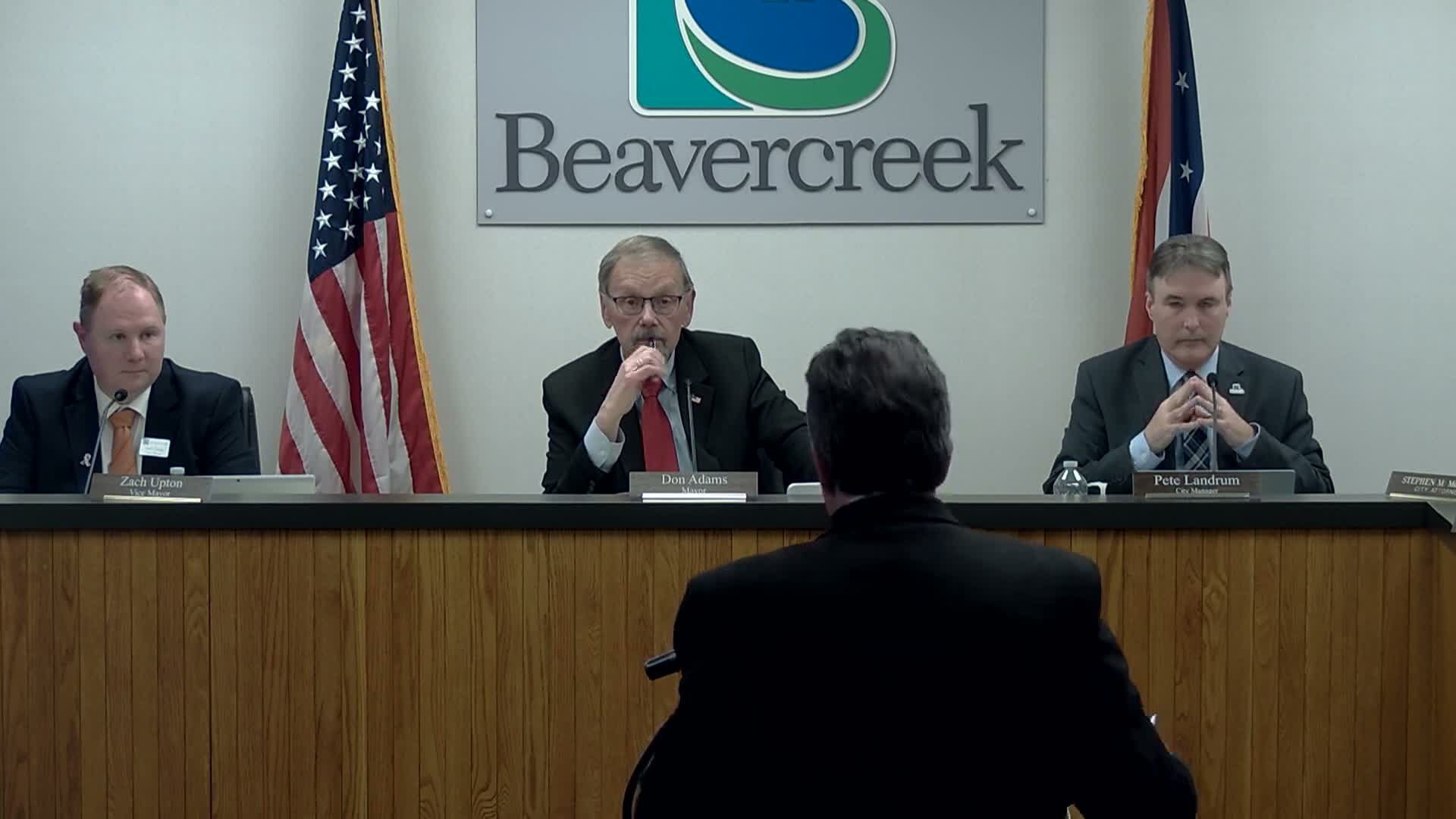
Beavercreek — The city’s finance director told council that property taxes account for roughly 64% of the city’s revenue and that several recently passed and proposed state measures would substantially constrain future local property‑tax growth.
David Graham presented two modeled scenarios for the council’s consideration: a 50% reduction in property‑tax levies paired with a 1% municipal income tax, and a full elimination of local property taxes replaced by a 2.9% income tax. Graham said the 1% option would be conservative and take several years to reach projected collection rates; the 2.9% rate was modeled as a ‘‘doomsday’’ fallback if property taxes were abolished statewide.
He told council the projected new millage and levy timing matters because property taxes are assessed in arrears and many levies are multi‑year. "You can see 64% of our revenue comes from property taxes," Graham said, noting that much of the city’s revenue is restricted by levy terms and grant conditions.
Under the 1%/50% scenario, the city could see a short‑term deficit (the presentation showed a projected $3.5 million deficit in 2028 before income‑tax collections ramp), then approach balance as collections rise. Under the full elimination/2.9% scenario, modeling showed an initial gap that would shrink as income‑tax receipts matured but would carry additional costs if the city had to assume services previously funded by township levies (fire and EMS) or renegotiate service contracts.
Council members asked about timing, collection rates and assumptions. Graham said Miami University's modeling (which staff used) estimated about $19.6 million annually from a 1% income tax and that collection would approach the projection over roughly three years (about 60% year 1, 85% year 2, near 100% year 3). He and staff warned that total service costs and any responsibility to provide township services would affect the final rate needed.
Graham recommended council consider revenue diversification rather than total elimination of property taxes and noted next steps include a public hearing and an ordinance for an income‑tax code scheduled for the March 9 council meeting.
David Graham presented two modeled scenarios for the council’s consideration: a 50% reduction in property‑tax levies paired with a 1% municipal income tax, and a full elimination of local property taxes replaced by a 2.9% income tax. Graham said the 1% option would be conservative and take several years to reach projected collection rates; the 2.9% rate was modeled as a ‘‘doomsday’’ fallback if property taxes were abolished statewide.
He told council the projected new millage and levy timing matters because property taxes are assessed in arrears and many levies are multi‑year. "You can see 64% of our revenue comes from property taxes," Graham said, noting that much of the city’s revenue is restricted by levy terms and grant conditions.
Under the 1%/50% scenario, the city could see a short‑term deficit (the presentation showed a projected $3.5 million deficit in 2028 before income‑tax collections ramp), then approach balance as collections rise. Under the full elimination/2.9% scenario, modeling showed an initial gap that would shrink as income‑tax receipts matured but would carry additional costs if the city had to assume services previously funded by township levies (fire and EMS) or renegotiate service contracts.
Council members asked about timing, collection rates and assumptions. Graham said Miami University's modeling (which staff used) estimated about $19.6 million annually from a 1% income tax and that collection would approach the projection over roughly three years (about 60% year 1, 85% year 2, near 100% year 3). He and staff warned that total service costs and any responsibility to provide township services would affect the final rate needed.
Graham recommended council consider revenue diversification rather than total elimination of property taxes and noted next steps include a public hearing and an ordinance for an income‑tax code scheduled for the March 9 council meeting.
View the Full Meeting & All Its Details
This article offers just a summary. Unlock complete video, transcripts, and insights as a Founder Member.
✓
Watch full, unedited meeting videos
✓
Search every word spoken in unlimited transcripts
✓
AI summaries & real-time alerts (all government levels)
✓
Permanent access to expanding government content
30-day money-back guarantee
