Department of Public Service seeks procedural fixes to Act 174 to align energy planning with Land Use Review Board timetable
February 24, 2026 | Environment & Energy, HOUSE OF REPRESENTATIVES, Committees, Legislative , Vermont
This article was created by AI summarizing key points discussed. AI makes mistakes, so for full details and context, please refer to the video of the full meeting. Please report any errors so we can fix them. Report an error »
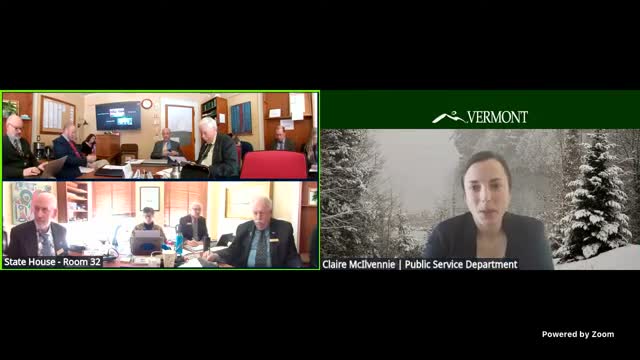
The Department of Public Service told the House Energy and Digital Infrastructure Committee on Feb. 24 that modest procedural edits to Act 174 would reduce duplicative hearings and prevent short gaps in a region’s ‘‘substantial deference’’ during rapid regional plan updates.
Claire McElvenney, the department’s data and equity policy manager, said the draft language the agency provided focuses on timing and process rather than substantive changes to local or regional energy policy. She said the changes would align the department’s enhanced‑energy‑plan review with the Land Use Review Board’s (LERB) new review timetable under Act 181 and streamline public engagement. "We're not aware of any siting petitions that have been denied because of a plan's substantial deference," McElvenney said, arguing that substantial deference has generally helped steer proposals toward locations communities favor.
The proposal would formalize what the department said is already common practice: regional planning commissions (RPCs) should solicit public feedback on draft enhanced energy plans at one of their public hearings before adoption, and the department would consider that feedback during its statutory review window rather than holding a second public hearing after plan adoption. The change would retain a public record for the department’s determination but aim to reduce 'engagement fatigue' by avoiding effectively identical hearings at both the RPC and state levels.
McElvenney also outlined two timing changes designed to reduce administrative burden. First, the department asked for up to one additional year after the Comprehensive Energy Plan is issued to adopt updated standards in keeping with the CEP cycle. Second, for regions that adopt new regional plans for non‑energy reasons (for example, to conform with Act 181 technical requirements), the department proposed a limited provisional determination to cover a region while the department completes a focused review so the region would not temporarily lose its affirmative determination and the resulting deference in PUC siting proceedings.
The department said the proposed fixes are procedural and intended to help it manage a near‑term surge of plan updates from RPCs responding to the Land Use Review Board’s schedule. McElvenney told the committee that the proposed edits were developed in consultation with several RPCs and the Land Use Review Board and that the drafts include annotations explaining the changes.
Committee members asked for clarification about where the proposed language would live in statute, how long the department would take to publish updated standards after a CEP, and whether removing the department’s own hearing would affect citizens’ ability to comment. McElvenney said materials are posted publicly during review, explained the department’s review period (proposed as a 60‑day window in the draft), and said the department would be required to consider comments solicited by RPCs when making its determination.
The committee did not take immediate action; staff requested final language and noted legislative scheduling constraints ahead of crossover. The Department of Public Service offered to provide the committee with the draft text and supporting annotations for committee staff review.
Claire McElvenney, the department’s data and equity policy manager, said the draft language the agency provided focuses on timing and process rather than substantive changes to local or regional energy policy. She said the changes would align the department’s enhanced‑energy‑plan review with the Land Use Review Board’s (LERB) new review timetable under Act 181 and streamline public engagement. "We're not aware of any siting petitions that have been denied because of a plan's substantial deference," McElvenney said, arguing that substantial deference has generally helped steer proposals toward locations communities favor.
The proposal would formalize what the department said is already common practice: regional planning commissions (RPCs) should solicit public feedback on draft enhanced energy plans at one of their public hearings before adoption, and the department would consider that feedback during its statutory review window rather than holding a second public hearing after plan adoption. The change would retain a public record for the department’s determination but aim to reduce 'engagement fatigue' by avoiding effectively identical hearings at both the RPC and state levels.
McElvenney also outlined two timing changes designed to reduce administrative burden. First, the department asked for up to one additional year after the Comprehensive Energy Plan is issued to adopt updated standards in keeping with the CEP cycle. Second, for regions that adopt new regional plans for non‑energy reasons (for example, to conform with Act 181 technical requirements), the department proposed a limited provisional determination to cover a region while the department completes a focused review so the region would not temporarily lose its affirmative determination and the resulting deference in PUC siting proceedings.
The department said the proposed fixes are procedural and intended to help it manage a near‑term surge of plan updates from RPCs responding to the Land Use Review Board’s schedule. McElvenney told the committee that the proposed edits were developed in consultation with several RPCs and the Land Use Review Board and that the drafts include annotations explaining the changes.
Committee members asked for clarification about where the proposed language would live in statute, how long the department would take to publish updated standards after a CEP, and whether removing the department’s own hearing would affect citizens’ ability to comment. McElvenney said materials are posted publicly during review, explained the department’s review period (proposed as a 60‑day window in the draft), and said the department would be required to consider comments solicited by RPCs when making its determination.
The committee did not take immediate action; staff requested final language and noted legislative scheduling constraints ahead of crossover. The Department of Public Service offered to provide the committee with the draft text and supporting annotations for committee staff review.
Don't Miss a Word: See the Full Meeting!
Go beyond summaries. Unlock every video, transcript, and key insight with a Founder Membership.
✓
Get instant access to full meeting videos
✓
Search and clip any phrase from complete transcripts
✓
Receive AI-powered summaries & custom alerts
✓
Enjoy lifetime, unrestricted access to government data
30-day money-back guarantee
