Committee weighs amendment allowing cannabis producers to form small cooperatives
February 23, 2026 | Legislative Sessions, Washington
This article was created by AI summarizing key points discussed. AI makes mistakes, so for full details and context, please refer to the video of the full meeting. Please report any errors so we can fix them. Report an error »
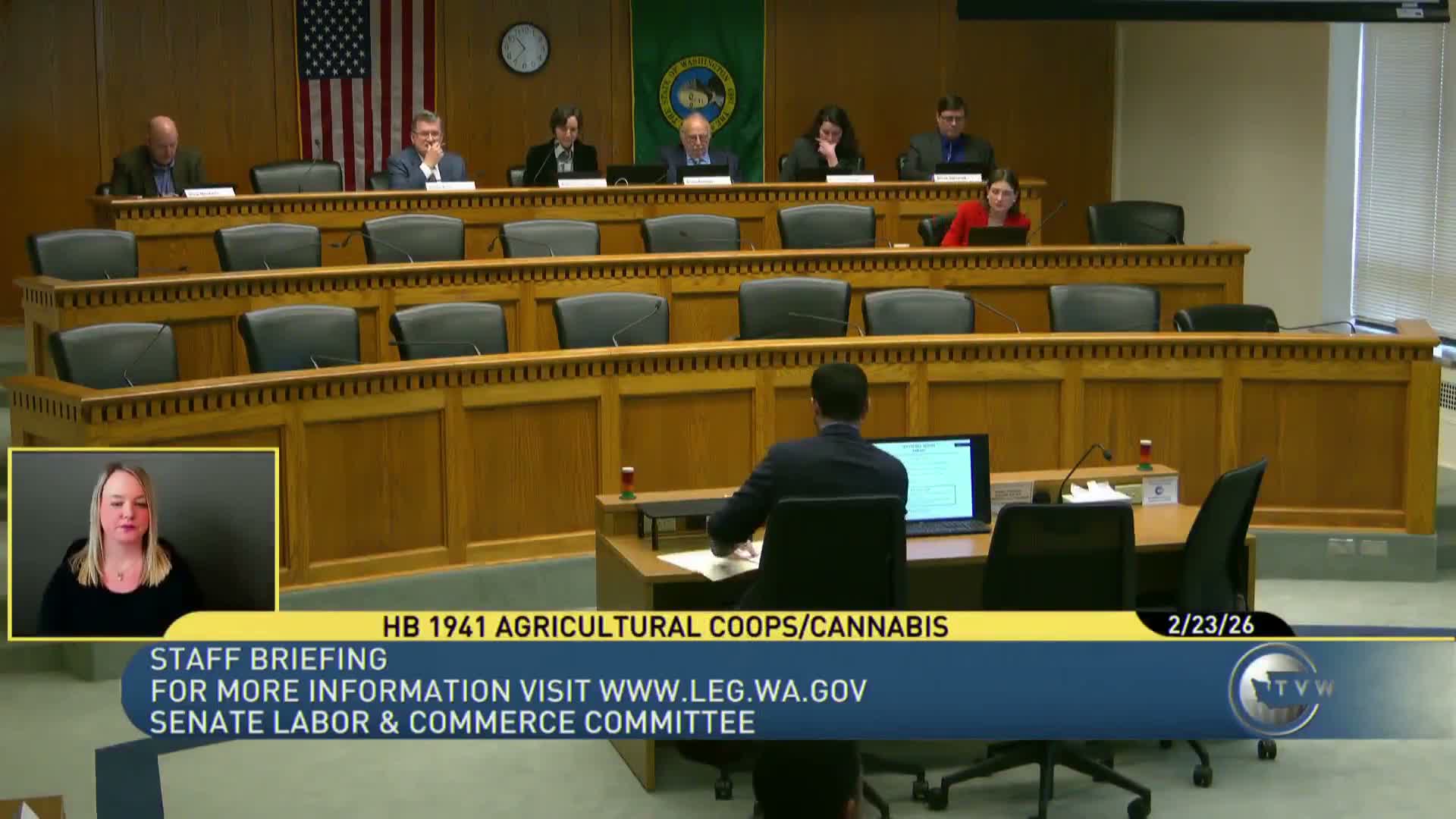
The Labor and Commerce Committee heard a striking amendment to House Bill 1941 on Feb. 25 that would permit licensed cannabis producers to organize agricultural associations or cooperatives to collectively process, handle and market their products.
Committee staff explained the amendment narrows the original bill’s market‑share metric (a 30% licensed canopy cap) and instead prohibits a single association from representing more than three producer licenses issued by the Liquor and Cannabis Board (LCB) at any time. Supporters said the cap is designed to allow small producers to pool resources while limiting consolidation that could further depress prices in a market with licensed capacity far exceeding current demand.
Producers and industry groups testified in favor with caveats. Micah Sherman and Ezra Eichmeier said Washington’s production capacity currently far outstrips market demand and urged caution and potential future amendments tied to federal legalization. Bethany Rondeau of the Washington Cannabis Licensing Association provided square‑footage figures showing licensed canopy greatly exceeds market demand and said the three‑license cap helps protect small craft producers.
Sponsor testimony framed the bill as restoring an agricultural tool long available to other commodities. "This is inequitable," a sponsor said, noting that producers currently cannot pool the marketing and processing tools available to farmers, ranchers and dairies.
Mark Webster of the LCB clarified the bill is governed by the Department of Agriculture’s statutory title and that the amended language reduces LCB’s role in canopy calculations. Committee members pressed industry witnesses on competitive effects and consumer protections; witnesses and LCB said the amendments address consolidation concerns while the three‑license cap preserves cooperative benefits for small producers.
The committee concluded the public hearing and later considered other bills in executive action. Supporters urged continued consideration of forward‑looking amendments should federal legalization create interstate commerce pressures.
Committee staff explained the amendment narrows the original bill’s market‑share metric (a 30% licensed canopy cap) and instead prohibits a single association from representing more than three producer licenses issued by the Liquor and Cannabis Board (LCB) at any time. Supporters said the cap is designed to allow small producers to pool resources while limiting consolidation that could further depress prices in a market with licensed capacity far exceeding current demand.
Producers and industry groups testified in favor with caveats. Micah Sherman and Ezra Eichmeier said Washington’s production capacity currently far outstrips market demand and urged caution and potential future amendments tied to federal legalization. Bethany Rondeau of the Washington Cannabis Licensing Association provided square‑footage figures showing licensed canopy greatly exceeds market demand and said the three‑license cap helps protect small craft producers.
Sponsor testimony framed the bill as restoring an agricultural tool long available to other commodities. "This is inequitable," a sponsor said, noting that producers currently cannot pool the marketing and processing tools available to farmers, ranchers and dairies.
Mark Webster of the LCB clarified the bill is governed by the Department of Agriculture’s statutory title and that the amended language reduces LCB’s role in canopy calculations. Committee members pressed industry witnesses on competitive effects and consumer protections; witnesses and LCB said the amendments address consolidation concerns while the three‑license cap preserves cooperative benefits for small producers.
The committee concluded the public hearing and later considered other bills in executive action. Supporters urged continued consideration of forward‑looking amendments should federal legalization create interstate commerce pressures.
View the Full Meeting & All Its Details
This article offers just a summary. Unlock complete video, transcripts, and insights as a Founder Member.
✓
Watch full, unedited meeting videos
✓
Search every word spoken in unlimited transcripts
✓
AI summaries & real-time alerts (all government levels)
✓
Permanent access to expanding government content
30-day money-back guarantee
