Senate committee hears EV Council update; state warns of fast‑charging and adoption shortfalls
February 23, 2026 | Legislative Sessions, Washington
This article was created by AI summarizing key points discussed. AI makes mistakes, so for full details and context, please refer to the video of the full meeting. Please report any errors so we can fix them. Report an error »
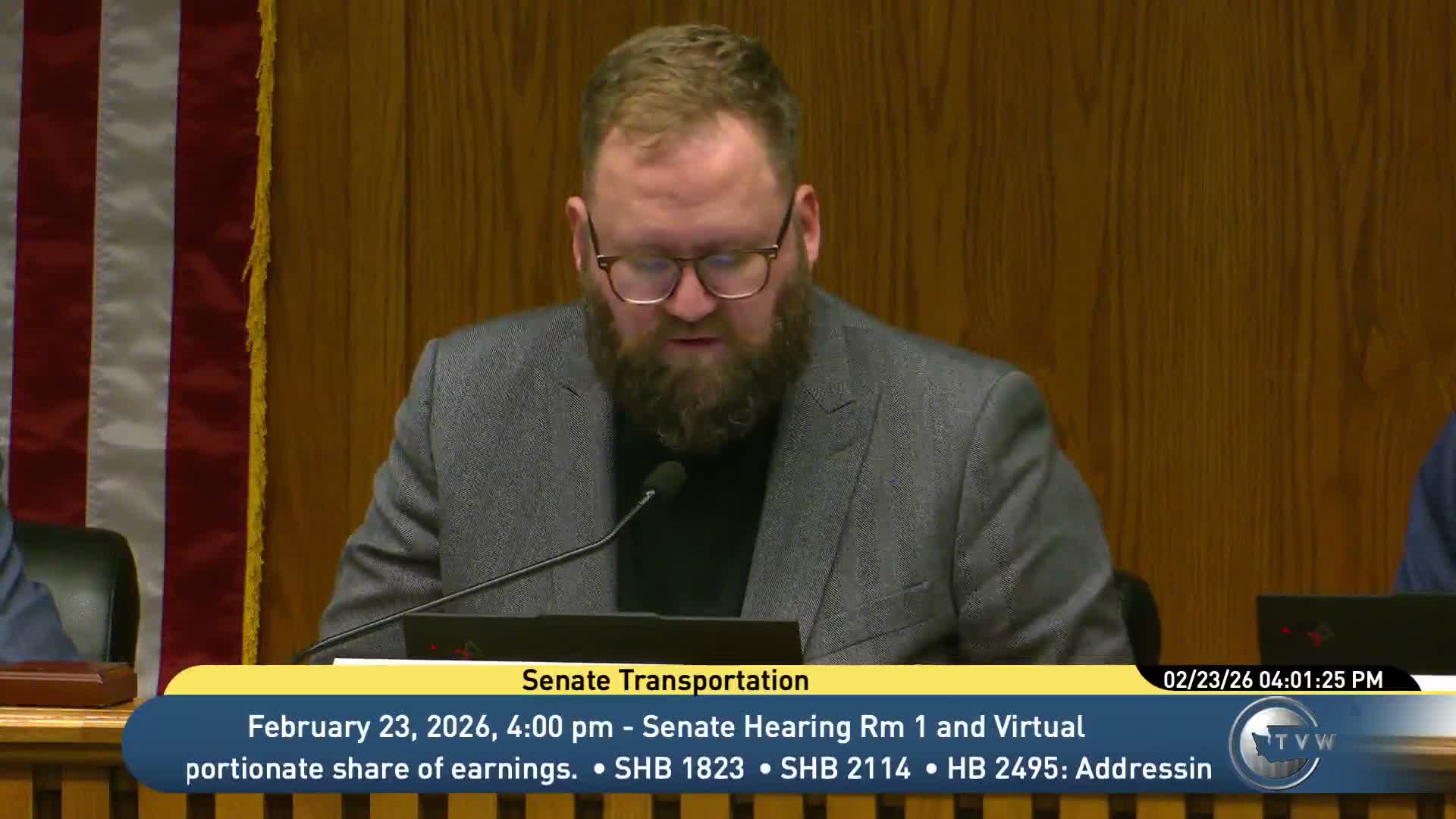
The Senate Transportation Committee on Feb. 23 heard from the interagency Electric Vehicle Coordinating Council, which warned that recent growth in electric vehicle adoption has flattened and that the state faces a significant shortfall in fast charging capacity.
Tonia Buell, alternative fuels program manager at the Washington State Department of Transportation and co‑chair of the EV Council, said the council — made up of about 10 state agencies — developed a Transportation Electrification Strategy that includes more than 100 recommendations and a public dashboard tracking progress. "We submit an annual report to you every year, and the next one's coming any day," Buell said.
Steven Hershkowitz, managing director of Clean Transportation at the Department of Commerce, said Washington's EV growth was robust in 2022–23 but has slowed in 2024–25. "We really need to do something to jumpstart the EV market," he told the committee, pointing to modeling showing Washington fell below targets set through Department of Ecology rules and citing an estimated gap of more than 700 fast‑charging ports needed to meet greenhouse‑gas reduction requirements.
Committee members asked technical questions about charging standards. Senator Wilson noted the shift in industry norms and asked whether the state's minimum definition of a fast charger could be updated; Buell replied that programs now use a 150‑kilowatt minimum, that NEVI sites generally require four ports and 600 kilowatts per site, and that applications proposing higher‑power chargers may receive bonus points.
Buell highlighted recent and planned grant activity: $12.6 million in federal NEVI awards to add nearly 100 fast ports across 14 communities, more than $100 million in recent grant applications to Commerce programs, and longstanding ZVIP public‑private grants that have helped install over 100 DC fast chargers. She also described WAZIP, a forthcoming voucher program for medium‑ and heavy‑duty zero‑emission vehicles and off‑road equipment that will provide point‑of‑purchase discounts for fleets.
On hydrogen, Buell and WSDOT’s medium‑ and heavy‑duty program supervisor Foy Truong said the agency is testing hydrogen vehicles and has invested about $33 million in hydrogen transit buses and refueling, funded a hydrogen fueling site in East Wenatchee through an agreement with Douglas PUD and is participating in a West Coast truck charging and fuel corridor project. Truong cautioned the committee that the hydrogen market is still maturing and said WSDOT will coordinate with regional stakeholders and track federal funding developments before committing additional funds.
The committee did not take formal action during the work session; presenters said they would return with regular annual reports and program updates.
Tonia Buell, alternative fuels program manager at the Washington State Department of Transportation and co‑chair of the EV Council, said the council — made up of about 10 state agencies — developed a Transportation Electrification Strategy that includes more than 100 recommendations and a public dashboard tracking progress. "We submit an annual report to you every year, and the next one's coming any day," Buell said.
Steven Hershkowitz, managing director of Clean Transportation at the Department of Commerce, said Washington's EV growth was robust in 2022–23 but has slowed in 2024–25. "We really need to do something to jumpstart the EV market," he told the committee, pointing to modeling showing Washington fell below targets set through Department of Ecology rules and citing an estimated gap of more than 700 fast‑charging ports needed to meet greenhouse‑gas reduction requirements.
Committee members asked technical questions about charging standards. Senator Wilson noted the shift in industry norms and asked whether the state's minimum definition of a fast charger could be updated; Buell replied that programs now use a 150‑kilowatt minimum, that NEVI sites generally require four ports and 600 kilowatts per site, and that applications proposing higher‑power chargers may receive bonus points.
Buell highlighted recent and planned grant activity: $12.6 million in federal NEVI awards to add nearly 100 fast ports across 14 communities, more than $100 million in recent grant applications to Commerce programs, and longstanding ZVIP public‑private grants that have helped install over 100 DC fast chargers. She also described WAZIP, a forthcoming voucher program for medium‑ and heavy‑duty zero‑emission vehicles and off‑road equipment that will provide point‑of‑purchase discounts for fleets.
On hydrogen, Buell and WSDOT’s medium‑ and heavy‑duty program supervisor Foy Truong said the agency is testing hydrogen vehicles and has invested about $33 million in hydrogen transit buses and refueling, funded a hydrogen fueling site in East Wenatchee through an agreement with Douglas PUD and is participating in a West Coast truck charging and fuel corridor project. Truong cautioned the committee that the hydrogen market is still maturing and said WSDOT will coordinate with regional stakeholders and track federal funding developments before committing additional funds.
The committee did not take formal action during the work session; presenters said they would return with regular annual reports and program updates.
Don't Miss a Word: See the Full Meeting!
Go beyond summaries. Unlock every video, transcript, and key insight with a Founder Membership.
✓
Get instant access to full meeting videos
✓
Search and clip any phrase from complete transcripts
✓
Receive AI-powered summaries & custom alerts
✓
Enjoy lifetime, unrestricted access to government data
30-day money-back guarantee
