House Transportation Committee hears substitute to add roughly $1.1 billion to 2026 transportation budget
February 23, 2026 | Legislative Sessions, Washington
This article was created by AI summarizing key points discussed. AI makes mistakes, so for full details and context, please refer to the video of the full meeting. Please report any errors so we can fix them. Report an error »
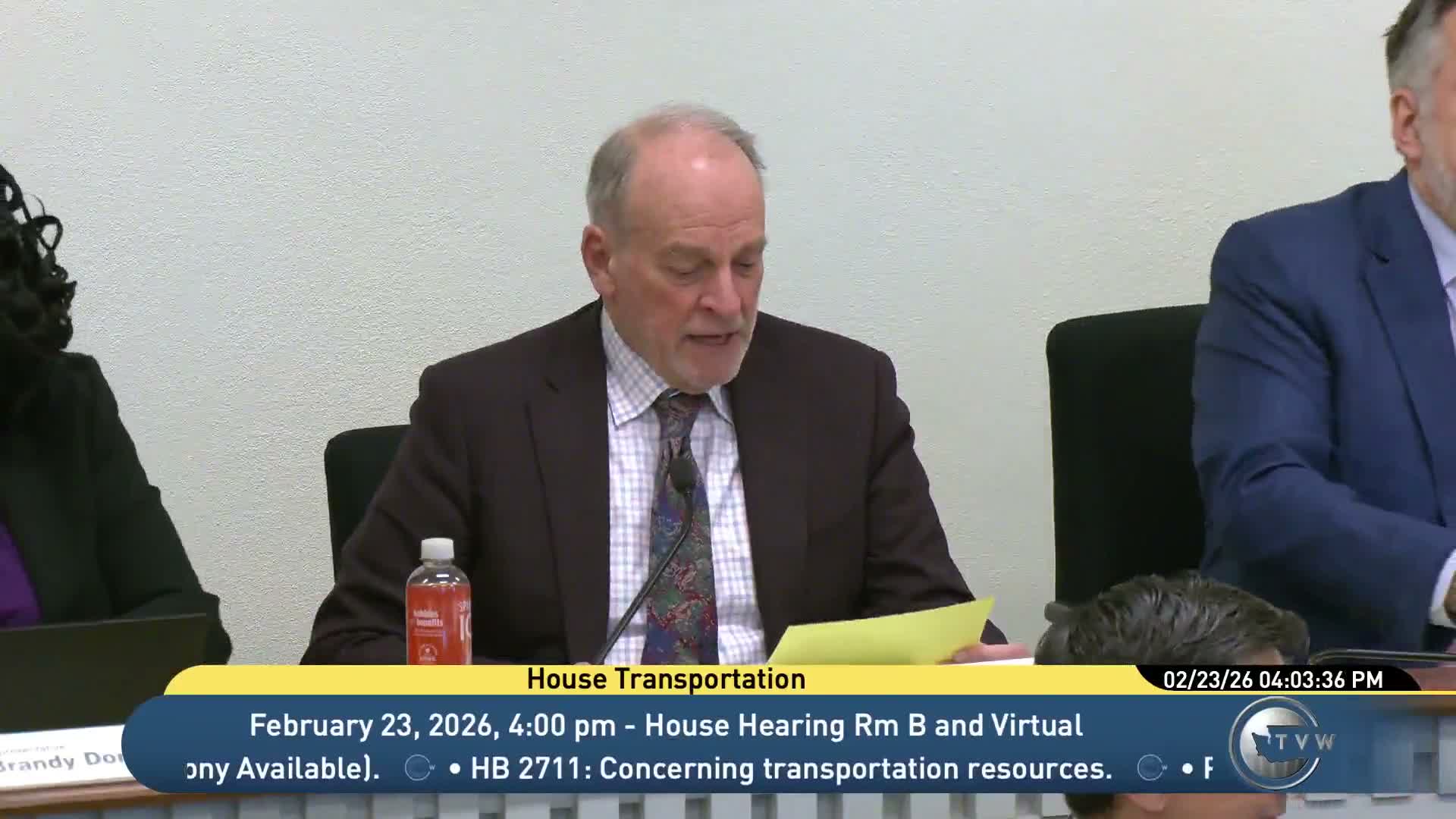
Committee staff presented a proposed substitute to House Bill 2306 on Feb. 23, describing changes to the 2026 supplemental transportation budget that would raise the transportation total by about $1.1 billion to roughly $16.5 billion.
The substitute, explained by committee staffer Amy Skate, would repurpose roughly $780 million in reappropriations from underspent capital balances and add new spending in several targeted areas, including $300 million for preservation and $35 million for maintenance. Skate said reappropriations result largely from agency reversions in the capital program and stressed that members should consult the packet materials and the LEAP site for itemized lists of projects.
Why it matters: the bill funds continuing capital projects while managing a weaker revenue forecast and avoiding new bond authority in the current biennium. Skate told the committee the substitute relies on existing bonding authority and cash balances rather than proposing new bonds now.
Key details and projects: staff listed a range of allocations and program changes in the substitute, including an emphasis on continuing Move Ahead Washington and related capital work; a re‑timing of the SR 3 freight corridor; $12 million carved from bridge funding for Fairfax Bridge planning and environmental review; and investments in rail and transit. Notable line items include about $12 million for three rail capital projects intended to improve Amtrak Cascades trip times; $12 million to King County Metro tied to I‑5 mitigation; $5 million for sidewalks and a mid‑block crossing in Spanaway (State Route 7); and $2 million for EV chargers at Department of Natural Resources regional administrative facilities. The substitute also provides $500,000 to the Joint Transportation Committee to convene a work group to study long‑range vessel and asset management for ferries.
Agency and program adjustments: staff identified $1.4 million for a second Department of Licensing mobile ('DOL to‑go') team to reach rural communities, expanded reimbursements from the abandoned RV program for removal of public‑property RVs, $7.6 million for the Washington State Patrol land mobile radio and statewide wide area network, and a $1.4 million reduction in toxicology appropriations that is expected to be reappropriated in a later biennium to continue work on backlog reduction.
Public testimony: witnesses from ports, transit and local government largely supported preservation, maintenance and specific projects in the substitute. Ryan Hart of the Port of Vancouver USA said the dredging and maintenance funding is critical to preserving a major trade corridor and noted, "The Columbia River system moves over 31,000,000,000 in cargo annually and supports more than 40,000 local jobs." Representatives of Climate Rail Alliance and other rail advocates welcomed state matching dollars for Cascades Corridor projects, citing potential congestion relief and improved on‑time performance for passenger rail. Local officials and associations asked for restorations or re‑allocations on projects affecting communities, including a City of Kent request to restore Phase 2 funding for the 224th Corridor project to avoid a construction pause.
Process and context: committee leaders described the substitute as cautious. Members were told the package contains a four‑year itemized project list for immediate items and a future column for later years and that local program funding will be smoothed across expected delivery years to reduce underspends and better match outlays to project delivery.
Next steps: the committee closed the public hearing and moved the bill to the executive session calendar for further consideration.
The substitute, explained by committee staffer Amy Skate, would repurpose roughly $780 million in reappropriations from underspent capital balances and add new spending in several targeted areas, including $300 million for preservation and $35 million for maintenance. Skate said reappropriations result largely from agency reversions in the capital program and stressed that members should consult the packet materials and the LEAP site for itemized lists of projects.
Why it matters: the bill funds continuing capital projects while managing a weaker revenue forecast and avoiding new bond authority in the current biennium. Skate told the committee the substitute relies on existing bonding authority and cash balances rather than proposing new bonds now.
Key details and projects: staff listed a range of allocations and program changes in the substitute, including an emphasis on continuing Move Ahead Washington and related capital work; a re‑timing of the SR 3 freight corridor; $12 million carved from bridge funding for Fairfax Bridge planning and environmental review; and investments in rail and transit. Notable line items include about $12 million for three rail capital projects intended to improve Amtrak Cascades trip times; $12 million to King County Metro tied to I‑5 mitigation; $5 million for sidewalks and a mid‑block crossing in Spanaway (State Route 7); and $2 million for EV chargers at Department of Natural Resources regional administrative facilities. The substitute also provides $500,000 to the Joint Transportation Committee to convene a work group to study long‑range vessel and asset management for ferries.
Agency and program adjustments: staff identified $1.4 million for a second Department of Licensing mobile ('DOL to‑go') team to reach rural communities, expanded reimbursements from the abandoned RV program for removal of public‑property RVs, $7.6 million for the Washington State Patrol land mobile radio and statewide wide area network, and a $1.4 million reduction in toxicology appropriations that is expected to be reappropriated in a later biennium to continue work on backlog reduction.
Public testimony: witnesses from ports, transit and local government largely supported preservation, maintenance and specific projects in the substitute. Ryan Hart of the Port of Vancouver USA said the dredging and maintenance funding is critical to preserving a major trade corridor and noted, "The Columbia River system moves over 31,000,000,000 in cargo annually and supports more than 40,000 local jobs." Representatives of Climate Rail Alliance and other rail advocates welcomed state matching dollars for Cascades Corridor projects, citing potential congestion relief and improved on‑time performance for passenger rail. Local officials and associations asked for restorations or re‑allocations on projects affecting communities, including a City of Kent request to restore Phase 2 funding for the 224th Corridor project to avoid a construction pause.
Process and context: committee leaders described the substitute as cautious. Members were told the package contains a four‑year itemized project list for immediate items and a future column for later years and that local program funding will be smoothed across expected delivery years to reduce underspends and better match outlays to project delivery.
Next steps: the committee closed the public hearing and moved the bill to the executive session calendar for further consideration.
View the Full Meeting & All Its Details
This article offers just a summary. Unlock complete video, transcripts, and insights as a Founder Member.
✓
Watch full, unedited meeting videos
✓
Search every word spoken in unlimited transcripts
✓
AI summaries & real-time alerts (all government levels)
✓
Permanent access to expanding government content
30-day money-back guarantee
