House Appropriations Committee holds public hearing on substitute House Bill 2289 amid contested cuts to adult therapy, education and climate-related accounts
February 23, 2026 | Legislative Sessions, Washington
This article was created by AI summarizing key points discussed. AI makes mistakes, so for full details and context, please refer to the video of the full meeting. Please report any errors so we can fix them. Report an error »
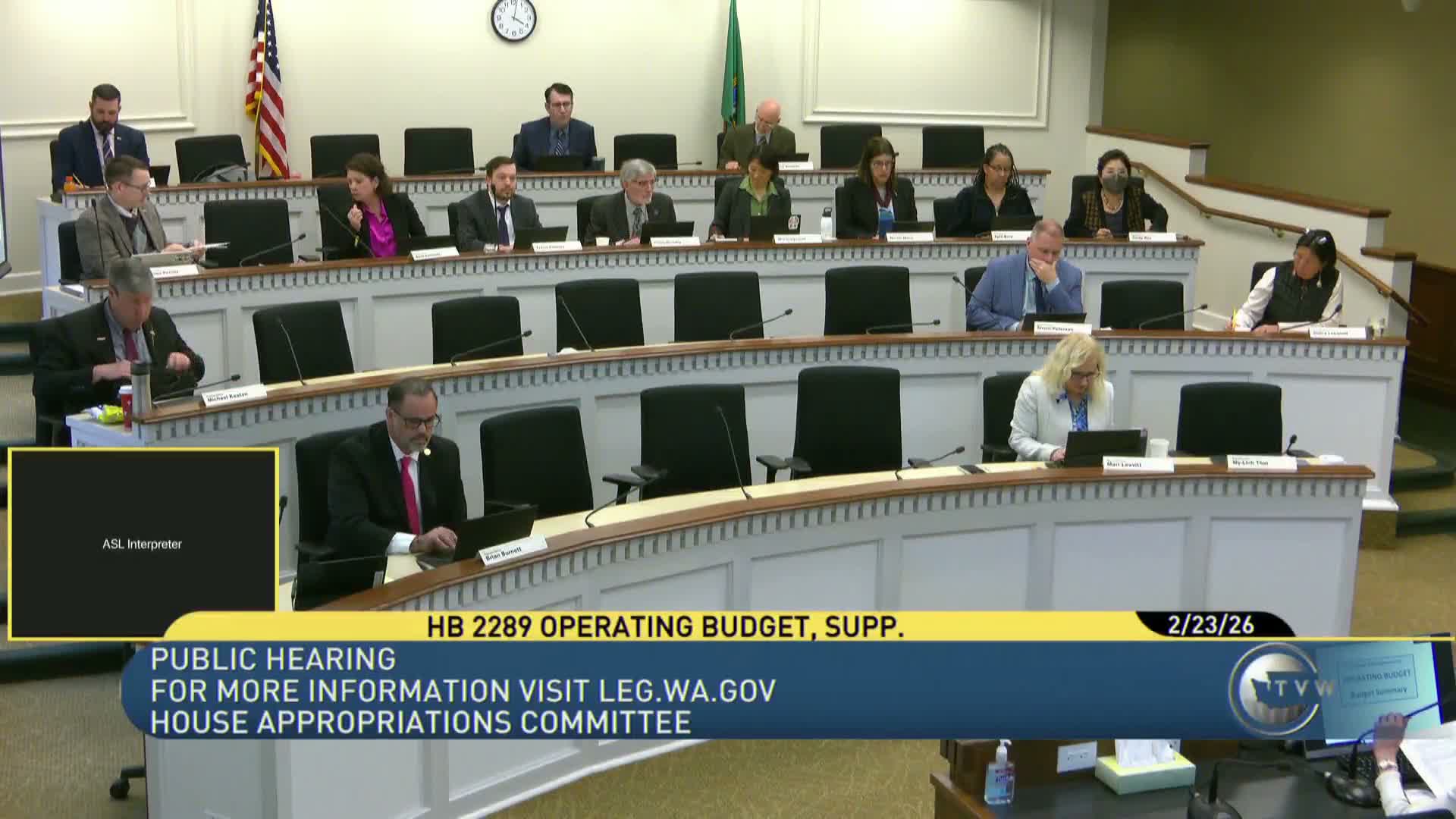
The House Appropriations Committee held a public hearing on substitute House Bill 2289 to consider a supplemental operating budget that would realign near-general-fund-outlook (NGFO) resources, employ an $880 million transfer from the Budget Stabilization Account (BSA) in the current biennium with repayment later, and assume $2.1 billion in FY29 NGFO revenues from a proposed tax increase on very high earners.
Mary Monroe, the committee’s budget coordinator, told members the proposal “does not assume the 4 and a half percent, revenue growth assumption in the outlook statutory methodology,” removing nearly $2 billion in previously assumed NGFO resources and leaving projected NGFO ending balances of about $247 million for the current biennium and $566 million at the end of the 4‑year outlook. Monroe described a multi-step mechanism that shifts $239 million from higher‑education building accounts into tuition operating-fee accounts and uses bond refinancing and Climate Commitment Act balances to keep capital projects whole, and said documentation is available on fiscal.wa.gov.
Why it matters: witnesses and local officials warned that line‑item choices in the substitute measure would have near‑term impacts on classrooms, long‑term care and public health programs. Testimony stretched across dozens of panels, with sustained opposition to proposed cuts to adult Medicaid therapy services and broad appeals to restore transition‑to‑kindergarten (TTK) and Local Effort Assistance (LEA) funding for K‑12.
Health and disability advocates focused on a proposed elimination of adult occupational, physical and speech therapy that witnesses said would force more people into institutional care. “This cut would affect 93,000 clients and result in roughly $32,000,000 in federal funding loss,” Deanna Winterrose of the Benton‑Franklin Parent Coalition told the committee, citing HCA data. Providers, therapists and family members described clinical cases where therapies prevented hospital readmissions, preserved independence and kept people in the community; many urged the committee to retain coverage and warned that eliminating the benefit would shift costs to hospitals, nursing homes and local governments.
Education and early learning groups urged restoration of TTK, LEA and running‑start protections. Representatives of school districts, the Washington Education Association and the Washington State PTA warned that reductions to transition to kindergarten slots and a 25% reduction to local effort assistance would disproportionately harm rural and property‑poor districts and create enrollment disruption ahead of the school year.
Natural‑resource, wildfire and climate advocates praised restored funding for wildfire response and forest health but expressed alarm at deeper general‑fund reductions for environmental justice and HEAL Act implementation. Dave Upley Grove, Commissioner of Public Lands, thanked the panel for restoring wildfire prevention funds but said deeper cuts would prevent the agency from meeting legal and programmatic obligations and could close recreation sites used by millions annually.
Other sectors that testified included higher education institutions seeking to avoid cuts and preserve compensation pools; local governments seeking restoration of public‑works and cannabis revenue‑sharing; juvenile and court administrators seeking full funding flexibility for youth early‑intervention programs; and housing, homelessness and eviction‑prevention advocates seeking ongoing rather than one‑time investments.
Procedure and next steps: the committee took scheduled breaks, completed an extensive in‑person panel and continued with virtual testimony. Committee staff announced amendment deadlines (10:00 a.m. Tuesday to file; caucus packets released Wednesday at 10:00 a.m.). The hearing did not produce a committee vote; members will consider amendments and negotiation with the Senate ahead of later floor action.
Representative Mary Monroe and multiple witnesses provided detailed budget documents and data during the hearing; appropriations analysts were identified as subject matter experts for follow‑up questions.
The committee adjourned after completing both in‑person and virtual testimony; no votes on the substitute bill were taken during this hearing.
Mary Monroe, the committee’s budget coordinator, told members the proposal “does not assume the 4 and a half percent, revenue growth assumption in the outlook statutory methodology,” removing nearly $2 billion in previously assumed NGFO resources and leaving projected NGFO ending balances of about $247 million for the current biennium and $566 million at the end of the 4‑year outlook. Monroe described a multi-step mechanism that shifts $239 million from higher‑education building accounts into tuition operating-fee accounts and uses bond refinancing and Climate Commitment Act balances to keep capital projects whole, and said documentation is available on fiscal.wa.gov.
Why it matters: witnesses and local officials warned that line‑item choices in the substitute measure would have near‑term impacts on classrooms, long‑term care and public health programs. Testimony stretched across dozens of panels, with sustained opposition to proposed cuts to adult Medicaid therapy services and broad appeals to restore transition‑to‑kindergarten (TTK) and Local Effort Assistance (LEA) funding for K‑12.
Health and disability advocates focused on a proposed elimination of adult occupational, physical and speech therapy that witnesses said would force more people into institutional care. “This cut would affect 93,000 clients and result in roughly $32,000,000 in federal funding loss,” Deanna Winterrose of the Benton‑Franklin Parent Coalition told the committee, citing HCA data. Providers, therapists and family members described clinical cases where therapies prevented hospital readmissions, preserved independence and kept people in the community; many urged the committee to retain coverage and warned that eliminating the benefit would shift costs to hospitals, nursing homes and local governments.
Education and early learning groups urged restoration of TTK, LEA and running‑start protections. Representatives of school districts, the Washington Education Association and the Washington State PTA warned that reductions to transition to kindergarten slots and a 25% reduction to local effort assistance would disproportionately harm rural and property‑poor districts and create enrollment disruption ahead of the school year.
Natural‑resource, wildfire and climate advocates praised restored funding for wildfire response and forest health but expressed alarm at deeper general‑fund reductions for environmental justice and HEAL Act implementation. Dave Upley Grove, Commissioner of Public Lands, thanked the panel for restoring wildfire prevention funds but said deeper cuts would prevent the agency from meeting legal and programmatic obligations and could close recreation sites used by millions annually.
Other sectors that testified included higher education institutions seeking to avoid cuts and preserve compensation pools; local governments seeking restoration of public‑works and cannabis revenue‑sharing; juvenile and court administrators seeking full funding flexibility for youth early‑intervention programs; and housing, homelessness and eviction‑prevention advocates seeking ongoing rather than one‑time investments.
Procedure and next steps: the committee took scheduled breaks, completed an extensive in‑person panel and continued with virtual testimony. Committee staff announced amendment deadlines (10:00 a.m. Tuesday to file; caucus packets released Wednesday at 10:00 a.m.). The hearing did not produce a committee vote; members will consider amendments and negotiation with the Senate ahead of later floor action.
Representative Mary Monroe and multiple witnesses provided detailed budget documents and data during the hearing; appropriations analysts were identified as subject matter experts for follow‑up questions.
The committee adjourned after completing both in‑person and virtual testimony; no votes on the substitute bill were taken during this hearing.
Don't Miss a Word: See the Full Meeting!
Go beyond summaries. Unlock every video, transcript, and key insight with a Founder Membership.
✓
Get instant access to full meeting videos
✓
Search and clip any phrase from complete transcripts
✓
Receive AI-powered summaries & custom alerts
✓
Enjoy lifetime, unrestricted access to government data
30-day money-back guarantee
