State EV Council warns of slowing EV growth, urges more charging investment
February 23, 2026 | Legislative Sessions, Washington
This article was created by AI summarizing key points discussed. AI makes mistakes, so for full details and context, please refer to the video of the full meeting. Please report any errors so we can fix them. Report an error »
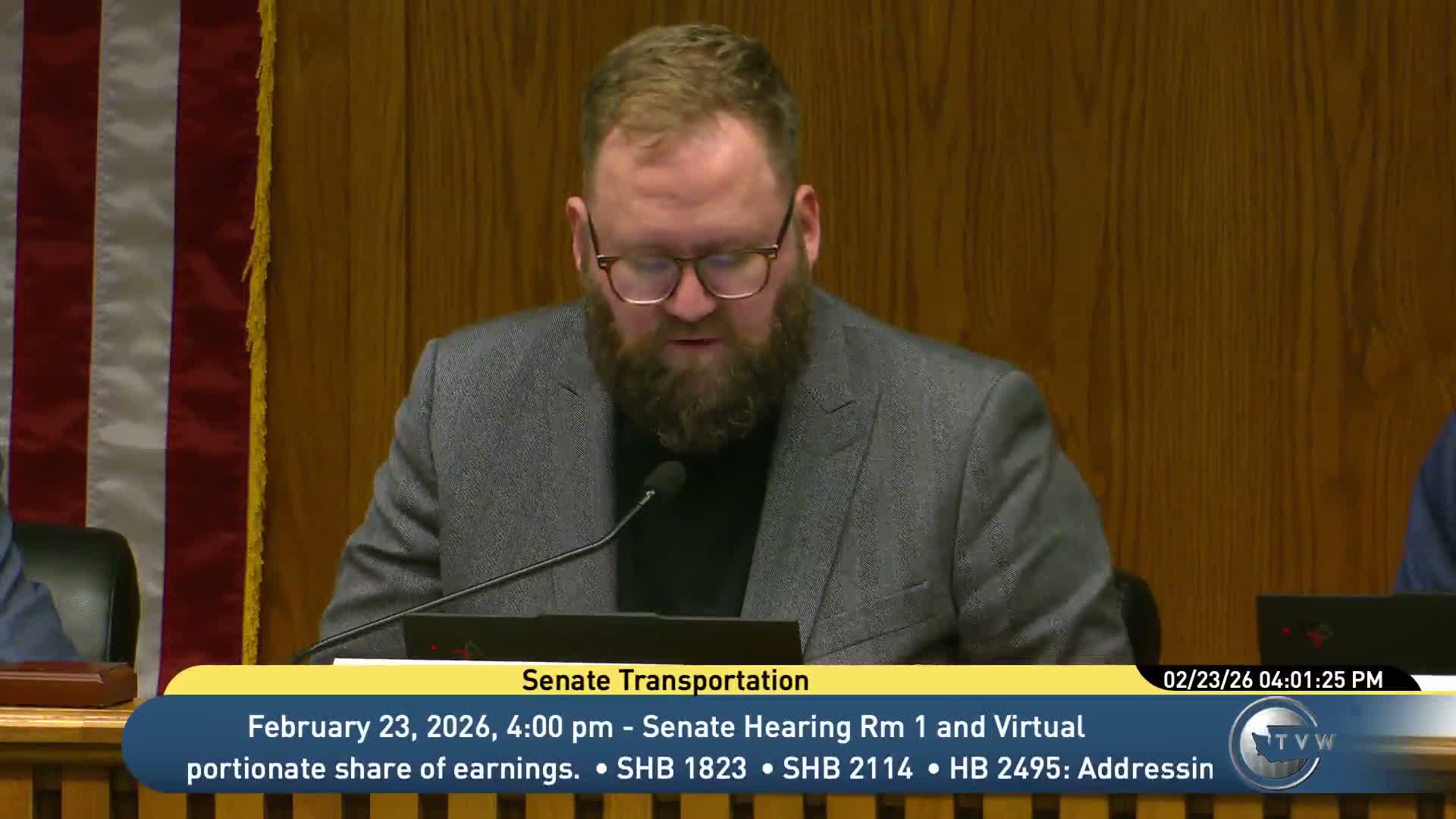
The Senate Transportation Committee heard an update from the Electric Vehicle Coordinating Council on Feb. 23, where council co‑chairs Tonia Buell of the Washington State Department of Transportation and Steven Hershkowitz of the Department of Commerce described a slowing rate of EV adoption and lingering charging gaps across the state.
"After great growth in 2022 and 2023, we have seen a flattening out of the growth rate," Hershkowitz told the committee, pointing to 2024–25 registration trends that fall short of Department of Ecology targets set in the state's Transportation Electrification Strategy (TEZ). He said the TEZ shows a gap of more than 700 fast‑charging ports compared with what would be needed to meet greenhouse‑gas reduction benchmarks.
The council outlined ongoing and planned programs intended to close those gaps. Buell said the National Electric Vehicle Infrastructure (NEVI) awards recently announced will add nearly 100 fast chargers in 14 communities through a $12.6 million federal award, and the state's ZVIP public–private program has funded more than 100 DC fast chargers in earlier rounds. Buell also described a forthcoming Washington State Zero‑Emission Incentive Program (WAZIP), a voucher program for medium‑ and heavy‑duty vehicles and off‑road equipment that aims to reduce purchase price at point of sale.
Buell and Hershkowitz emphasized that a mix of federal and state funding will be needed and that proposed budget additions — while helpful — cover only a small fraction of the total infrastructure cost. Hershkowitz noted the governor's proposed additional $13 million would pay for roughly 4% of overall charging system costs identified in the TEZ modeling.
Committee members pressed the presenters on charger specifications. Senator Wilson asked whether 600 kW per site configurations could be reallocated (for example, two 300 kW chargers instead of four 150 kW ports). Buell said applicants may propose higher‑power chargers and are awarded bonus points for doing so; she described a recent application for two 360 kW chargers and added that siting, local power availability and transformer costs affect optimal configurations.
The council also described tools to improve coordination and planning, including an online EV map aggregating more than 100 GIS datasets and dashboards showing registration counts by legislative district and census tract. Buell said the council files an annual report to the legislature and maintains regular council meetings streamed on TVW.
The committee recessed the discussion to move onto other agenda items and to take questions from members.
"After great growth in 2022 and 2023, we have seen a flattening out of the growth rate," Hershkowitz told the committee, pointing to 2024–25 registration trends that fall short of Department of Ecology targets set in the state's Transportation Electrification Strategy (TEZ). He said the TEZ shows a gap of more than 700 fast‑charging ports compared with what would be needed to meet greenhouse‑gas reduction benchmarks.
The council outlined ongoing and planned programs intended to close those gaps. Buell said the National Electric Vehicle Infrastructure (NEVI) awards recently announced will add nearly 100 fast chargers in 14 communities through a $12.6 million federal award, and the state's ZVIP public–private program has funded more than 100 DC fast chargers in earlier rounds. Buell also described a forthcoming Washington State Zero‑Emission Incentive Program (WAZIP), a voucher program for medium‑ and heavy‑duty vehicles and off‑road equipment that aims to reduce purchase price at point of sale.
Buell and Hershkowitz emphasized that a mix of federal and state funding will be needed and that proposed budget additions — while helpful — cover only a small fraction of the total infrastructure cost. Hershkowitz noted the governor's proposed additional $13 million would pay for roughly 4% of overall charging system costs identified in the TEZ modeling.
Committee members pressed the presenters on charger specifications. Senator Wilson asked whether 600 kW per site configurations could be reallocated (for example, two 300 kW chargers instead of four 150 kW ports). Buell said applicants may propose higher‑power chargers and are awarded bonus points for doing so; she described a recent application for two 360 kW chargers and added that siting, local power availability and transformer costs affect optimal configurations.
The council also described tools to improve coordination and planning, including an online EV map aggregating more than 100 GIS datasets and dashboards showing registration counts by legislative district and census tract. Buell said the council files an annual report to the legislature and maintains regular council meetings streamed on TVW.
The committee recessed the discussion to move onto other agenda items and to take questions from members.
Don't Miss a Word: See the Full Meeting!
Go beyond summaries. Unlock every video, transcript, and key insight with a Founder Membership.
✓
Get instant access to full meeting videos
✓
Search and clip any phrase from complete transcripts
✓
Receive AI-powered summaries & custom alerts
✓
Enjoy lifetime, unrestricted access to government data
30-day money-back guarantee
