House Education Committee advances five bills on school health, devices, college planning and program review
February 23, 2026 | Legislative Sessions, Washington
This article was created by AI summarizing key points discussed. AI makes mistakes, so for full details and context, please refer to the video of the full meeting. Please report any errors so we can fix them. Report an error »
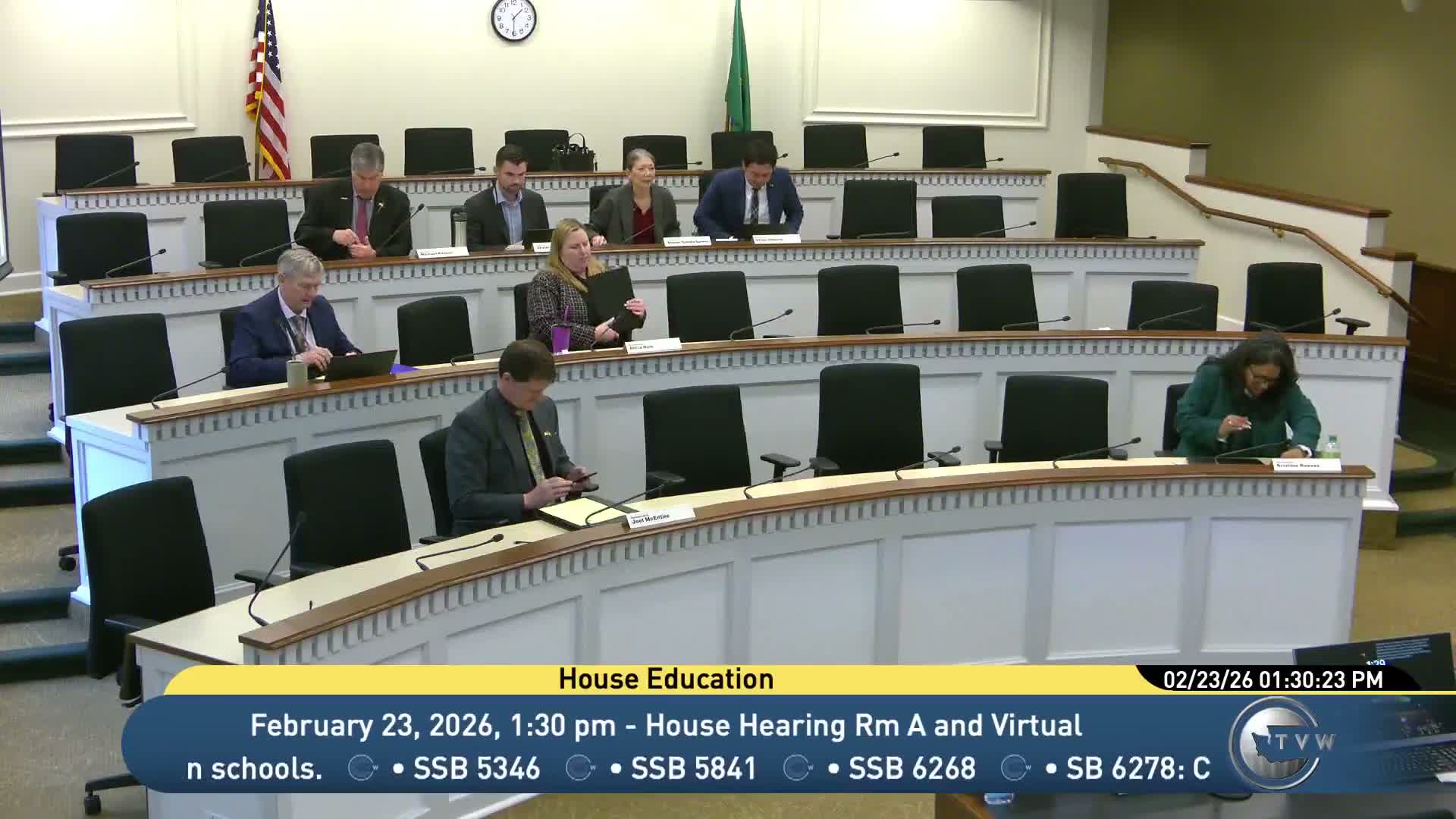
The House Education Committee reconvened for an executive session and reported five substitute Senate bills out of committee with due-pass recommendations after adopting amendments, the committee chair said.
The bills advanced range from school health measures to student technology policies and educator preparation oversight. Staff briefed committee members on each bill before votes in the executive session.
Substitute Senate Bill 5,240: anaphylaxis medication in schools
Staff member Megan told the committee that Substitute Senate Bill 5,240 expands authorization for designated trained school personnel to administer single-use, premeasured epinephrine in response to suspected anaphylaxis, extends the liability protections to school contractors, requires documentation of anaphylaxis training, and applies the provisions to charter and state-tribal education compact schools. Representative Marshall moved amendment H3616.1, which the committee amended to correct drafting language (changing an erroneous reference to albuterol to epinephrine) and then adopted. "The number 1 cause of death is delayed administration of epinephrine," Representative Marshall said in urging adoption. The committee reported SB 5,240 out of committee as amended by a voice vote; the clerk announced 19 ayes, 0 nays and 0 excused.
Substitute Senate Bill 5,346: student mobile-device policy and OSPI reporting
Staff member Ethan summarized SB 5,346, which requires the Office of the Superintendent of Public Instruction (OSPI) to post research and report to the Legislature on school policies and procedures that limit student mobile-device use during instructional hours. Representative Santos sponsored amendment MOET 540 (adopted), which adjusts reporting timing and cites examples of research that could be posted. Supporters said the bill balances local district flexibility with statewide best-practice guidance. The committee advanced SB 5,346 as amended; a roll call recorded 17 ayes, 1 nay (Representative Steele), and 1 excused.
Substitute Senate Bill 5,841: high school and beyond plans and financial aid information
Ethan briefed SB 5,841, which would require the state's high-school planning platform to import financial-aid application data and ensure students receive information on programs including the Washington Opportunity Scholarship. Amendment MOET 539 (adopted) requires review of certain information before graduation to help identify eligibility for scholarships and financial aid. Supporters argued the change helps students complete aid applications and connect to postsecondary options. The committee reported SB 5,841 as amended by voice vote (19 ayes, 0 nays, 0 excused).
Senate Bill 6,268: online record of special-education complaint decisions
Megan briefed SB 6,268, which requires OSPI to maintain a freely accessible online record of final decisions on special-education complaints for the preceding 20 years. Members described the bill as a transparency measure that preserves decisions families and districts use as precedents. The committee reported the bill out of committee with a due-pass recommendation.
Senate Bill 6,278: ongoing review of educator preparation programs
Megan said SB 6,278 directs the Professional Educator Standards Board (PESB) to include program and educator-role standards, program-submitted evidence, and constituent input in its ongoing review of approved teacher and principal preparation programs and to provide processes when programs fall short of standards. Members noted the measure largely codifies current PESB practice. The committee reported SB 6,278 with a due-pass recommendation.
Votes at a glance
- SB 5,240 (anaphylaxis medication in schools), as amended (H3616.1 incorporated): reported out as amended — voice vote announced 19 ayes, 0 nays, 0 excused.
- SB 5,346 (mobile devices), as amended (MOET 540): reported out as amended — roll call 17 ayes, 1 nay, 1 excused.
- SB 5,841 (high school and beyond plans), as amended (MOET 539): reported out as amended — voice vote announced 19 ayes, 0 nays, 0 excused.
- SB 6,268 (special-education complaint records): reported out — voice vote announced 19 ayes, 0 nays (excused status noted during debate).
- SB 6,278 (teacher/principal preparation review): reported out — voice vote announced 19 ayes, 0 nays, 0 excused.
Procedural notes and next steps
Committee members caucused before the executive session to allow work on striking amendments and agreed staff would prepare corrections where drafting errors were identified. The chair reminded members that amendments for bills scheduled for possible executive action the following day must be approved by 6 p.m. the same evening. The committee adjourned after reporting the bills out.
Sources: Committee briefing and executive session transcript provided to the committee; direct quotes and vote tallies are recorded in the committee record.
The bills advanced range from school health measures to student technology policies and educator preparation oversight. Staff briefed committee members on each bill before votes in the executive session.
Substitute Senate Bill 5,240: anaphylaxis medication in schools
Staff member Megan told the committee that Substitute Senate Bill 5,240 expands authorization for designated trained school personnel to administer single-use, premeasured epinephrine in response to suspected anaphylaxis, extends the liability protections to school contractors, requires documentation of anaphylaxis training, and applies the provisions to charter and state-tribal education compact schools. Representative Marshall moved amendment H3616.1, which the committee amended to correct drafting language (changing an erroneous reference to albuterol to epinephrine) and then adopted. "The number 1 cause of death is delayed administration of epinephrine," Representative Marshall said in urging adoption. The committee reported SB 5,240 out of committee as amended by a voice vote; the clerk announced 19 ayes, 0 nays and 0 excused.
Substitute Senate Bill 5,346: student mobile-device policy and OSPI reporting
Staff member Ethan summarized SB 5,346, which requires the Office of the Superintendent of Public Instruction (OSPI) to post research and report to the Legislature on school policies and procedures that limit student mobile-device use during instructional hours. Representative Santos sponsored amendment MOET 540 (adopted), which adjusts reporting timing and cites examples of research that could be posted. Supporters said the bill balances local district flexibility with statewide best-practice guidance. The committee advanced SB 5,346 as amended; a roll call recorded 17 ayes, 1 nay (Representative Steele), and 1 excused.
Substitute Senate Bill 5,841: high school and beyond plans and financial aid information
Ethan briefed SB 5,841, which would require the state's high-school planning platform to import financial-aid application data and ensure students receive information on programs including the Washington Opportunity Scholarship. Amendment MOET 539 (adopted) requires review of certain information before graduation to help identify eligibility for scholarships and financial aid. Supporters argued the change helps students complete aid applications and connect to postsecondary options. The committee reported SB 5,841 as amended by voice vote (19 ayes, 0 nays, 0 excused).
Senate Bill 6,268: online record of special-education complaint decisions
Megan briefed SB 6,268, which requires OSPI to maintain a freely accessible online record of final decisions on special-education complaints for the preceding 20 years. Members described the bill as a transparency measure that preserves decisions families and districts use as precedents. The committee reported the bill out of committee with a due-pass recommendation.
Senate Bill 6,278: ongoing review of educator preparation programs
Megan said SB 6,278 directs the Professional Educator Standards Board (PESB) to include program and educator-role standards, program-submitted evidence, and constituent input in its ongoing review of approved teacher and principal preparation programs and to provide processes when programs fall short of standards. Members noted the measure largely codifies current PESB practice. The committee reported SB 6,278 with a due-pass recommendation.
Votes at a glance
- SB 5,240 (anaphylaxis medication in schools), as amended (H3616.1 incorporated): reported out as amended — voice vote announced 19 ayes, 0 nays, 0 excused.
- SB 5,346 (mobile devices), as amended (MOET 540): reported out as amended — roll call 17 ayes, 1 nay, 1 excused.
- SB 5,841 (high school and beyond plans), as amended (MOET 539): reported out as amended — voice vote announced 19 ayes, 0 nays, 0 excused.
- SB 6,268 (special-education complaint records): reported out — voice vote announced 19 ayes, 0 nays (excused status noted during debate).
- SB 6,278 (teacher/principal preparation review): reported out — voice vote announced 19 ayes, 0 nays, 0 excused.
Procedural notes and next steps
Committee members caucused before the executive session to allow work on striking amendments and agreed staff would prepare corrections where drafting errors were identified. The chair reminded members that amendments for bills scheduled for possible executive action the following day must be approved by 6 p.m. the same evening. The committee adjourned after reporting the bills out.
Sources: Committee briefing and executive session transcript provided to the committee; direct quotes and vote tallies are recorded in the committee record.
View the Full Meeting & All Its Details
This article offers just a summary. Unlock complete video, transcripts, and insights as a Founder Member.
✓
Watch full, unedited meeting videos
✓
Search every word spoken in unlimited transcripts
✓
AI summaries & real-time alerts (all government levels)
✓
Permanent access to expanding government content
30-day money-back guarantee
