Michigan 2-1-1 asks House subcommittee for $6.6 million to expand statewide services
February 24, 2026 | 2025-2026 House Legislature MI, Michigan
This article was created by AI summarizing key points discussed. AI makes mistakes, so for full details and context, please refer to the video of the full meeting. Please report any errors so we can fix them. Report an error »
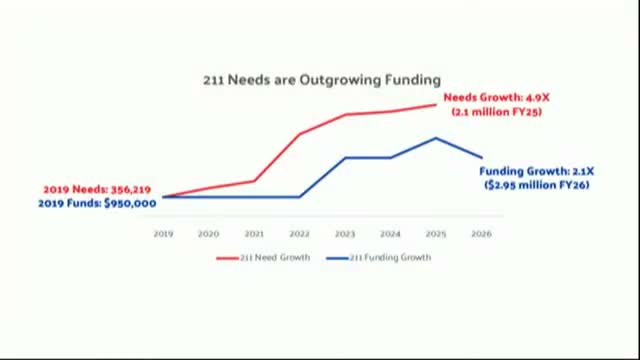
LANSING — Michigan 2-1-1 representatives asked the House Appropriations Subcommittee on Human Services for $6,600,000 in ongoing state funding to expand a statewide information-and-referral system serving residents in crisis.
"What we're asking for is $6,600,000 in ongoing funding from the state of Michigan," a presenter told the committee as leaders from Michigan 2-1-1 and United Way described the system's role linking callers to food, housing, utility assistance and other social supports.
The presenters, including Jenny Pollock, executive director of Michigan 2-1-1, and Kyle Dubuc, vice president of communications and advocacy at United Way for Southeastern Michigan, said 2-1-1 handled more than 400,000 connections in 2025 and documented more than 625,000 needs through calls, texts and chats. They described a resource directory with nearly 7,000 organizations and over 27,000 services and said the directory was updated about 87,000 times last year to keep listings current.
The funding request would be used to sustain and scale the statewide shared infrastructure, increase social navigation and community health worker capacity, and bring smaller community organizations into a single, searchable platform and closed-loop referral systems called community information exchanges (CIEs). Presenters said increased state investment could relieve pressure on philanthropic funds and allow the network to meet spikes in demand during disasters.
United Way presenters and 2-1-1 staff emphasized the system's role in emergency response, citing examples including responses to the Flint water crisis, an historic ice storm and disruptions to SNAP benefits. Chad Beazer, emergency management officer for Michigan 2-1-1 regional centers, said the system provides real-time data used by emergency operation centers to identify needs and coordinate sheltering, volunteer support and critical services.
Lawmakers asked how 2-1-1 would diversify revenue. Representative Longjohn asked whether community health worker services could be billed under new Medicare/Medicaid billing codes; presenters said they are "exploring those options" and working on partnerships with health systems but are not yet billing those codes. The presenters said stable state funding would support workforce development that could help leverage future reimbursement opportunities.
The subcommittee took no formal vote on the funding request during the meeting and moved on after the presentations. The committee later approved routine minutes and adjourned.
"What we're asking for is $6,600,000 in ongoing funding from the state of Michigan," a presenter told the committee as leaders from Michigan 2-1-1 and United Way described the system's role linking callers to food, housing, utility assistance and other social supports.
The presenters, including Jenny Pollock, executive director of Michigan 2-1-1, and Kyle Dubuc, vice president of communications and advocacy at United Way for Southeastern Michigan, said 2-1-1 handled more than 400,000 connections in 2025 and documented more than 625,000 needs through calls, texts and chats. They described a resource directory with nearly 7,000 organizations and over 27,000 services and said the directory was updated about 87,000 times last year to keep listings current.
The funding request would be used to sustain and scale the statewide shared infrastructure, increase social navigation and community health worker capacity, and bring smaller community organizations into a single, searchable platform and closed-loop referral systems called community information exchanges (CIEs). Presenters said increased state investment could relieve pressure on philanthropic funds and allow the network to meet spikes in demand during disasters.
United Way presenters and 2-1-1 staff emphasized the system's role in emergency response, citing examples including responses to the Flint water crisis, an historic ice storm and disruptions to SNAP benefits. Chad Beazer, emergency management officer for Michigan 2-1-1 regional centers, said the system provides real-time data used by emergency operation centers to identify needs and coordinate sheltering, volunteer support and critical services.
Lawmakers asked how 2-1-1 would diversify revenue. Representative Longjohn asked whether community health worker services could be billed under new Medicare/Medicaid billing codes; presenters said they are "exploring those options" and working on partnerships with health systems but are not yet billing those codes. The presenters said stable state funding would support workforce development that could help leverage future reimbursement opportunities.
The subcommittee took no formal vote on the funding request during the meeting and moved on after the presentations. The committee later approved routine minutes and adjourned.
Don't Miss a Word: See the Full Meeting!
Go beyond summaries. Unlock every video, transcript, and key insight with a Founder Membership.
✓
Get instant access to full meeting videos
✓
Search and clip any phrase from complete transcripts
✓
Receive AI-powered summaries & custom alerts
✓
Enjoy lifetime, unrestricted access to government data
30-day money-back guarantee
