Michigan State Police warns of retirements, staffing shortages and rising workload across Field Services
February 24, 2026 | 2025-2026 House Legislature MI, Michigan
This article was created by AI summarizing key points discussed. AI makes mistakes, so for full details and context, please refer to the video of the full meeting. Please report any errors so we can fix them. Report an error »
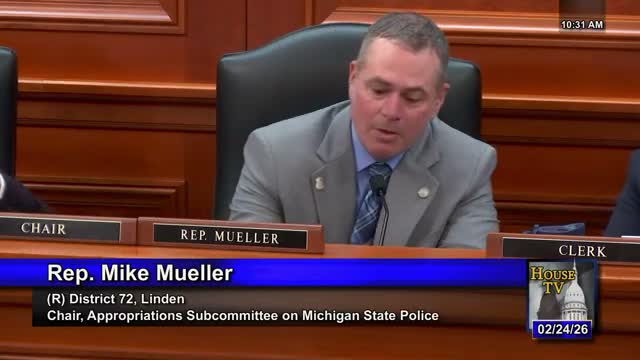
Lieutenant Colonel Sazinski, who leads the Michigan State Police Field Services Bureau, told the House Subcommittee on the Michigan State Police that the bureau operates roughly 31 posts and about 54 detachments with "a little over 1,900 members in FSB itself." He warned of a wave of retirements through 2030, noting a projected peak of 137 retirements in 2029 and saying MSP has averaged "about a 113 troopers a year" in recent recruit classes.
Sazinski said the department changed recruit assignment rules to address uneven staffing at posts. "About 8 years ago, what we started doing is we started asking recruits as they came in, where would you like to work?" he said, and described a newer practice of limiting post choices until around week eight of training to reduce quit rates and place troopers where needs are greatest. "We're telling them the posts they can't pick," he said, describing an "85% study" target that guides assignments.
Committee members pressed Sazinski on acute shortages at Metro North, where members said staffing had fallen from roughly 80% to "down to 20." The chair and members urged coordination on recruitment, retention and temporary reassignments while MSP increases hires. "We need to really look, you know, come together and look at see what we can do because ... we might be not having a Trooper school this year," one member said.
Sazinski outlined how shortages affect operations across districts, from the 2nd Districts freeway investigations and motorcade responsibilities to multi-jurisdictional homicide task forces. He said specialized units increasingly respond to non-MSP requests: "For requests last year, 40% were non MSP requests and 60% were MSP," and said that trend is rising as partners ask MSP for technical support, aerial mapping, and specialized investigative tools.
The lieutenant colonel described several high-profile operational responses to illustrate capability and strain. He recounted the D. Warner missing-person homicide investigation in Lenawee County, in which MSP used cadaver dogs, marine services and forensic x-ray to locate a victim's body inside a propane cylinder. He also described the Grand Blanc church shooting response, noting troopers and specialists were later recognized with valor awards for entering a burning building and preserving evidence.
Sazinski detailed mobilization assets for large events or civil disturbances: statewide Special Support Teams, five staged equipment trailers with mobilization gear, tactical bike teams, aviation assets and counter-UAS vehicles. Using a recent hostage incident in Saginaw as an example, he said negotiators and drone support helped draw a suspect to a window and that a marksman engaged the suspect without injuring the hostage.
He described the bureaus technical capabilities in depth: aviation platforms with downlink trucks that can stream live imagery to a command post; a bomb squad with containment vehicles, robots and x-ray tools; a K-9 fleet of roughly 60 canines including vapor-wake and cyber-detection dogs; marine services with AUV and ROV capability for deep recoveries; and traffic crash reconstructionists who handle fatal crash mapping.
On training, Sazinski said the Emergency Support Team and other specialists have adjusted training cycles to avoid overuse: "what they started doing as of last year is they cycle some training and gotta be a little bit smarter on the calls." He called staffing the bureaus main problem and sought committee help coordinating recruitment and resources.
The committee did not take formal action on policy changes at the hearing. The exchange closed with members calling for continued engagement between MSP leadership and local law enforcement to mitigate short-term staffing gaps while planned recruit classes and other measures are pursued.
Sazinski said the department changed recruit assignment rules to address uneven staffing at posts. "About 8 years ago, what we started doing is we started asking recruits as they came in, where would you like to work?" he said, and described a newer practice of limiting post choices until around week eight of training to reduce quit rates and place troopers where needs are greatest. "We're telling them the posts they can't pick," he said, describing an "85% study" target that guides assignments.
Committee members pressed Sazinski on acute shortages at Metro North, where members said staffing had fallen from roughly 80% to "down to 20." The chair and members urged coordination on recruitment, retention and temporary reassignments while MSP increases hires. "We need to really look, you know, come together and look at see what we can do because ... we might be not having a Trooper school this year," one member said.
Sazinski outlined how shortages affect operations across districts, from the 2nd Districts freeway investigations and motorcade responsibilities to multi-jurisdictional homicide task forces. He said specialized units increasingly respond to non-MSP requests: "For requests last year, 40% were non MSP requests and 60% were MSP," and said that trend is rising as partners ask MSP for technical support, aerial mapping, and specialized investigative tools.
The lieutenant colonel described several high-profile operational responses to illustrate capability and strain. He recounted the D. Warner missing-person homicide investigation in Lenawee County, in which MSP used cadaver dogs, marine services and forensic x-ray to locate a victim's body inside a propane cylinder. He also described the Grand Blanc church shooting response, noting troopers and specialists were later recognized with valor awards for entering a burning building and preserving evidence.
Sazinski detailed mobilization assets for large events or civil disturbances: statewide Special Support Teams, five staged equipment trailers with mobilization gear, tactical bike teams, aviation assets and counter-UAS vehicles. Using a recent hostage incident in Saginaw as an example, he said negotiators and drone support helped draw a suspect to a window and that a marksman engaged the suspect without injuring the hostage.
He described the bureaus technical capabilities in depth: aviation platforms with downlink trucks that can stream live imagery to a command post; a bomb squad with containment vehicles, robots and x-ray tools; a K-9 fleet of roughly 60 canines including vapor-wake and cyber-detection dogs; marine services with AUV and ROV capability for deep recoveries; and traffic crash reconstructionists who handle fatal crash mapping.
On training, Sazinski said the Emergency Support Team and other specialists have adjusted training cycles to avoid overuse: "what they started doing as of last year is they cycle some training and gotta be a little bit smarter on the calls." He called staffing the bureaus main problem and sought committee help coordinating recruitment and resources.
The committee did not take formal action on policy changes at the hearing. The exchange closed with members calling for continued engagement between MSP leadership and local law enforcement to mitigate short-term staffing gaps while planned recruit classes and other measures are pursued.
View the Full Meeting & All Its Details
This article offers just a summary. Unlock complete video, transcripts, and insights as a Founder Member.
✓
Watch full, unedited meeting videos
✓
Search every word spoken in unlimited transcripts
✓
AI summaries & real-time alerts (all government levels)
✓
Permanent access to expanding government content
30-day money-back guarantee
