Rutherford County committee backs resolution recognizing financial wellness as a public-health priority, sends it to steering
February 24, 2026 | Rutherford County, Tennessee
This article was created by AI summarizing key points discussed. AI makes mistakes, so for full details and context, please refer to the video of the full meeting. Please report any errors so we can fix them. Report an error »
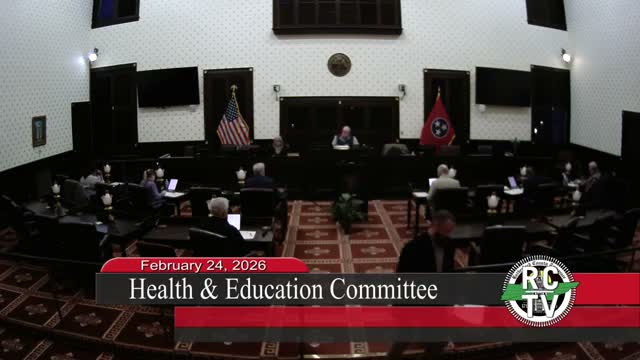
The Rutherford County Health & Education Committee voted Tuesday to send a resolution recognizing financial wellness as a public-health priority to the commission’s steering committee, moving it one step closer to consideration by the full county commission.
Vice Chair Phil Wilson introduced Bill Parker, director of the Tennessee Financial Literacy Commission, and said the county-specific Financial Wellness Scorecard — produced with the UT Boyd Center — highlights both strengths and affordability pressures in Rutherford County. "We recognize financial wellness as a public health priority and support collaborative efforts to improve financial outcomes for all residents," the template resolution reads.
Parker summarized the scorecard’s key county findings, noting Rutherford County ranked 11th of 95 counties on overall financial wellness, with a median income of $82,588 and a poverty rate of 8.8%. He warned that 27.6% of residents have subprime credit scores and that the share of median income needed to afford a median-priced home reached 39.8%, above the 30% affordability threshold. "When nearly 28% of residents have subprime credit, that carries consequences not just to the individual, but the individual's family and also the community," Parker said.
The resolution urges cross-sector partnerships among public health agencies, financial institutions, nonprofits and community organizations; supports community-based, non-sales-oriented financial-education initiatives; and calls for integrating financial-wellness strategies into public health, housing and social-service programs. Parker and committee members emphasized the commission’s role is primarily educational and convening partners, not drafting legislation. "We, Financial Literacy Commission, totally focus on the education side," Parker said.
Committee members asked how the resolution would affect curriculum or legislative action. Parker said the commission is developing teacher trainings and resources to bolster K–12 instruction and to create shared entry points for families seeking services, but that policy changes would require engagement with state legislators. Vice Chair Wilson noted the resolution was prepared as a template to build local momentum and said it was written for the commission to consider at its March 12 meeting.
Representative Mike Sparks, who was invited to comment, urged attention to affordability and predatory lending, saying community education must pair with enforcement and broader policy discussion. "Smart choices matter," Sparks said, describing predatory-lending practices he said have harmed local residents.
The committee approved the motion to send the resolution to steering by voice vote; the packet and resolution language will move forward to the steering committee and then the full commission for consideration.
The county’s next procedural step on the resolution is its steering committee review; the resolution’s sponsors indicated the commission’s March 12 meeting as the anticipated full-commission consideration date.
Vice Chair Phil Wilson introduced Bill Parker, director of the Tennessee Financial Literacy Commission, and said the county-specific Financial Wellness Scorecard — produced with the UT Boyd Center — highlights both strengths and affordability pressures in Rutherford County. "We recognize financial wellness as a public health priority and support collaborative efforts to improve financial outcomes for all residents," the template resolution reads.
Parker summarized the scorecard’s key county findings, noting Rutherford County ranked 11th of 95 counties on overall financial wellness, with a median income of $82,588 and a poverty rate of 8.8%. He warned that 27.6% of residents have subprime credit scores and that the share of median income needed to afford a median-priced home reached 39.8%, above the 30% affordability threshold. "When nearly 28% of residents have subprime credit, that carries consequences not just to the individual, but the individual's family and also the community," Parker said.
The resolution urges cross-sector partnerships among public health agencies, financial institutions, nonprofits and community organizations; supports community-based, non-sales-oriented financial-education initiatives; and calls for integrating financial-wellness strategies into public health, housing and social-service programs. Parker and committee members emphasized the commission’s role is primarily educational and convening partners, not drafting legislation. "We, Financial Literacy Commission, totally focus on the education side," Parker said.
Committee members asked how the resolution would affect curriculum or legislative action. Parker said the commission is developing teacher trainings and resources to bolster K–12 instruction and to create shared entry points for families seeking services, but that policy changes would require engagement with state legislators. Vice Chair Wilson noted the resolution was prepared as a template to build local momentum and said it was written for the commission to consider at its March 12 meeting.
Representative Mike Sparks, who was invited to comment, urged attention to affordability and predatory lending, saying community education must pair with enforcement and broader policy discussion. "Smart choices matter," Sparks said, describing predatory-lending practices he said have harmed local residents.
The committee approved the motion to send the resolution to steering by voice vote; the packet and resolution language will move forward to the steering committee and then the full commission for consideration.
The county’s next procedural step on the resolution is its steering committee review; the resolution’s sponsors indicated the commission’s March 12 meeting as the anticipated full-commission consideration date.
Don't Miss a Word: See the Full Meeting!
Go beyond summaries. Unlock every video, transcript, and key insight with a Founder Membership.
✓
Get instant access to full meeting videos
✓
Search and clip any phrase from complete transcripts
✓
Receive AI-powered summaries & custom alerts
✓
Enjoy lifetime, unrestricted access to government data
30-day money-back guarantee
