Committee backs Barrero bill to ease local land-use hurdles for housing; amendment adopted
February 24, 2026 | 2026 Legislature FL, Florida
This article was created by AI summarizing key points discussed. AI makes mistakes, so for full details and context, please refer to the video of the full meeting. Please report any errors so we can fix them. Report an error »
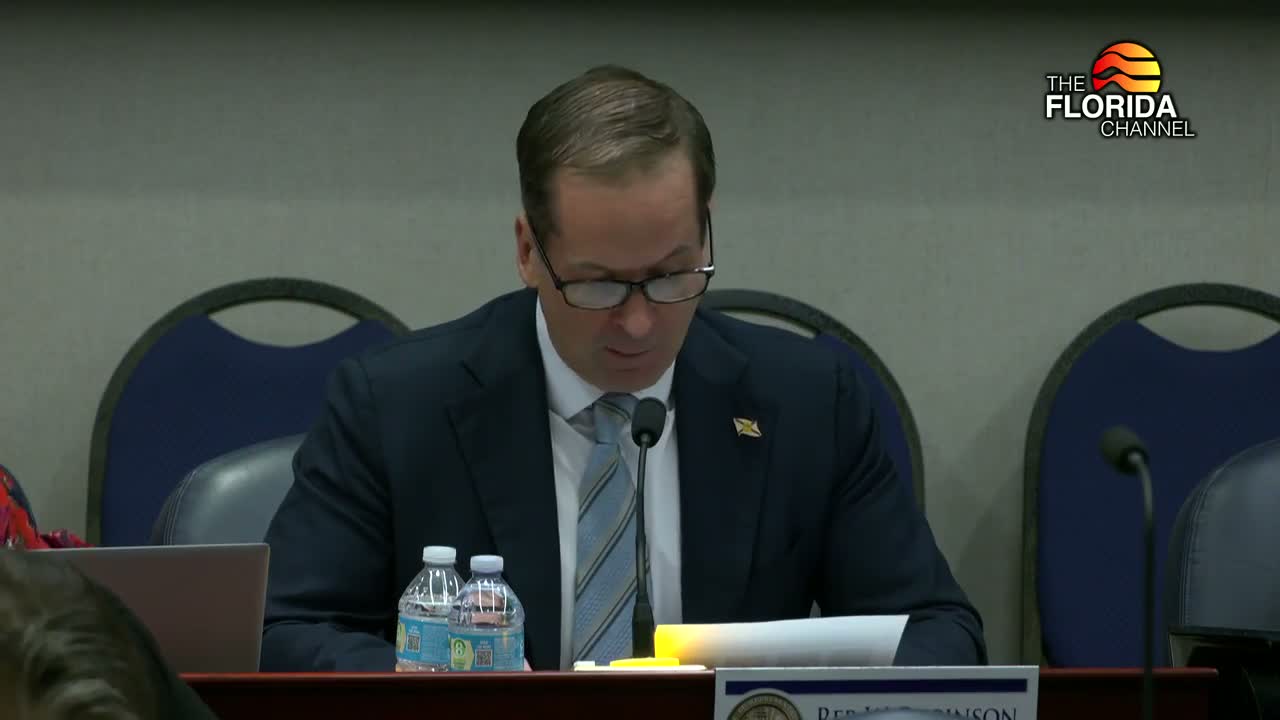
Representative Barreiro presented CS for CS for HB 399, saying the bill targets housing affordability by allowing county commissions to approve land-development applications by a simple majority instead of a supermajority and by requiring local governments to define "compatibility" when denying applications. He argued developers often face lengthy and costly entitlement processes that increase housing prices.
The committee adopted a strike-all amendment (barcode 614439) that, among other changes, would allow local governments to administratively approve minor special exceptions for "large destination resorts" meeting a size/room/occupancy threshold and treat certain manufactured residential housing in RV parks as equivalent to site-built homes. Barreiro said the amendment also curbs what he described as unreasonable local review board restrictions.
Members pressed the sponsor on several points: whether local historic designations beyond the National Register would retain force under the bill, the fiscal impact of limiting application fees to direct review costs, and whether an urban development boundary (UDB) study could undercut voter-approved local boundaries. Rep. Gantt and others warned that statewide preemption could nullify local referenda; Barreiro said the intent is narrowly to increase land available for development and estimated only a handful of properties ("5 to 10") would be affected.
Public testimony was mixed: city officials from Miami Beach opposed parts of the amendment; industry groups including the Florida Manufactured Home Association and Florida Home Builders Association expressed support. The committee adopted the amendment by voice and, after closing debate, reported CS for CS for HB 399 favorably by roll call (16 yeas, 10 nays).
The committee adopted a strike-all amendment (barcode 614439) that, among other changes, would allow local governments to administratively approve minor special exceptions for "large destination resorts" meeting a size/room/occupancy threshold and treat certain manufactured residential housing in RV parks as equivalent to site-built homes. Barreiro said the amendment also curbs what he described as unreasonable local review board restrictions.
Members pressed the sponsor on several points: whether local historic designations beyond the National Register would retain force under the bill, the fiscal impact of limiting application fees to direct review costs, and whether an urban development boundary (UDB) study could undercut voter-approved local boundaries. Rep. Gantt and others warned that statewide preemption could nullify local referenda; Barreiro said the intent is narrowly to increase land available for development and estimated only a handful of properties ("5 to 10") would be affected.
Public testimony was mixed: city officials from Miami Beach opposed parts of the amendment; industry groups including the Florida Manufactured Home Association and Florida Home Builders Association expressed support. The committee adopted the amendment by voice and, after closing debate, reported CS for CS for HB 399 favorably by roll call (16 yeas, 10 nays).
Don't Miss a Word: See the Full Meeting!
Go beyond summaries. Unlock every video, transcript, and key insight with a Founder Membership.
✓
Get instant access to full meeting videos
✓
Search and clip any phrase from complete transcripts
✓
Receive AI-powered summaries & custom alerts
✓
Enjoy lifetime, unrestricted access to government data
30-day money-back guarantee
