State AG trainer reviews open-meetings and public-records rules at Pasco workshop
February 23, 2026 | Pasco City, Franklin County, Washington
This article was created by AI summarizing key points discussed. AI makes mistakes, so for full details and context, please refer to the video of the full meeting. Please report any errors so we can fix them. Report an error »
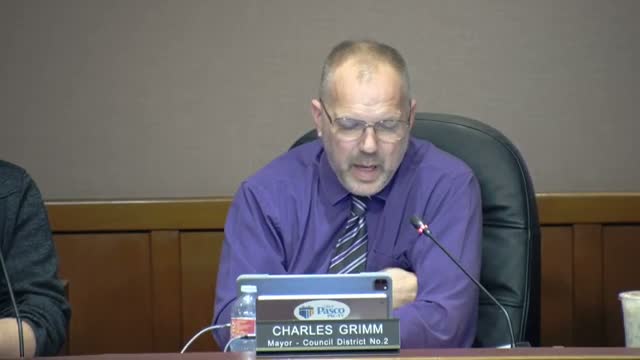
The Pasco City Council received mandatory training on Washington's open-government laws Thursday evening as part of a special workshop. Melissa Drury, a public-records consultant with the Washington Attorney General's office, reviewed requirements under the Open Public Meetings Act (OPMA) and the Public Records Act (PRA), told council members how to avoid procedural violations and answered questions about documentation and redaction.
Drury said the training fulfills the requirement that members of governing bodies take open-government instruction within 90 days of assuming office and every four years thereafter. "When it comes to open government training, it is required for every member of a governing body to take this training within 90 days of taking office," she said, adding that public-record rules change more frequently and officials should refresh that training more often.
The presentation highlighted several common compliance risks: inadvertent "serial meetings" over email or text that function as decision-making fora, insufficient advance notice for special meetings, improper final action taken outside a public session, and inadequate documentation of public-record searches. Drury urged the council to adopt a conservative approach to publicity of meetings: if in doubt, post the meeting and the agenda.
On public records, Drury told elected officials that "writing" now includes email, text messages and other electronic communications and that agencies must treat requests as legal processes that require tracked steps. She outlined the PRA's five-day acknowledgment requirement and the five standard responses staff can send (providing a record, supplying a web link, giving a reasonable time estimate, asking for clarification, or denying if the record is not held). Drury also reviewed exemptions and the narrow standard for privacy-based redactions.
The training included examples of penalties for serious violations and urged robust internal documentation. "The adequacy of a search is judged by a standard of reasonableness," she said, advising staff and council members to document search terms and locations to support public-record determinations.
Mayor (unnamed) thanked Drury for the in-person presentation. No formal action occurred during the workshop; the council moved on to the night's other agenda items after a brief recess.
Drury said the training fulfills the requirement that members of governing bodies take open-government instruction within 90 days of assuming office and every four years thereafter. "When it comes to open government training, it is required for every member of a governing body to take this training within 90 days of taking office," she said, adding that public-record rules change more frequently and officials should refresh that training more often.
The presentation highlighted several common compliance risks: inadvertent "serial meetings" over email or text that function as decision-making fora, insufficient advance notice for special meetings, improper final action taken outside a public session, and inadequate documentation of public-record searches. Drury urged the council to adopt a conservative approach to publicity of meetings: if in doubt, post the meeting and the agenda.
On public records, Drury told elected officials that "writing" now includes email, text messages and other electronic communications and that agencies must treat requests as legal processes that require tracked steps. She outlined the PRA's five-day acknowledgment requirement and the five standard responses staff can send (providing a record, supplying a web link, giving a reasonable time estimate, asking for clarification, or denying if the record is not held). Drury also reviewed exemptions and the narrow standard for privacy-based redactions.
The training included examples of penalties for serious violations and urged robust internal documentation. "The adequacy of a search is judged by a standard of reasonableness," she said, advising staff and council members to document search terms and locations to support public-record determinations.
Mayor (unnamed) thanked Drury for the in-person presentation. No formal action occurred during the workshop; the council moved on to the night's other agenda items after a brief recess.
View the Full Meeting & All Its Details
This article offers just a summary. Unlock complete video, transcripts, and insights as a Founder Member.
✓
Watch full, unedited meeting videos
✓
Search every word spoken in unlimited transcripts
✓
AI summaries & real-time alerts (all government levels)
✓
Permanent access to expanding government content
30-day money-back guarantee
